
Paramount Metal Gates fabricates custom wrought iron gates in Paramount, CA, serving surrounding cities including Bellflower, Downey, Lynwood, Cerritos and Whittier. Ornamental iron is drawn, cut, formed and welded in our own shop to the dimensions of your opening, which is what allows a pattern to be scaled to the gate rather than a stock panel being trimmed until it approximately fits between two posts.
What the trade calls wrought iron today is mild steel worked into ornamental forms, and that is an improvement rather than a compromise. Modern steel is stronger, more consistent and holds a protective finish far better than the historic material. The name now describes the craft and the visual language rather than the metallurgy, and only genuine antique restoration needs the original material treated on its own terms.
Iron is the heaviest common gate material, and nearly everything that goes wrong with an ornamental gate traces back to that weight being underestimated. Hinges, posts, footings and operators all have to be specified against the finished leaf rather than against its width, which is why we calculate the weight before the design is finalized rather than after.
Ornamental Detail and Pattern
Scrollwork, Pickets and Finials
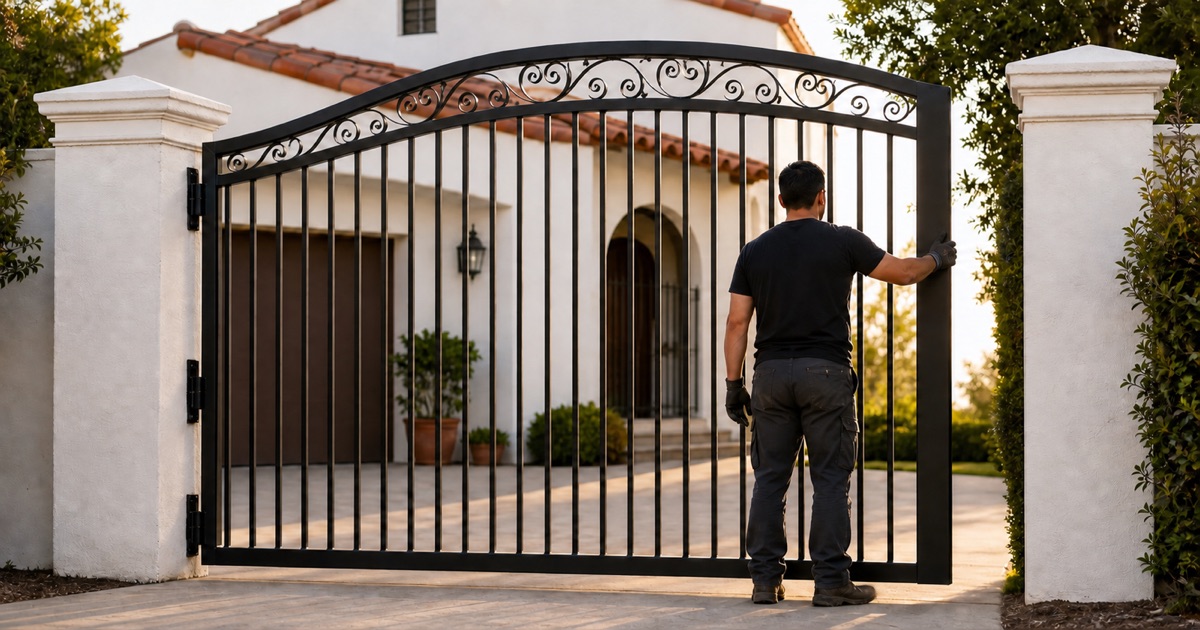
The vocabulary of an iron gate is its picket profile, its top treatment and the scrollwork between them. Spear tops, ball finials, twisted pickets, quatrefoil panels, cattail and grapevine scrolls each carry a different weight, and the spacing between them decides whether a gate reads as open and decorative or solid and defensive. We draw the pattern to the actual opening so that repeats land symmetrically rather than being cut short at one edge.
Arched, Flat and Scalloped Tops
The top line does more to set the character of a gate than any other single element. Arched and bell-curve tops suit Spanish and Mediterranean entries and pair with a matching arch in the stucco or the pillar caps, while flat tops read modern and sit better under a low roofline.
Scalloped and split-arch tops work well across double gates, where the two leaves meet and the join becomes part of the pattern. We match the arc to what the elevation is already doing rather than importing a stock radius that fights the house it is bolted to.
Construction and Frame
Frame, Section and Bracing
The visible ornament hangs on a structural frame, and that frame is what keeps a gate square. We size tube section and wall thickness to the finished weight and build diagonal bracing into the frame itself, concealed behind the pattern rather than strapped across the face. A gate that flexes when pushed will rack over time no matter how good the ornamental work is, and racking is what eventually stops it latching.
Hinges, Posts and Footings
An ornamental leaf places a large cantilevered load on a single post, so we use ball-bearing or heavy weld-on hinges rated well above the actual weight, with grease fittings where the gate cycles frequently. Post section and footing depth are sized to the leaf and the soil rather than reused from an old fence line. On the older lots common in this area, shallow legacy footings are a frequent cause of gates that sag within a year.
Finish and Protection
Zinc-Rich Primer and Galvanizing
Rust starts where coating is thinnest, which means welds and the bottom rail. Every welded joint is treated with zinc-rich primer before any topcoat goes near it, and frames are specified for hot-dip galvanizing where the exposure justifies it. Because this area is close enough to the coast for salt-laden air to reach fixings, this specification does more for the life of a gate than the choice of pattern ever will.
Powder Coating and Color
Over the primer, a TGIC polyester powder coat holds color and gloss under UV far longer than wet paint, and it resists the chalking that makes an older gate look tired. Matte black and satin black remain the most requested finishes, with bronze, oil-rubbed bronze and hammered textures suiting Spanish and Mediterranean work. We pretreat properly before coating, because powder over an unprepared surface fails at the edges regardless of the quality of the powder.
Repair and Restoration
Rebuilding Corroded Sections
Where an ornamental gate has rusted through at the bottom rail or at a joint, the pattern above is usually still sound and worth keeping. We cut out the failed steel, weld in new tube matched to the original section, treat the joints and refinish the leaf. On detailing that is no longer commercially available, rebuilding preserves something a replacement gate cannot reproduce at any sensible price.
Matching Existing Ironwork
Adding a pedestrian gate, replacing a damaged leaf or extending a run means matching what is already there. We reproduce scroll patterns, picket profiles and finial styles so the new work reads as part of the original set rather than as an obvious addition. Where an exact match is not achievable, we say so before fabrication and propose a deliberate complementary detail instead of an approximation nobody is happy with.
- Licensed & Insured
- Free On-Site Measure
- Fixed-Price Quotes