
Paramount Metal Gates installs gate access control in Paramount, CA, covering keypads, intercoms, telephone entry, card and fob readers, cellular controllers and the vehicle sensing that goes with them. We install the gate, the operator and the entry system as one job, so the credential hardware is matched to an operator we know will accept it rather than bolted onto something that half supports it.
Access control is really a question about people rather than hardware. A single-family driveway needs something reliable for a handful of regular users, while an apartment entrance has to admit visitors who hold no credential at all.
A commercial yard needs to know who came through and when, and a storage site needs to revoke a credential the day a tenant leaves. Those are four different systems with four different answers, and the common mistake is choosing the device before answering the question.
The most valuable thing a properly specified system does is separate credentials by user. When every household member, contractor and tenant has their own code or fob, access can be withdrawn one at a time. A single code shared by everyone can only be changed for everyone, which is why in practice it never gets changed.
Entry Devices
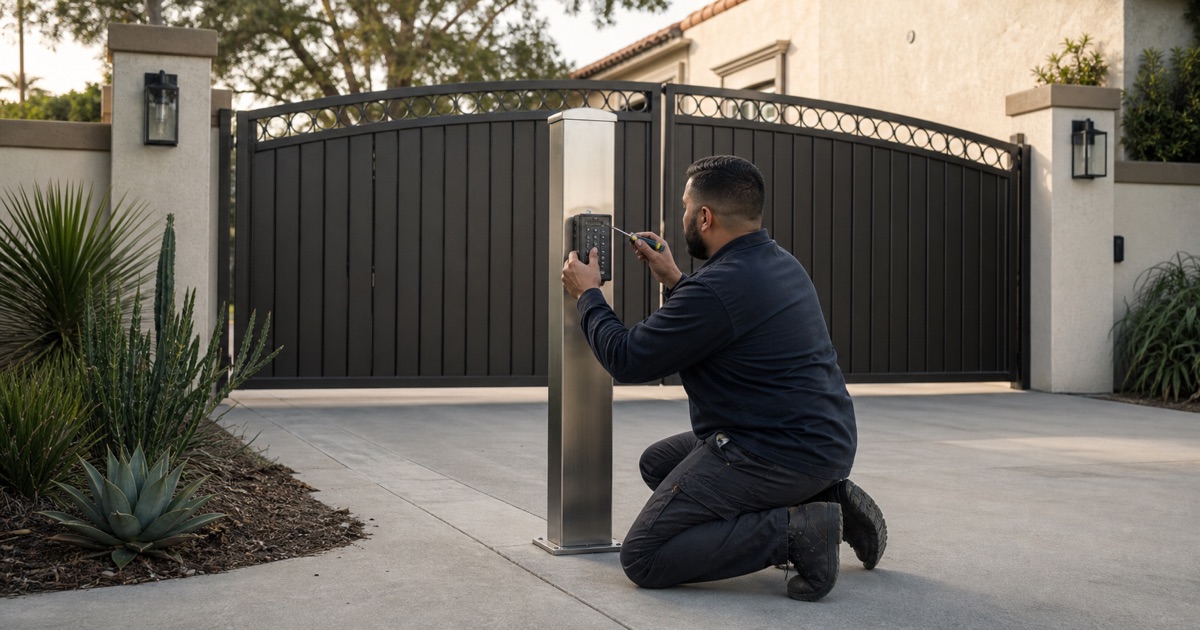
Keypads and Code Entry
A keypad is the simplest reliable way to admit people who already have permission, and it avoids the problem of physical keys entirely. We mount weather-rated units at a height that works from a vehicle window, gasket them properly, and set up separate codes per user rather than one code for the property. Exposed keypads that were never sealed correctly are a common source of faults, because a unit that has taken on water starts reporting presses nobody made.
Intercoms and Telephone Entry
Telephone entry and intercom stations exist for the visitor who has no credential: the delivery driver, the guest, the trades appointment. The call station lets a resident decide whether to open the gate. We install and program directory-based systems for multi-unit property and simpler station-to-station intercoms for single residences, siting the unit so a driver can reach it without leaving the vehicle or blocking the roadway.
Card Readers, Fobs and Transmitters
Credential readers suit commercial sites and multi-unit property where the population changes and each entry should be attributable. Fobs and cards are issued and revoked individually, and transmitters remain the simplest option for a small number of regular vehicles. We supply and program the credentials, and set the system up so adding or removing a user is something you can do yourself rather than a service call every time somebody moves out.
Networked and Remote Access
Cellular and Smartphone Gate Access
A cellular controller connects the gate to a mobile network, which means opening it remotely, issuing one-time access to a delivery, and reviewing an entry history without a phone line to the street. It suits long driveways where cabling is expensive and rental property where access changes often. We commission the system, create the first users and hand over the account credentials, and we are direct that these systems depend on an ongoing service plan.
Multi-User Management and Revocation
The administrative side is what determines whether a system is still useful in two years. We set up user groups so that residents, staff, cleaners and contractors are distinguishable, and show you how to add and revoke access without needing us. On rental and multi-unit property in particular, where turnover is constant, the ability to remove one credential in a few seconds is worth more than any hardware feature.
Entry Logging and Audit Trails
Where it matters who came through and when, credential systems and cellular controllers can record entries per user. Self-storage, commercial yards and managed property rely on it, both for security and for resolving disputes after the fact. Logging capability varies widely between products at similar prices, so we tell you what a given system actually records before you commit to it rather than after.
Vehicle Sensing and Safety Integration
Exit, Safety and Shadow Loops
Inductive loops cut into the driveway detect vehicles, and each type does a different job. An exit loop opens the gate for a car approaching from inside so nobody has to reach a device, while a safety loop holds the gate open for as long as a vehicle occupies the opening.
A shadow loop prevents the gate closing onto a car that has stopped short of the opening, which is the failure people notice most. We saw-cut, seal and tune every loop properly, because one that has taken on water produces intermittent behavior that looks convincingly like an operator fault and sends people shopping for a new motor.
Photo Eyes and Monitored Sensing
Access devices decide who gets in; safety devices decide whether the gate is allowed to move. Current requirements call for monitored entrapment protection, meaning the operator verifies its own sensors and refuses to run when one has failed. We integrate entry hardware and safety sensing so that a failed photo eye stops the gate rather than being quietly ignored while everyone assumes the system is protecting them.
Fire Department Access and Emergency Override
Any gate across a fire apparatus access road has to be openable by the fire department, which in practice means a Knox box or a key switch wired into the operator with a fail-safe arrangement on loss of power. It is the requirement most often missing from otherwise well-specified access control, and the one most likely to be raised at an inspection. We confirm what the authority having jurisdiction requires and wire it in rather than assuming a standard arrangement will satisfy them.
- Licensed & Insured
- Free On-Site Measure
- Fixed-Price Quotes