
Paramount Metal Gates installs automatic gate operators in Paramount, CA, serving surrounding cities including Bellflower, Downey, Lakewood, Compton and Norwalk. We fabricate gates and install the automation that drives them, which means the operator is specified against a leaf whose real weight we know rather than estimated from a photograph, and the electrical half of the job is not handed to somebody else.
Automating a gate is a structural decision before it is an electrical one. A gate built to be pushed by hand becomes a powered machine capable of injuring somebody the moment a motor is attached, and the construction requirements that apply to automated gates take effect at that point. Frames, hinges, gaps and end stops all have to be right first, which is why we assess the gate before quoting an operator for it.
We install and service LiftMaster, DoorKing, HySecurity and FAAC units across residential driveways, apartment entrances and commercial yards. Every installation is commissioned properly before handover: sensors verified, limits set so the gate reaches its stops without straining, entry devices programmed, and the full cycle run repeatedly rather than tested once.
Choosing and Sizing the Operator
Swing Gate Operators
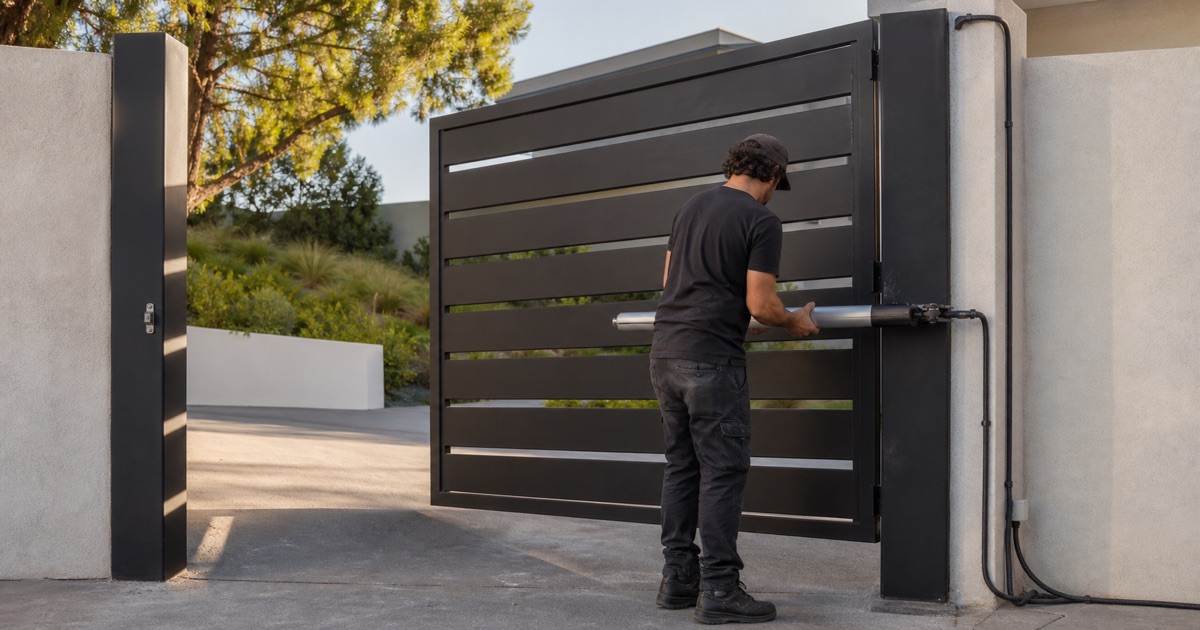
Swing operators come as linear actuators, articulated arms and underground units, and the right one depends on post geometry, the arc the gate travels and how much room sits behind the hinge. A linear actuator suits most residential driveways; an articulated arm handles a wide pillar where the hinge sits well back from the mounting point. We size to the leaf weight and length together, since a long light gate and a short heavy one load an operator in very different ways.
Slide and Cantilever Gate Operators
Sliding gate operators are rated by gate weight and by duty cycle, and both matter. A residential slider running a few times a day is a very different specification from a yard gate cycling through a shift, even at similar weights. We size with genuine headroom above the load rather than to the nearest catalog match, because an operator working flat out on every cycle is the single most common reason a gate needs a replacement unit within a few years.
Solar-Powered Gate Operators
Where a mains supply would mean trenching a long driveway or crossing hard landscaping, a solar operator with battery backup avoids the excavation entirely. The engineering that matters is sizing the panel and battery to real usage and to winter daylight rather than to a summer average. We calculate against your actual cycle count, because an undersized solar installation works perfectly for six months and then leaves you unable to open the gate on a short overcast day.
Safety Systems and Compliance
Monitored Entrapment Protection
Current UL 325 requirements call for monitored external entrapment protection, which means the operator continuously checks its own safety devices and refuses to run when one has failed. We fit photo eyes and safety edges matched to the gate’s class and verify the operator is genuinely monitoring them. Unmonitored sensing is the worst of both worlds: a device that has quietly failed leaves everyone on the property believing the gate will stop for them.
Photo Eyes, Safety Edges and Gap Screening
Photo eyes protect the opening, safety edges protect the leading and trailing surfaces where contact can happen, and screening closes gaps that a hand could enter as the gate travels. Retrofitting a picket gate frequently needs mesh screening up to a defined height for exactly that reason. We place devices where entrapment can actually occur rather than where they are convenient to mount, which is the difference between compliance and the appearance of it.
Loop Detectors and Vehicle Sensing
Inductive loops cut into the driveway tell the operator that a vehicle is present, and each loop does a distinct job: an exit loop opens the gate on approach from inside, a safety loop holds it open while a vehicle occupies the opening, and a shadow loop prevents closure onto a stationary car. We saw-cut, seal and tune loops properly, because a poorly sealed loop takes on water and the gate begins behaving unpredictably in ways that look like an operator fault.
Controls, Power and Handover
Access Devices and Programming
Every automated gate needs a way in, whether that is transmitters, a keypad, an intercom, a card reader or a cellular controller. We install and program the devices, set up users, and hand over the account details rather than leaving you to pair a system yourself. Where a property has several categories of user, we separate credentials so that access can be withdrawn one at a time instead of requiring everything to be reset.
Battery Backup and Manual Release
Power cuts are the most common reason a working gate appears to fail. Battery backup keeps the operator running for a period after a supply is lost, and a manual release disengages the drive so the gate can be moved by hand. We show you both and explain how to re-engage the drive afterward, since a gate left disengaged after an outage produces a service call where the operator runs perfectly and the gate never moves.
Commissioning and the Full-Cycle Test
Nothing is handed over until the gate has run its complete cycle repeatedly with every safety device confirmed to stop it, limits set so the gate reaches its positive stops without straining, and every access device tested by the people who will actually use it. A gate that worked once while the installer watched is not a commissioned gate, and the difference shows up within weeks.
Retrofitting an Existing Gate
Assessing the Frame and Hinges
A gate designed to be pushed by hand has never carried the forces an operator applies, and the assessment is not a formality. We check the frame for racking, the hinges for wear and adequate rating, the posts for movement at grade, and the leaf for the sag that a manual gate tolerates and a powered one does not. Where the frame flexes visibly when pushed, that flex becomes a fault the operator will fight on every cycle.
Bringing the Gate Up to Standard
Automated gate construction requirements cover the gaps a moving gate creates, which is why a picket gate frequently needs mesh screening up to a defined height before an operator is fitted. Positive stops are added at both ends of travel so the gate cannot overrun, and rollers on a slide gate are replaced with non-pinch equivalents where the originals expose a trapping point. This work happens before automation, not as an afterthought.
When Automation Is Not the Right Answer
Some gates should not be automated as they stand. A frame rusted through at the bottom rail, hinges long past their rating, or a post whose footing has already moved will all fail faster once a motor is applying force to them. In those cases we say plainly that the gate needs rebuilding or replacing first, because fitting an operator to a failing gate produces two problems where there was one.
- Licensed & Insured
- Free On-Site Measure
- Fixed-Price Quotes