
Paramount Metal Gates builds custom driveway gates in Paramount, CA, serving surrounding cities including Bellflower, Lakewood, Downey, Norwalk and Cerritos. Every gate is fabricated to a measured opening in our own shop rather than ordered in a standard width and packed out with filler hardware until it roughly fits, which is the single biggest reason a driveway gate ends up dragging, binding or sagging inside its first year.
A driveway gate is the largest moving object on a residential property, and almost everything that goes wrong with one traces back to a decision made before fabrication started. The wrong swing direction on a short lot, a leaf too wide for its hinge, an operator sized to the price rather than the weight, or a post set in a footing that was never deep enough. We measure the fall of the driveway, the curb line, the available side run and the clearance at full travel before recommending a configuration.
The housing stock across this part of Los Angeles County is largely 1950s, which shapes the work more than any style preference. Driveways are narrower, front setbacks are shorter, and gateposts land closer to the sidewalk than modern gate designs assume. That is frequently what rules out an inward swing and makes a slide or cantilever the right answer, and it is why a gate specified from a photograph tends to disappoint.
Driveway Gate Configurations
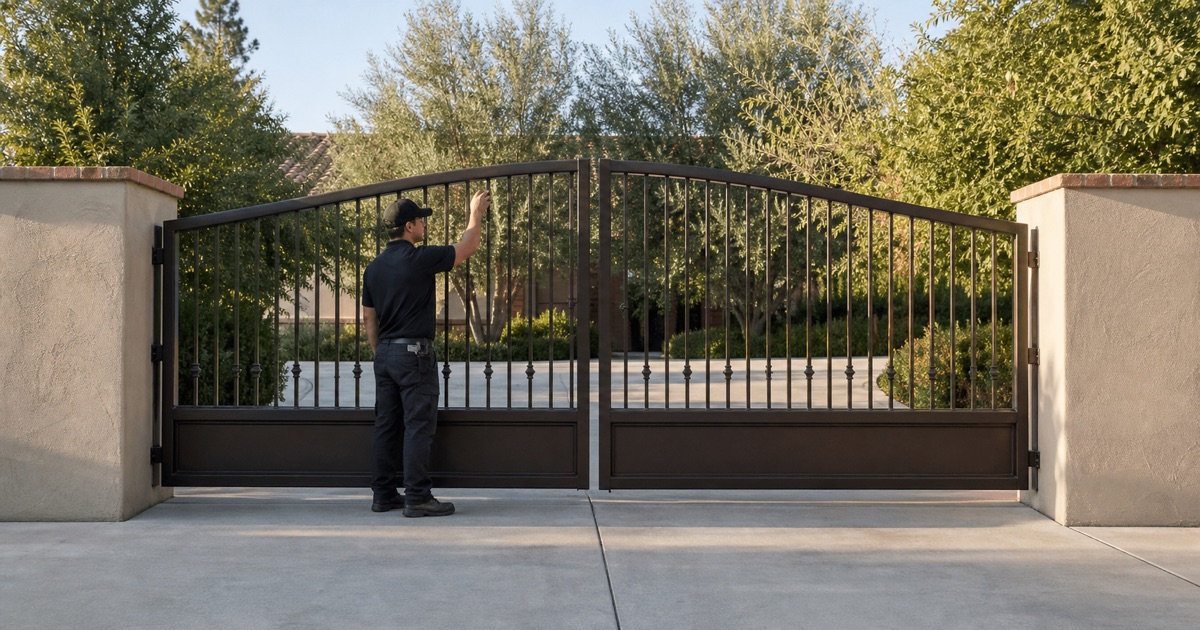
Single and Double Swing Gates
Swing gates are the traditional choice and the simplest to maintain, with no ground track to fill with debris and fewer moving parts to wear. They need clear arc room inside the property and ground level enough that the leaf does not catch as it travels. We split wide openings into a double gate rather than hanging one oversized leaf, because a single wide leaf concentrates enormous leverage at the hinge and is the most common cause of a gate that drops out of square within a season.
Sliding Gates on V-Track
A sliding gate rolls along a track set into the driveway, needing side room along the fence line rather than arc room inside the property. It handles a rising driveway or a short approach that would defeat a swing gate entirely. We set the track true and specify non-pinch rollers where the original design would expose a trapping hazard, and we are direct about the trade-off: a ground track in a dusty or heavily trafficked entrance needs clearing, or it will destroy rollers early.
Cantilever Driveway Gates
A cantilever gate crosses the opening carrying its whole weight on truck assemblies set back to one side, with nothing on the ground at all. That suits uneven ground, heavy vehicle traffic and any entrance where a track would not survive. It needs meaningful side room for the counterbalanced tail, typically around half the opening width again, and a gate built without that tail will never run reliably. We check the run is genuinely there before proposing one.
Materials and Construction
Ornamental Wrought Iron Gates
Ornamental iron gives a driveway gate the visual weight that suits a masonry pillar entry, with solid pickets, scrollwork and spear or finial tops. We build the frame from steel tube sized to the leaf rather than to a standard section, then set the infill to your drawing or ours. Iron rewards good detailing and punishes thin material, so the frame is specified around the finished weight rather than the design being drawn first and the frame chosen afterward.
Steel Tube and Panel Gates
Steel tube frames with solid, slat or perforated infill cover most modern driveway gates, from privacy screening to semi-open faces. Section size, wall thickness and bracing decide whether a gate stays flat, and a solid infill gate also has to handle wind load that an open picket gate simply passes through. We build with diagonal bracing concealed within the frame so that the leaf holds square without an exposed cross-brace spoiling the face.
Aluminum Driveway Gates
Aluminum extrusion in 6005-T5 and 6061-T6 will never corrode from the inside out, and at a fraction of the weight of steel it reduces load on hinges, posts and the operator. That makes it a strong answer for very wide openings and for properties closest to the coast. The trade-off is cost per foot and a softer material that dents more readily, so we specify heavier wall sections wherever a gate takes daily traffic or sits where vehicles maneuver tightly.
Style and Finish
Spanish, Mediterranean and Arched Gates
Arched and bell-curve tops, iron strapping, clavos and mixed wood-and-iron faces belong to the Spanish Colonial and Mediterranean entries found throughout Southern California. The detail that decides whether it works is proportion: we match arc height and picket spacing to the arch of the surrounding stucco, the pillar caps or the entry roofline rather than defaulting to a stock radius that fights the elevation it is bolted to.
Horizontal Slat and Modern Gates
Horizontal slat gates in matte black, bronze or a wood-look powder coat are the dominant contemporary look across Los Angeles, and slat spacing is the decision that matters. Tight spacing gives privacy and screening but catches wind, which increases load on the operator on exposed runs. Wider spacing gives a lighter face and easier travel. We set it deliberately against what the property actually needs rather than copying a spacing off a photograph.
Powder Coating and Corrosion Protection
Finish is protection first and appearance second. Welded joints get zinc-rich primer before anything else, because a weld is exactly where the coating is thinnest and where rust will begin. Over that we specify hot-dip galvanizing or a TGIC polyester powder coat, which holds color and gloss under UV far longer than wet paint. On a gate ten miles from the coast, that specification is what decides whether the bottom rail is sound in ten years.
Posts, Footings and Hardware
Gate Posts and Footings
Most gates that fail early were hung on posts that were never adequate. A gate post carries the entire leaf as a cantilevered load, and the deeper and wider the footing, the less the post rotates over time. We size the post section and the footing to the finished weight of the gate and the soil it is going into, rather than reusing whatever the old fence post happened to be, because a post that moves a degree at grade shows up as several inches of drop at the latch.
Hinges Sized to the Leaf
Hinge selection is where a heavy gate is quietly set up to fail. We use ball-bearing or heavy weld-on hinges rated well above the actual leaf weight, with grease fittings where the gate will be cycled often, so the load is carried on a bearing surface designed for it. Undersized hinges do not fail suddenly; they wear, the leaf drops, and the gate begins catching the driveway long before anyone connects the two.
Latches, Drop Rods and Stops
The hardware that holds a gate closed matters as much as what holds it up. Double gates need a drop rod or cane bolt into a ground socket so the inactive leaf is genuinely fixed rather than relying on the latch to resist wind. Positive stops at both ends of travel keep an automated gate from overrunning its intended limits, which is a construction requirement on automated gates rather than an optional refinement.
- Licensed & Insured
- Free On-Site Measure
- Fixed-Price Quotes