
Paramount Metal Gates fabricates custom gates in Paramount, CA, with design, cutting, welding, assembly and finishing all handled in our own shop. Building in-house is what makes it possible to size a gate to a measured opening rather than to the nearest standard width, and to size the frame against the finished weight rather than against an assumption made by whoever designed a catalog panel.
Most gates that fail early were compromised before they were ever installed. A prefabricated leaf packed out with filler hardware to bridge an oversized gap, a frame section chosen for a lighter design than the one it ended up carrying, or a post reused from an old fence line all introduce a weakness that shows up as sag, misalignment or a gate that no longer latches. None of those is a maintenance problem; they are specification problems.
Custom work also covers the gates nobody stocks: openings that are unusually wide, entrances on a slope, and gates that have to match ironwork installed decades ago. The same shop capability produces the pedestrian gates, security screen doors and railings that need to read as part of the same set rather than as separate purchases.
Design and Measurement
Working From a Drawing, a Photo or an Idea
We work from formal drawings, from photographs of something you have seen, or from a description and a site visit. A drawing is straightforward. A photograph establishes style and proportion but carries no dimensions and says nothing about the ground or the structure, so the first step is translating it into something buildable against a measured opening. That translation is where problems surface early, while they are still cheap to solve.
Measuring the Opening Properly
Every gate starts with the numbers: clear width, the fall across the driveway, the plumb of existing posts or pilasters, ground clearance at the widest point of travel, and what the gate must clear as it moves. On the older lots common around here, posts are frequently out of plumb and driveways rarely level, and a gate built to nominal dimensions rather than measured ones will bind somewhere in its travel.
Fabrication
Cutting, Welding and Assembly
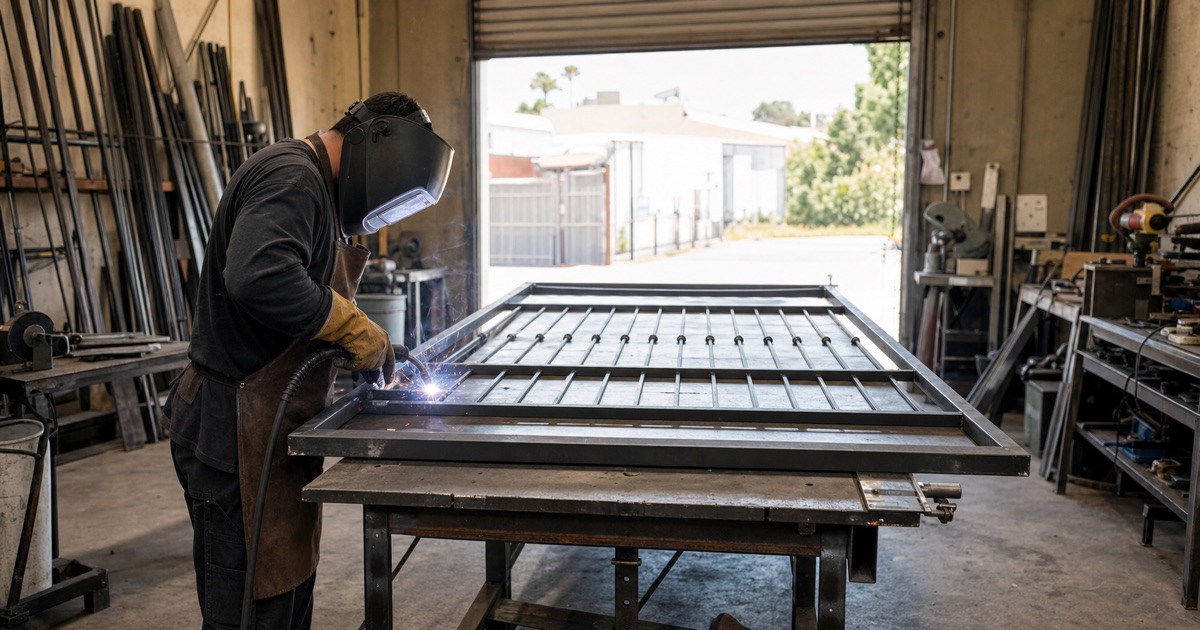
Frames are cut and welded square in the shop on a flat surface rather than assembled in place, which is the only reliable way to get a leaf that stays true. Diagonal bracing is built into the frame and concealed behind the infill rather than strapped across the face. Welds are ground back where they will be visible and left with full section where they are carrying load, since appearance and strength want different things at a joint.
Matching Existing Ironwork
Adding a second leaf, replacing a damaged gate or extending a run means matching what is already there. We reproduce picket profiles, scroll patterns, finial styles and rail spacing so new work belongs to the original set. Where a profile is no longer produced and an exact match is not possible, we say so before fabrication and propose a complementary detail rather than delivering an approximation and hoping it passes.
Finishing and Installation
Coating and Corrosion Protection
Finishing decides how long a gate lasts far more than the material does. Welded joints are treated with zinc-rich primer before anything else, since a weld is where coating ends up thinnest and where corrosion starts. Over that we specify hot-dip galvanizing or a TGIC polyester powder coat over pretreated steel. With salt-laden air reaching this far inland, that specification does more for the life of a gate than any other decision.
Posts, Hardware and Hanging
A gate is only as good as what carries it. Post section and footing depth are sized to the finished leaf weight and the ground rather than reused from whatever was there, and hinges are rated well above the actual load with grease fittings where the gate will cycle often. Drop rods, cane bolts and positive stops are fitted where the configuration needs them rather than left off to be added later when the gate starts moving in the wind.
Mobile Welding and Repair
On-Site Welding
Much of the work has to happen where the gate is. Cracked joints, sheared hinges, broken drop rods, vehicle impact damage and rusted-through bottom rails are all repairable in place, which avoids removing a gate and leaving an opening unsecured. Where damage is extensive enough that the leaf needs shop time, we take it away, rebuild it properly and rehang it rather than patching something that will fail again in the same place.
Fabricating Replacement Parts
Older gates frequently need a component nobody sells any more: a hinge in an unusual size, a bracket for a discontinued operator, a latch to suit a non-standard post, or a section of picket in a profile that has been out of production for decades. Making the part is regularly quicker and cheaper than redesigning the gate around something currently available, and it keeps the original detailing intact.
- Licensed & Insured
- Free On-Site Measure
- Fixed-Price Quotes