
Paramount Metal Gates repairs driveway gates, sliding and cantilever gates, operators and access hardware across Paramount, CA, serving surrounding cities including Bellflower, Lynwood, Downey, Compton and South Gate. We fabricate in our own shop, which matters on a repair call: a bent frame or a rusted-through bottom rail can be cut out and rebuilt on site rather than condemned, and a gate worth keeping usually is.
Most gate faults are not what they look like. A gate that will not close is rarely a dead motor, a gate that scrapes the driveway is rarely a latch problem, and an operator that hums without moving is rarely a failed control board. Each of those points somewhere cheaper than the part people expect to buy, which is why we diagnose the whole assembly before quoting anything.
We carry common operators, transmitters, receivers, hinges, rollers and safety sensors on the service vehicle, so a large share of calls finish on the first visit rather than turning into a parts order and a second appointment. On commercial sites where a gate stuck open means an unsecured yard overnight, that difference is the whole job.
Automatic Gate Repair and Operator Faults
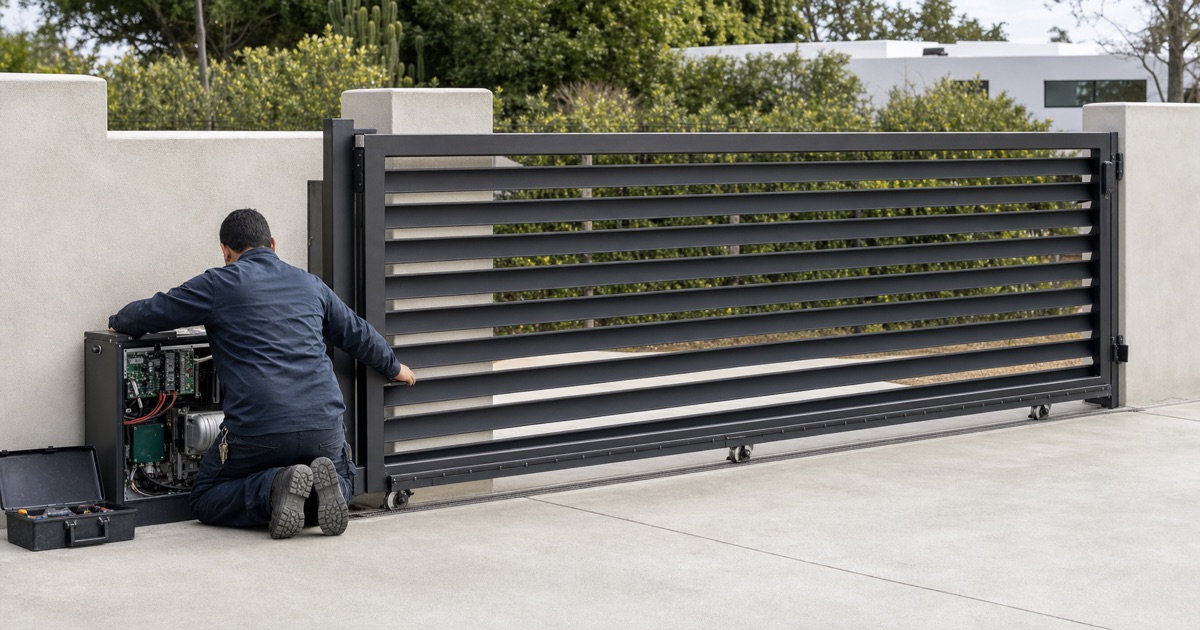
Gate Opens but Will Not Close
An operator that will open and refuses to close is almost always obeying a safety input rather than failing. A misaligned photo eye, a damaged safety edge, or a saw-cut loop that has filled with water all report an obstruction that is not there. We test the sensing chain first, realign or reseal what is faulty, and confirm the operator is genuinely monitoring its sensors afterward rather than simply wired to them. Photo eyes drift out of alignment from a knock, a delivery van, or a post that has moved a fraction over a season, and a beam that misses its reflector by a degree reads as a permanent obstruction.
Motor Runs but the Gate Does Not Move
When the operator sounds healthy but nothing moves, the fault sits between motor and gate: a sheared key, a stripped gear, a slipping clutch, a broken chain, or a manual release left disengaged after a power cut. We open the unit and identify which one, because swapping an entire operator to cure a sheared drive pin is the most expensive possible answer to a cheap problem. Manual releases in particular catch people out: after a power cut somebody disengages the gate to get out, nobody re-engages it, and the operator then runs perfectly while the gate stands still.
Operator Replacement and Sizing
When a unit genuinely is finished, we replace it with one sized to the gate’s real weight, length and cycle count rather than to the old model number. Operators run at the top of their rating fail early, and the previous installer’s choice is often why the gate is being repaired at all. We fit LiftMaster, DoorKing, HySecurity and FAAC units and match the UL 325 class to the site, since a residential unit put on a commercial yard gate is being asked to do a job it was never rated for. Duty cycle matters more than horsepower on a gate cycling dozens of times a day, and it is the specification most often ignored.
Structural Gate Repair and Welding
Sagging, Dragging and Out-of-Square Gates
A swing gate that catches the driveway has dropped at its hinge or moved at its footing; it has not stretched. Tightening the latch side pulls the frame further out of square and buys a few weeks. We re-hang on ball-bearing hinges sized to the actual leaf weight, add diagonal bracing or an anti-sag cable where the frame allows, and re-plumb or re-pour the post where the footing has shifted. On the 1950s lots common across this area, posts were frequently set in shallow footings that have since moved, so the gate is often reporting a foundation problem rather than a gate problem.
Rust Repair and Bottom Rail Rebuilds
Rust starts where water sits and where coating is thinnest, which means bottom rails and welded joints. Once a section is perforated, paint achieves nothing. We cut out the failed steel, weld in new tube, treat the joints with zinc-rich primer and refinish the leaf properly. On ornamental iron with detailing you cannot buy off a shelf, rebuilding is routinely cheaper than replacing.
Because this area sits close enough to the coast for salt-laden air to reach welds, we specify galvanizing or powder coat over primed steel rather than putting enamel back onto the same joint that just failed. Refinishing a repaired gate with the same system that failed the first time simply resets the clock.
Vehicle Impact and Emergency Welding
Impact bends frames, shears hinges, twists posts and cracks footings, and a frame straightened cold never tracks true again. We assess whether the leaf can be rebuilt or needs replacing, reset the post and footing properly, and provide written documentation of the damage where an insurer, a landlord or a commercial tenant needs it. Vehicle strikes are one of the few faults where the visible damage understates the problem: the leaf may look repairable while the post has cracked its footing below grade.
Sliding and Cantilever Gate Repair
Gates Off Track and Worn Rollers
A slide gate that grinds, jumps or slows at one point is reporting a flat-spotted roller, a track packed with grit, or a worn cantilever truck assembly. We clean and realign the track, replace rollers with non-pinch equivalents where the originals expose a trapping hazard, and re-shim the run so weight is carried evenly instead of loading a single wheel to destruction. Ground-track gates in industrial yards fill with grit, gravel and debris faster than anywhere else, and a track nobody clears will chew through a set of rollers in a fraction of their normal life.
Cantilever Truck and Counterbalance Adjustment
Cantilever gates carry everything on truck assemblies set back from the opening, so wear there shows up as sag at the leading edge and a gate that no longer clears. We replace worn trucks, reset the counterbalance and check that the tail length is genuinely adequate, because a cantilever built short will never run reliably no matter how many parts it is given. Where the original build is the problem, we say so rather than selling a third set of trucks into a gate that will keep eating them.
Access Hardware and Entry Faults
Remote, Keypad and Intercom Repair
When a gate answers the wall button but ignores the transmitter, the fault is in the radio or entry hardware rather than the operator: a flat battery, a lost receiver code, a corroded keypad, or a failed intercom supply. We carry common transmitters and receivers, so a call that turns out to be reprogramming is usually finished before we leave. Entry hardware also fails in ways that look like something worse: a keypad that has taken on water reports random presses, and an intercom with a failing power supply works intermittently in a pattern that looks like a gate fault.
Safety Sensor and Loop Detector Faults
Photo eyes drift out of alignment, safety edges fail internally, and loop detectors misbehave once a saw-cut has taken on water. Because current requirements call for monitored entrapment protection, a failed sensor should stop the gate rather than be quietly ignored. We restore sensing to a state where the operator is actually verifying it, not merely wired to it. A sensor that has quietly failed is worse than no sensor at all, because everybody on the property carries on assuming the gate will stop for them.
How a Service Call Works
Diagnosis Before Any Quote
We test the gate as a whole assembly before pricing anything: operator, drive, sensing, hinges, track, posts and entry hardware. Quoting from a description over the phone is how the wrong part gets fitted, and a gate that will not close has half a dozen plausible causes that cost very different amounts to put right.
A Written Price Before Work Starts
Once we know the actual fault you get the price in writing, itemized, with the repair-or-replace recommendation stated plainly. If the honest answer is that the gate has reached the end of what repair can sensibly do, we say that at this stage rather than after you have paid for another round of parts.
Repair, Usually on the First Visit
Common operator components, transmitters, receivers, hinges, rollers and safety sensors travel on the vehicle, so most faults are corrected during the same appointment. Where a part has to be ordered or a leaf needs shop time for welding and refinishing, we secure the opening in a usable state before leaving.
Testing the Full Cycle Before Sign-Off
Nothing is called finished until the gate has run its full cycle repeatedly under the sensing that is meant to protect it, with photo eyes and safety edges confirmed to actually stop it. A repair that works once while somebody watches is not a repair that will still be working next month.
- Licensed & Insured
- Free On-Site Measure
- Fixed-Price Quotes