
Paramount Metal Gates repairs gate operators throughout Paramount, CA, serving surrounding cities including Bellflower, South Gate, Lakewood, Norwalk and Compton. We work on LiftMaster, DoorKing, HySecurity and FAAC units across residential driveways, apartment entrances and commercial yards, and we carry the components that account for most faults on the service vehicle.
An operator is one part of a system that includes the gate, its hinges or rollers, its posts, its sensing and its power supply. That matters on a repair call because most of what gets blamed on the opener originates elsewhere, and fitting a new unit to a gate that is dragging or a circuit that is failing simply relocates the problem. Diagnosis starts with the whole assembly rather than the box on the post.
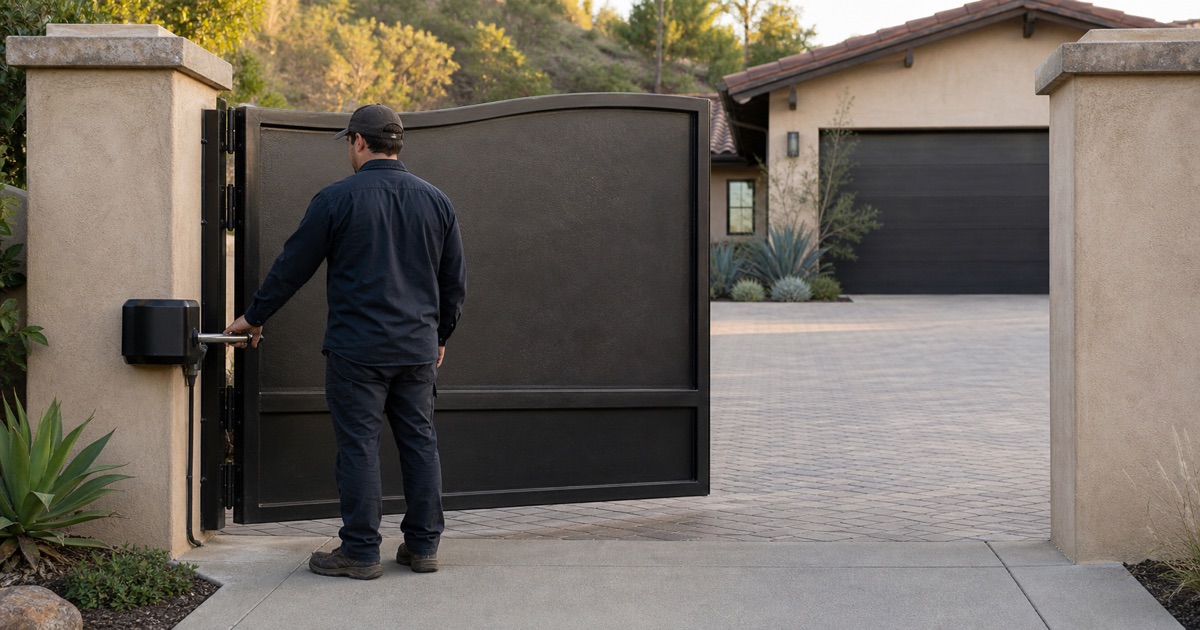
The single most useful thing you can do before calling is to disengage the manual release and push the gate by hand. A gate that is heavy or catches under hand pressure is telling you the fault is structural. A gate that glides freely but will not move under power points squarely at the operator, and that distinction saves a great deal of time.
Diagnosing Operator Faults
Motor Runs but the Gate Stays Put
When the unit sounds healthy and nothing moves, the failure sits between motor and gate: a sheared key, a stripped gear, a worn chain, a slipping clutch, or most commonly a manual release left disengaged after a power cut. We open the operator and identify the specific component, because replacing an entire unit to cure a sheared drive pin is the most expensive available answer to one of the cheapest faults.
No Response at All
A completely dead operator is usually a power problem rather than a mechanical one. Tripped breakers, failed transformers, corroded connections, an aged backup battery that collapses under load, or a solar array undersized for winter daylight all present identically. We test the supply through to the board before condemning anything, since a control board replaced on a circuit that is still faulty will fail again in the same way.
Erratic Travel and Fault Codes
Operators that stop partway, reverse unexpectedly or beep out a fault pattern are usually reporting sensing or limit trouble rather than motor trouble. Limit switches drift, magnets and cams work loose, and photo eyes that have shifted a fraction read as a permanent obstruction. Most units publish their fault patterns, and reading what the operator is actually reporting is considerably faster than replacing parts in sequence until the symptom disappears.
Components We Replace
Control Boards, Limits and Batteries
Boards, limit switches, backup batteries, capacitors and transformers are routine replaceable items on every major brand, and swapping the failed component is nearly always the right answer over replacing a working unit around it. Batteries are the most commonly overlooked: a cell that has aged past its useful life tests fine at rest and collapses the moment the gate demands current, which reads to everyone on site as a dead operator.
Gears, Chains and Drive Components
Drive wear is progressive and audible long before it becomes a failure, which means it is usually catchable. Worn gears, stretched chains, slipping clutches and failed bearings all announce themselves through noise and rough travel first. We replace the worn component and check what caused it, because a gate that is dragging or misaligned will destroy a new drive as reliably as it destroyed the old one.
Transmitters, Receivers and Keypads
When the gate answers its wall button but ignores the remote, the fault is in the radio rather than the operator. Flat transmitter batteries, lost receiver codes, failed antennas and water-damaged keypads all produce the same symptom. We carry common transmitters and receivers, so a call that turns out to be a reprogramming job is generally finished during the same visit rather than becoming a parts order.
Replacement and Sizing
When an Operator Should Be Replaced
Some units are genuinely finished, and the honest signals are parts no longer being available, a housing that has corroded through, or a motor that has been running at the top of its rating since the day it was installed. In that last case the original specification is the fault, and replacing like with like guarantees a repeat visit. We say which situation applies plainly rather than quoting a new unit for every call.
Sizing the Replacement Correctly
A replacement is specified against the gate rather than against the old model number: leaf weight, length, swing or slide, and the realistic number of cycles per day. Duty cycle is the figure most often ignored and the one that matters most on a commercial gate running dozens of times daily. We also confirm the new unit provides monitored entrapment protection, since sensing requirements have moved on considerably from what many older installations were built to.
- Licensed & Insured
- Free On-Site Measure
- Fixed-Price Quotes