
Paramount Metal Gates builds sliding and cantilever gates for driveways, yards and commercial entrances throughout Paramount, CA. Both configurations solve the same problem in different ways: they open an entrance without needing the arc room a swing gate requires, which on a short driveway or a rising approach is frequently the difference between a workable gate and one that catches every time it moves.
The choice between them comes down to what crosses the opening. A V-track sliding gate rolls on a rail set into the driveway, which is simpler and less expensive but puts hardware on the ground where debris and vehicle wheels reach it. A cantilever gate carries its whole weight on truck assemblies set back to one side and crosses with nothing on the ground at all, at the cost of needing meaningful side room for its tail.
Local geometry decides more of this than preference does. Much of the housing here dates from the 1950s, when driveways were narrower and setbacks shorter than modern gate designs assume, and the city’s industrial areas run heavy vehicle traffic across entrances that a ground track would not survive. We measure the opening, the fall and the available side run before recommending either.
Sliding Gates on Track
V-Track and Ground-Track Systems
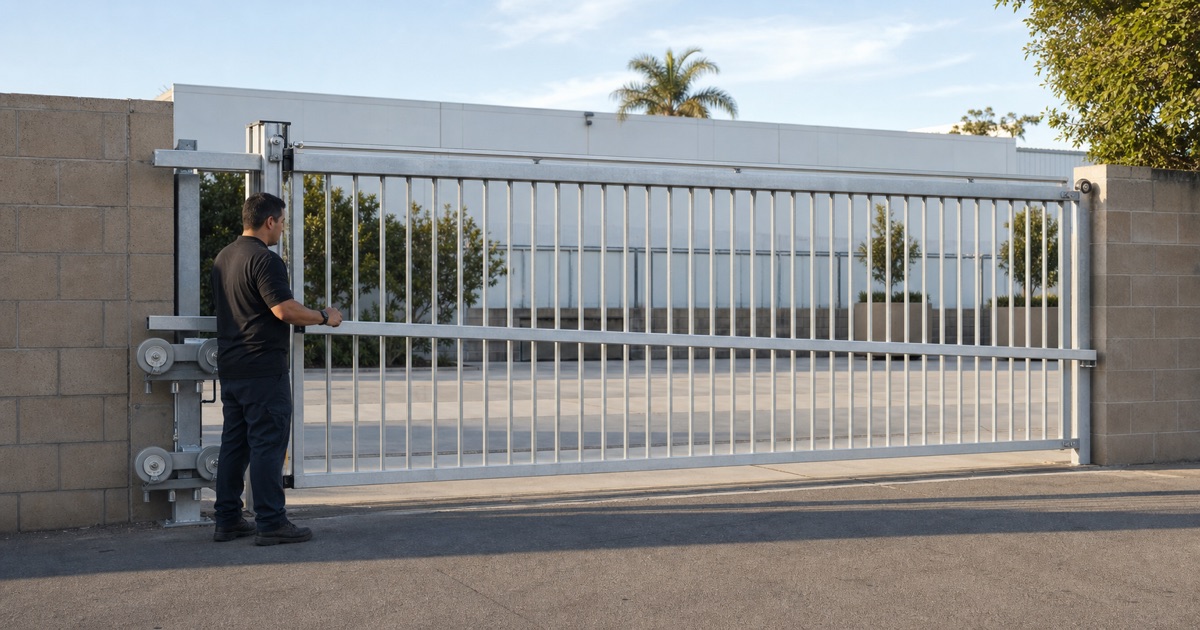
A V-track gate runs on grooved wheels along a rail fixed into the driveway surface, with guide rollers at the top keeping it upright. It is a proven, economical arrangement that suits clean residential entrances and sites with limited side room. The rail has to be set true and level along its whole length, because a track laid to follow an uneven driveway will make the gate rise and fall as it travels and load one wheel far harder than the others.
Rollers, Guides and Wear
Roller condition is what determines how a slide gate feels and how long it lasts. Flat-spotted wheels make the gate grind and shudder, and a track packed with grit accelerates that enormously. We replace rollers with non-pinch equivalents where the original design exposes a trapping point between wheel and rail, and re-shim the run so weight is distributed evenly instead of one wheel carrying the leaf and destroying itself.
Cantilever Gates
Truck Assemblies and Counterbalance
A cantilever gate hangs from truck assemblies mounted on posts set back beside the opening, so the leaf floats across the entrance carrying nothing on the ground. Four-wheel and eight-wheel assemblies are specified against gate weight and length. The counterbalanced tail is what holds the leaf level, and its length is the specification that decides whether the system works at all rather than a detail to be trimmed if space is tight.
Aluminum Cantilever Systems
Modular aluminum cantilever systems in single and dual track give a very light gate for their span, which reduces load on trucks, posts and the operator and removes corrosion from the equation entirely. That combination suits long commercial openings and sites closest to the coast particularly well. Steel remains the choice where impact resistance matters more than weight, such as yards where vehicles maneuver tightly near the gate.
Site and Configuration
Sloped and Tight Driveways
Because a sliding gate travels parallel to the opening rather than through an arc, a driveway that rises from the street presents no problem for it. That is the most common reason we specify a slide on the older, shorter lots around Paramount, where an inward swing would catch on the rise and an outward swing into the public right of way is not an acceptable answer.
Telescopic and Bi-Parting Gates
Where the opening is wide but the side room is not, a telescopic gate stacks two or three leaves that travel together, covering a long span from a short run-back. A bi-parting arrangement splits the opening and slides from both sides, halving the run needed at each end. Both add hardware and cost relative to a single leaf, so we propose them where geometry genuinely demands rather than as a default.
Automation and Safety
Operators and Duty Cycle
Slide gate operators are rated by gate weight and by cycle count, and a yard gate running through a shift is a different specification from a residential gate opening a few times a day even at similar weights. We size with genuine headroom above the load, since an operator working at the top of its rating on every cycle is the most common reason a gate needs a replacement unit within a few years.
Entrapment Protection on Sliding Gates
Sliding gates create pinch and shear points that swing gates do not, particularly between the leaf and its posts and between rollers and rail. Automated slide gates need monitored entrapment protection, screening over gaps a hand could enter, non-pinch rollers, and positive stops at both ends of travel. We build to those requirements as part of the gate rather than adding sensors afterward to a gate that was never detailed for automation.
- Licensed & Insured
- Free On-Site Measure
- Fixed-Price Quotes