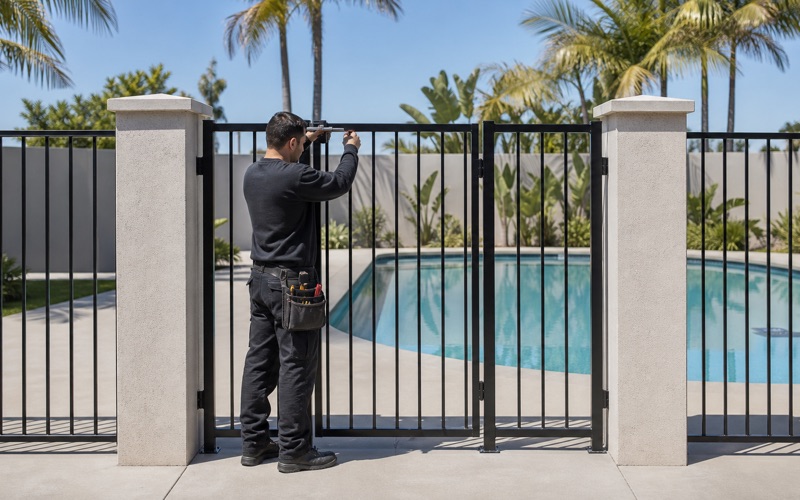
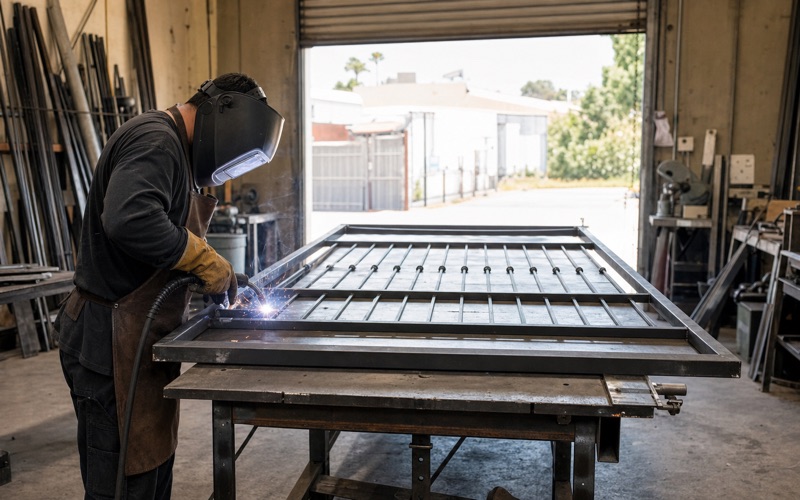
Two things shape gate work in South Pasadena more than anything else: the city is old and it knows it, and its streets are under a mature tree canopy that has been there longer than most of the gates. The first sets what a gate should look like. The second frequently sets where it can physically go.
Paramount Metal Gates builds driveway, pedestrian, courtyard and garden gates across the city, and on a great many properties the constraint that decides the job is not the opening but what is growing beside it. Root systems under a parkway and along a property line are not something to be worked through with a spade and an opinion, and a footing dug without regard to them can damage a tree that predates the house.
Alongside that, this is a city with an unusually strong preservation culture. A gate here is assessed by neighbors as much as by anybody official, which is worth knowing before a design is settled.
Trees, Roots and Footings
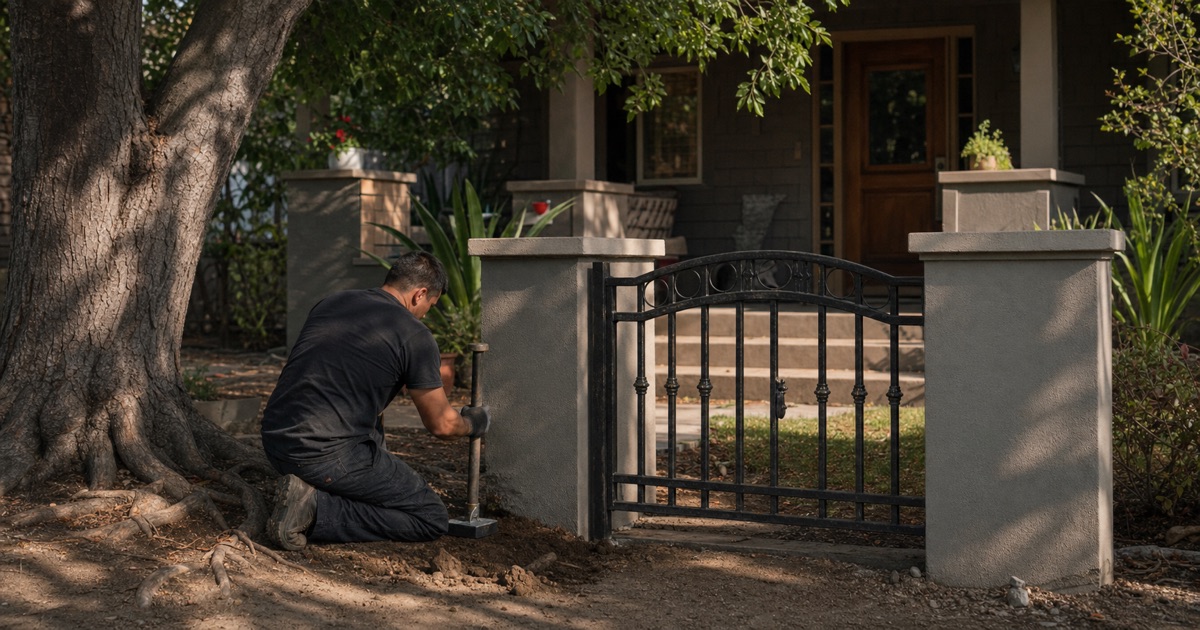
Working Around Established Root Systems
A gate post needs a footing, and a footing needs a hole in exactly the ground a mature tree has spent decades filling with roots. Cutting through structural roots can destabilize a tree and shorten its life considerably, and on a protected street tree that is a serious matter rather than a gardening inconvenience. We locate roots before excavating and shift a post rather than cut through what we find.
Alternatives to a Conventional Footing
Where a post cannot go where the design wants it, the answer is usually to change the design rather than the tree. Repositioning the opening, spanning further with a heavier frame, using a lighter aluminum leaf that reduces the load a post must carry, or transferring load into existing masonry are all ways to avoid a footing in the wrong place. Which is appropriate depends on the site and none of them requires damaging anything.
Roots and Ground Movement Over Time
Established roots keep growing, and a footing set beside one will be pushed by it over years. That shows as a post drifting out of plumb long after the work was done, which owners understandably read as poor installation. Where we can see that coming we say so at the outset and place the footing accordingly, because it is far cheaper to allow for than to correct.
Canopy, Shade and Solar
The same canopy that complicates footings also rules out solar operators on many properties here, or at least demands honest sizing. A panel under a dense canopy will not deliver what an open-sky calculation promises, particularly in winter. Where the shade is real we would rather run a supply than fit an array that performs adequately in July and strands somebody in January.
Looking for metal gates closer to El Segundo? See Metal Gates in El Segundo.
Period-Appropriate Design
Reading an Old House Properly
The housing here includes genuinely old building, and a stock gate pattern in front of a period elevation reads wrong immediately. Craftsman properties want restrained horizontal forms and cloud-lift shapes rather than scrollwork; Victorian and early elevations want something different again. We look at the roofline, the porch detail and the window proportions before proposing anything.
Using Original Ironwork as the Reference
Where original ironwork survives anywhere on a property — a porch rail, a window guard, an older gate — it is the best available guide and usually worth reproducing rather than complementing. We measure and copy profiles, scroll forms and spacing so new work belongs to the original scheme rather than sitting alongside it as an obvious addition.
Restraint on a Historic Street
The most frequent error on these streets is simply too much gate. A tall, heavily ornamented entrance in front of a modest bungalow overwhelms it, and the result reads as expensive rather than appropriate. We will argue for lower, simpler and better-detailed, and would rather talk an owner down a size than build something that fights its house for the next thirty years.
Restoring What Is Already There
Older ornamental gates here are frequently worth saving even when they look poor, because the pattern above a corroded rail is usually sound and reproducing it would cost far more than repairing it. Cutting out failed steel, welding in matched section, treating the joints and refinishing the whole leaf keeps something that cannot be bought.
Compact Lots and Access
Driveway Gates on Narrow Frontages
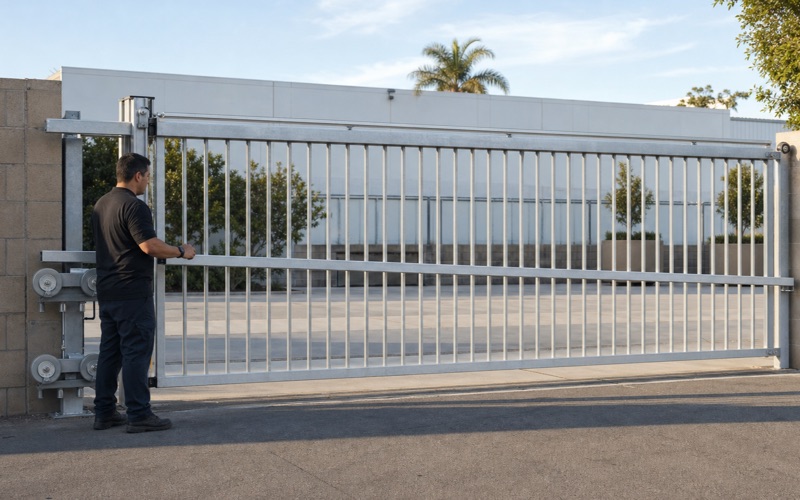
Lots here are considerably smaller than in the estate cities nearby, and driveways are correspondingly tight, with the house close to one boundary. That constrains configuration before style is discussed: where a leaf has nowhere to swing, a gate that travels sideways is the answer, and where the run alongside is also occupied, splitting the opening buys the clearance back.
Pedestrian and Garden Gates
On a small lot the pedestrian gate is used constantly and looked at from a few feet away, which makes latch action and finish quality matter more than they would on a driveway gate seen from a car. We specify mechanisms that work cleanly one-handed and set them at a height that suits the household rather than to a default.
Side Access and Rear Yards
Side passages here are frequently narrow, and the gate in them has to be built to the gap that exists rather than to a standard width. Fitting the nearest manufactured size and packing out the difference loads components never designed to carry it, and that packing is reliably where the installation eventually gives.
Getting Materials to the Opening
On a tight lot under a canopy there may be no route to bring a finished leaf to where it is going. We plan that before building, fabricating in sections for assembly on site where access requires it, rather than discovering at delivery that a completed gate cannot physically reach its opening.
Working in a Preservation-Minded City
Neighbors as Well as Committees
Exterior work here is noticed, and a gate that jars with a street will attract comment whether or not any formal process applies. That is worth taking seriously rather than resenting, because a design that respects the street is usually also the better-looking design, and it avoids a conversation nobody enjoys having after the work is finished.
Documentation Prepared Properly
Where a formal review does apply, applications fail for vagueness far more often than for being unacceptable. Elevations with dimensions, material specified rather than described, and finish named are what let one progress, and it is the same information required to build. We prepare it as part of the job rather than handing an owner a form.
Height, Setback and Sightlines
The underlying limits apply regardless of any approval: restricted height at the front of a lot, a greater allowance behind the front-yard line, and clear sightlines at corners. On a period-appropriate design those are settled first, since a gate reduced in height afterward loses the proportions that made it suit the house.
Long-Term Service
Gates here tend to stay for decades, and components wear predictably rather than randomly: closers weaken, hinges wear and let a leaf drop, finishes chalk under sun that reaches through in winter when the canopy thins. Those are cheap to address on a planned visit and expensive to meet at the point the gate has stopped working.
The City Itself
One of the County’s Oldest Municipalities
South Pasadena incorporated on 2 March 1888 with a population slightly over five hundred, becoming the sixth municipality in Los Angeles County, after residents in the southern part of Pasadena sought more control over their own property. That early independence is part of why the city has held onto its character so deliberately since.
A City That Defended Its Streets
The long-running proposal to route a freeway through the center of the city, cutting through neighborhoods here and in adjoining areas, shaped local attitudes to change for generations. Whatever one thinks of that history, it produced a place where the built environment is genuinely valued, and it explains why a gate here is looked at more closely than it would be elsewhere.
Old Streets and Old Trees Together
The practical result is a city where the housing and the planting have grown old together, and both constrain what a gate can be. Working here means designing to a house that has earned its character and building around roots that were established before anybody thought about a driveway gate, and both are better treated as the starting point than as obstacles.
Materials and Finish
Choosing Material for an Old House
Steel carries ornamental detail that aluminum cannot reproduce convincingly, which matters on a period property where the gate has to relate to original ironwork. Where weight is the constraint, whether because a post cannot be upgraded or because a footing has to avoid roots, aluminum becomes worth its cost. We choose against the actual constraint rather than defaulting to one material.
Protecting Steel Under a Canopy
A gate that spends much of the year in shade stays damp longer after rain than one in open sun, and that favors corrosion at joints and along the bottom rail. Welds get zinc-rich primer before anything else and the protective build is specified for the damper microclimate a canopy creates, which is not the same as the exposure a few streets away in the open.
Finishes That Suit a Period Elevation
Matte and satin black suit most of the housing here, with bronze and oil-rubbed finishes working on warmer masonry. What we avoid is a high-gloss finish, which reads modern and fights an older elevation regardless of how the pattern is drawn. The finish is part of the period judgement rather than a choice made after it.
Keeping a Repair Invisible
On a gate people pass closely every day, a repair that reads as a repair is a poor outcome even if it is structurally sound. Matching section, dressing welds properly and refinishing the whole leaf rather than the mended part is what makes the difference, and it is worth the extra work on a gate somebody intends to keep for another twenty years.
- Licensed & Insured
- Free On-Site Measure
- Fixed-Price Quotes