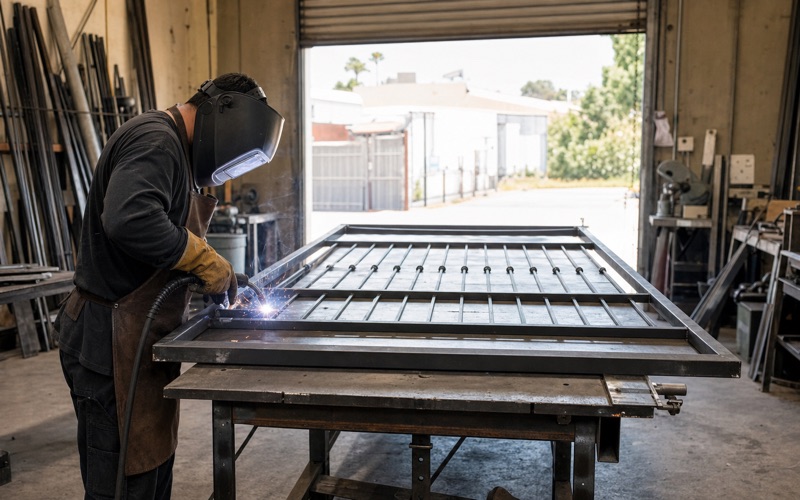
Paramount Metal Gates builds and repairs metal gates in Signal Hill, covering hillside driveway gates, sliding and cantilever installations on sloped approaches, perimeter gates on working oil sites, and the operators and sensing that run them. Every gate is fabricated to a measured opening in our own shop, and on this hill the measurement that matters most is not the width of the opening but the fall across it.
Signal Hill is exactly what its name says: a hill, with residential streets climbing it and driveways that pitch noticeably from the roadway. That grade is the defining constraint on gate work here, because a swinging leaf travels through an arc and a rising driveway will catch it partway through that arc no matter how carefully the hinges are set. Raising the gate to clear the rise leaves a gap underneath that defeats the point of having one.
Sliding and cantilever gates travel parallel to the opening and are indifferent to the fall, which is why they appear so much more often here than on flat streets a mile away. The other half of the work is the oil infrastructure that still occupies parts of the hill, where the requirement is a secure, documented perimeter rather than an entrance.
Gates on Sloped Driveways
Why Grade Rules Out a Swing
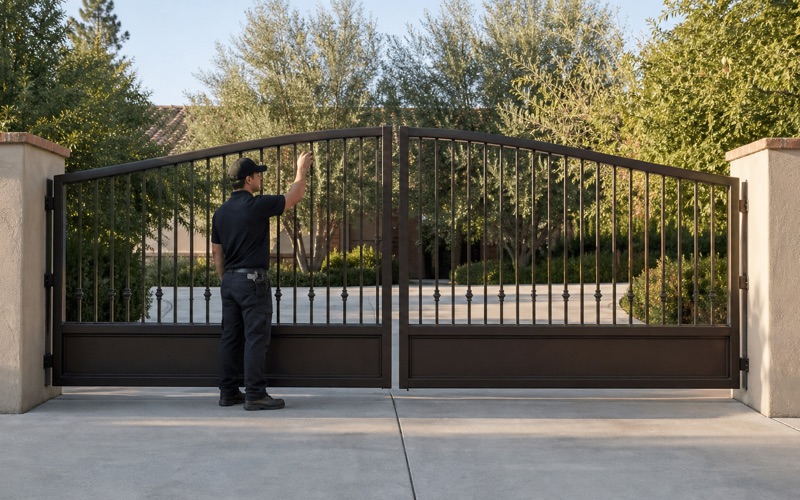
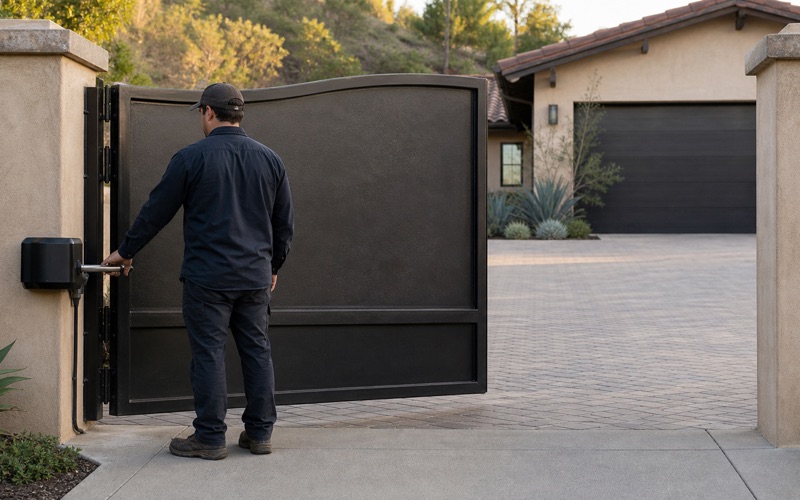
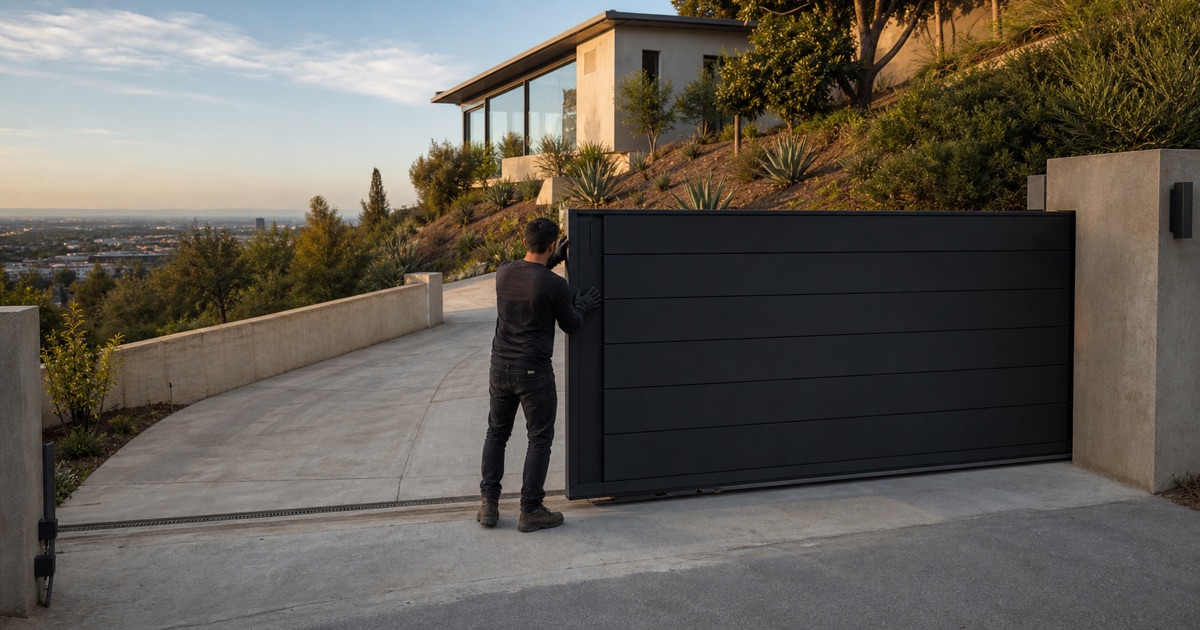
A swing gate needs its whole arc to clear the ground it passes over. On a driveway that rises from the street, the ground under the middle of that arc is higher than the ground at the hinge, so the leaf strikes it before it reaches full travel. Setting the gate higher solves the strike and creates a gap beneath, which is why on a genuinely sloped approach the honest answer is a different configuration rather than a compromise on the same one.
Sliding Gates Along the Contour
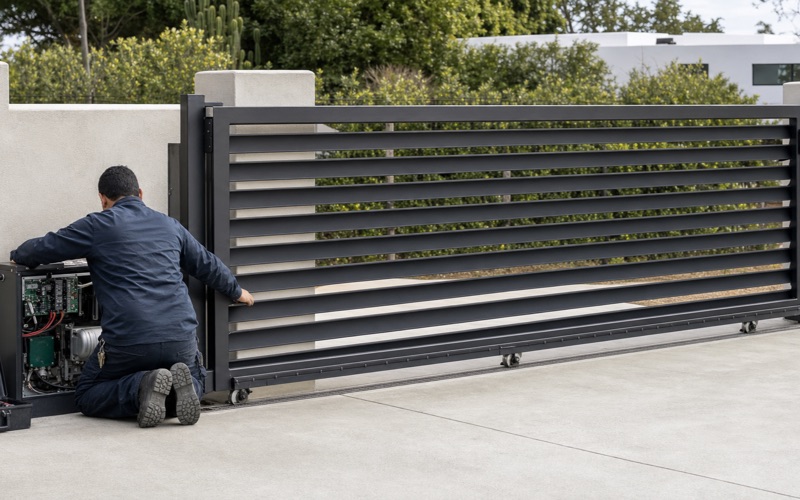
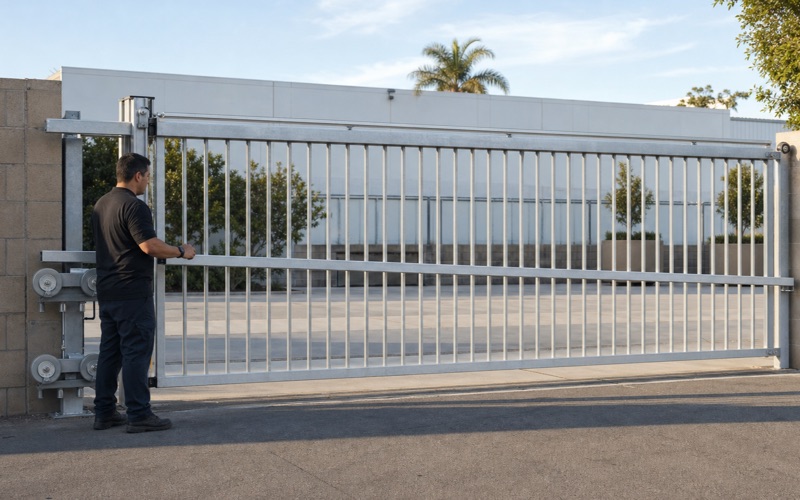
A sliding gate travels parallel to the opening rather than across the slope, so a rising driveway presents no problem for it. What it needs is a clear run alongside for the leaf to move into, and on a hillside lot that run may itself be on a grade or interrupted by a retaining wall. We survey the run as carefully as the opening, because a track laid to follow an uneven surface makes the gate rise and fall as it travels and loads one wheel far harder than the rest.
Cantilever Gates Where the Ground Is Poor
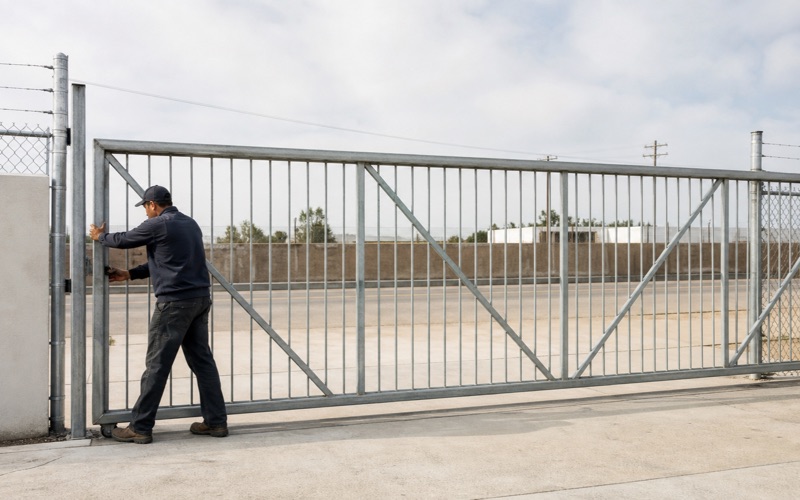
Where a ground track would be impractical, whether because of the slope, a poor surface or drainage running down the driveway, a cantilever crosses the opening carrying its weight on truck assemblies set back to one side, with nothing on the ground at all. It needs meaningful side room for the counterbalanced tail, which on a constrained hillside lot is the specification most likely to rule it out, so we confirm the run before proposing it.
Retaining Walls and What Carries the Gate
Hillside properties frequently anchor gates to retaining walls, and a retaining wall is designed to hold back earth rather than to carry a cantilevered gate load. We establish what the wall actually is and how it is built before fixing anything to it, because a gate that gradually pulls a retaining structure out of plumb creates a far more expensive problem than the gate was ever worth.
Looking for metal gates closer to Commerce? See Metal Gates in Commerce.
Drainage and Ground Behavior
Water Running Down a Driveway
On a slope, everything that falls on the driveway runs toward the bottom of it, and if the gate is at the bottom then the gate is standing in that flow. Bottom rails, footings and any ground track all sit in the path of it. We set clearance and detailing with drainage in mind rather than purely for appearance, because a leaf that spends every wet week sitting in running water will corrode from the bottom regardless of the finish above it.
Footings on Sloping Ground
A post on a slope is loaded differently from one on the flat, because the earth resisting rotation is not symmetrical around it. Footings need to be sized and set with that asymmetry in mind rather than to a standard hole, and we allow proper cure time before hanging anything. A post that moves a degree at grade presents as several inches of drop at the latch, and on a slope that movement is easier to induce.
Track and Roller Wear on a Grade
A sliding gate on any grade is fighting gravity in one direction and helped by it in the other, which shows up as uneven wear and, if the geometry is wrong, a gate that will not stay where it is put. We set the run true, specify rollers to the actual load, and re-shim where necessary so weight is carried evenly rather than concentrated on the downhill wheel.
Corrosion Where Coast Meets Hill
Signal Hill is close enough to the coast for salt-laden air to reach welds and fixings, and combining that with water running down a driveway is a demanding environment for steel. Welds get zinc-rich primer before anything else, with hot-dip galvanizing or a TGIC polyester powder coat above, because corrosion starts at joints and bottom rails rather than in the middle of a panel.
Oil Sites and Working Perimeters
Gates on Active Well Sites
Parts of the hill remain in production, and gate work on those sites answers to a different standard than residential work. The requirement is a secure, documented perimeter with controlled access, arrangements that hold when power is lost, and hardware that resists forcing rather than merely looking substantial. We build to the written scope those sites operate from and document what was installed.
Perimeter Integrity and Clearance
A boundary is only as good as its opening, so we build perimeter gates from heavy galvanized frame with anti-lift detailing at the hinges and controlled ground clearance so nothing passes beneath. On a slope, that clearance varies along the length of the gate, which is precisely the detail that gets missed when a gate is specified from a plan rather than from the ground.
Access Control and Records
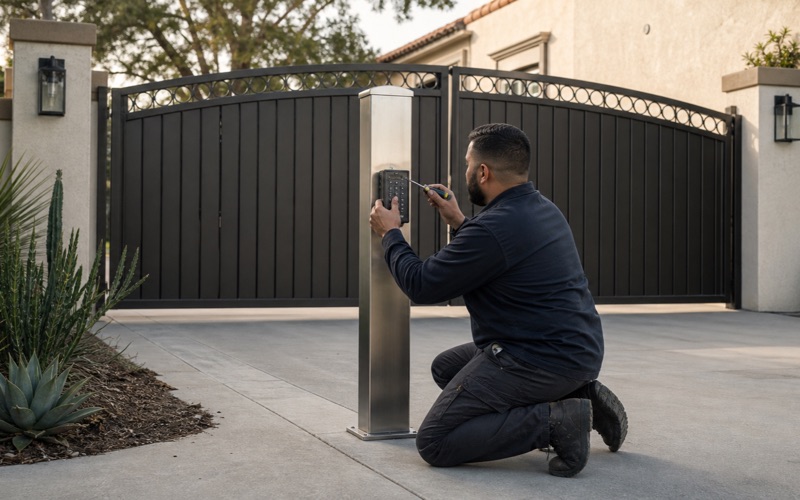
Working sites are entered by staff, contractors and service vehicles, and a single shared code can only be changed for everyone, so in practice it never is. We set up credentials issued per person or vehicle so access can be withdrawn individually, with entries logged per credential where the system supports it, which matters on property where entry has to be accounted for afterward.
Fire Access on the Hill
A gate across a fire apparatus access road must be openable by the fire department, with an arrangement that still works when power is gone and the access width maintained. On a hill where approaches are steep and alternatives are limited, that requirement carries more weight rather than less, so we confirm what the local authority wants before fabrication rather than after an inspection raises it.
Residential Work on the Hill
Views, Sightlines and Open Faces
Hillside properties are frequently bought for the outlook, and a solid gate at the foot of a driveway can take a meaningful part of that away. Open picket and wide-spaced slat faces keep a view while still closing the property, and they carry far less wind load on an exposed hillside than a solid panel does. We raise the trade deliberately rather than defaulting to solid infill because it looks more secure.
Pedestrian Gates and Steps
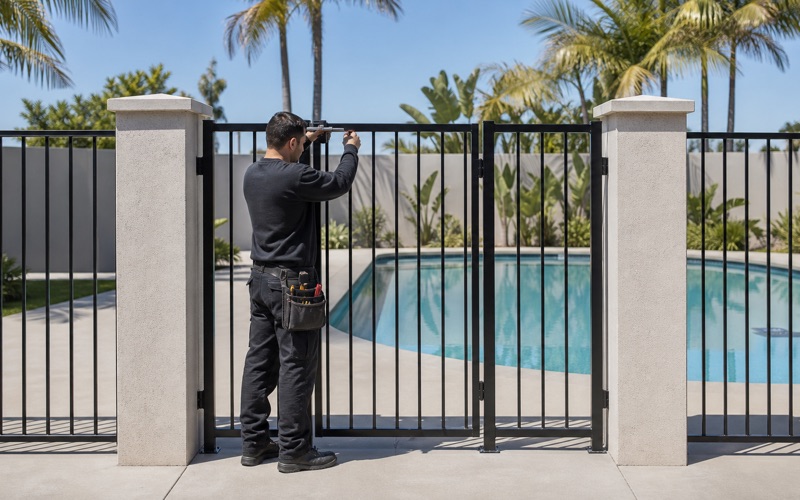
Where a property is entered on foot up a flight of steps, the pedestrian gate is used far more than the driveway gate and is often the harder of the two to get right. Self-closing hardware has to work against a gate that may be hung on a slope, and it has to be sized to the actual leaf weight, since a closer specified for a light gate leaves a heavy one resting against a latch that never engages.
Automation on a Steep Approach
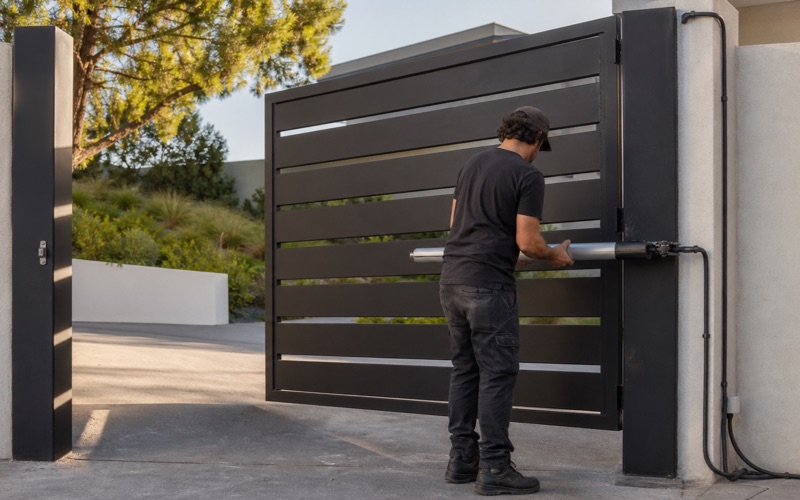
An operator on a sloped driveway works harder than the same unit on the flat, particularly on a swing installation where part of every cycle is lifting the leaf against the grade. We size with real headroom above the load rather than to the nearest catalog match, and fit battery backup as standard, because on a hill a gate that fails closed at the bottom of a driveway strands a vehicle rather than merely inconveniencing somebody.
Repair on Older Hillside Installations
Many gates here have been in place for decades and fail in a recognizable order: the downhill hinge wears first, the leaf drops, and the gate begins catching at the point where the driveway rises most. We re-hang on properly rated hinges, correct the geometry rather than moving the strike plate to meet a drooping leaf, and reset posts where footings have shifted on the grade.
Signal Hill’s Origins
Oil, and the City That Followed
Oil was discovered on the hill in 1921, and the city incorporated in 1924, roughly three years later, largely as a consequence of that discovery. Before the oil there were large homes on the hill itself with agricultural land below, growing fruit, vegetables and flowers. That sequence explains the present pattern: residential streets and working energy infrastructure occupying the same small area rather than separated into zones.
Building on the Hill Itself
Because the city is essentially one landform, almost every property here sits on some degree of slope, and that is the single most useful fact for anyone specifying a gate. The flat-driveway assumptions that work fine a few miles away simply do not transfer, and a gate ordered to a standard configuration without measuring the fall is very likely to be the wrong gate.
A Small City Surrounded by a Larger One
Signal Hill is compact and entirely surrounded by Long Beach, which means short distances and quick response for service calls. Combined with carrying common operator parts, transmitters, receivers and sensors on the vehicle, that is why a large share of repair work here is completed on the first visit rather than becoming a return trip.
- Licensed & Insured
- Free On-Site Measure
- Fixed-Price Quotes