Metal gates in Sierra Madre have a job most gates never have to think about: they must not become the reason a fire engine cannot reach a house, and they must not become fuel. Paramount Metal Gates builds here with those two requirements treated as the starting point rather than as additions to a design chosen for other reasons.
Sierra Madre sits directly against the San Gabriel Mountains, with the Mount Wilson Trail leading up out of the town and the wildland beginning where the streets stop. That position sets the priorities. Every gated property on the upper streets is a property that may one day need to be reached quickly by people who do not have the code, and possibly left quickly by the people who do.
Everything below follows from that. It does not mean gates here have to be plain or defensive-looking; it means the requirements are settled first and the design is drawn within them.
Emergency Access
Getting the Fire Department Through
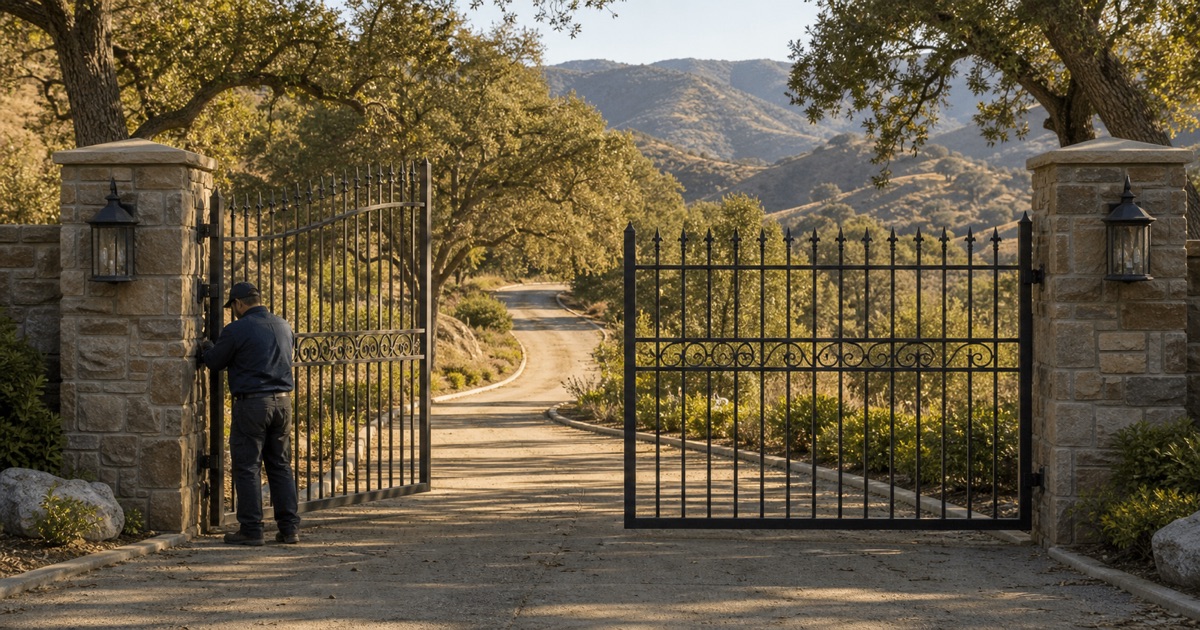
A gate across a fire apparatus access road has to be openable by the department, and how that is achieved matters. A Knox box holds a key the department controls; a key switch wired to the operator opens the gate directly. Whichever is specified has to work when the power is gone, which is precisely the circumstance a wildfire produces. We confirm the requirement with the local authority rather than fitting what worked on the last job.
Width, Clearance and the Whole Approach
An openable gate on an approach that has narrowed is not access. Apparatus needs width along the full length of the route and vertical clearance where vegetation has grown across it, and both are easy to lose gradually without anyone noticing. When we survey a gate we look at the approach it serves rather than only the opening, and say plainly where the constraint actually is.
Evacuation and Leaving in a Hurry
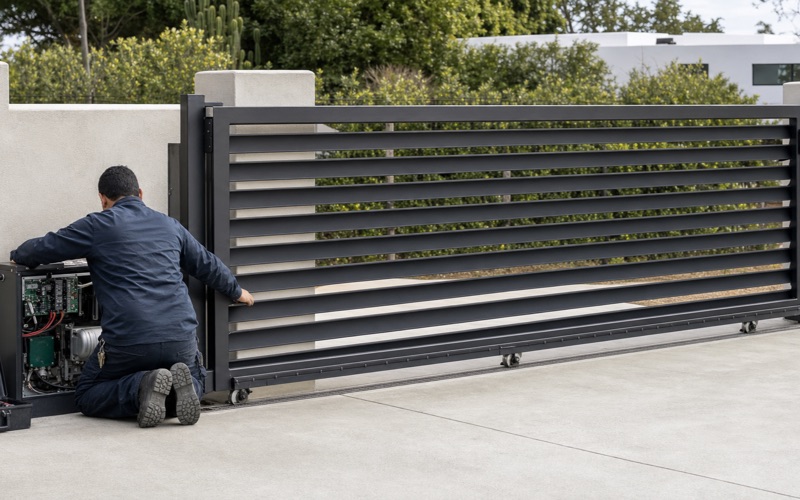
Access is not only about getting in. A powered gate that fails closed with the power out traps vehicles behind it, and residents leaving under pressure at night should not be discovering where the manual release is for the first time. We fit battery backup as a matter of course, position the release where it can be found and worked quickly, and make sure the household actually knows how it operates.
Gates That Fail in the Right Direction
Whether a gate should fail open or fail closed is a decision rather than a default, and at the wildland edge the answer usually differs from the answer in a city. We raise it explicitly at specification, because a gate configured to hold secure in a power cut is exactly wrong on an evacuation route, and nobody wants to discover that in the circumstances where it matters.
Looking for metal gates closer to La Cañada Flintridge? See Metal Gates Services in La Cañada Flintridge.
Building Against the Wildland Edge
Non-Combustible Detailing
Steel and aluminum are not the problem; what gets attached to them frequently is. Timber infill, composite panels and plastic trims all introduce combustible material into a boundary that may be the last defensible line at a property. Where an owner wants the appearance of wood we would rather achieve it with a wood-look powder coat on metal than by bolting timber to the leaf.
Keeping Fuel Away From the Gate Line
A gate is part of the defensible space around a property, and vegetation packed against a gate line is a fuel bed running straight to the structure it protects. We set clearance and detailing so the gate line can actually be maintained, and we point out when a planting scheme, however attractive, is going to make that impossible without cutting it back every season.
Embers, Gaps and Small Openings
Wind-driven embers get through gaps rather than over walls, and detailing that ignores them is a missed opportunity in a place like this. Where a gate meets a wall or a post, closing the gaps properly costs almost nothing at fabrication and is difficult to add afterward. It is not the whole answer to ember exposure, and it is a sensible part of it.
Finishes That Survive Heat and Sun
Foothill properties see stronger sun and greater temperature swings than the basin below, which is harder on coatings than most owners expect. Powder over properly pretreated steel holds up considerably better than wet paint, and we specify with the exposure in mind rather than to the finish schedule that would suit a sheltered street a few miles south.
Hillside Practicalities
Grade at the Driveway
The streets climb here, and a driveway that rises from the roadway will catch a swinging leaf partway through its travel. Lifting the gate to clear the rise opens a gap beneath it that defeats the purpose. On a genuinely sloped approach the sensible answer is a leaf that travels sideways rather than through an arc, and we would rather say so than build a compromise.
Long Approaches and Power
Where a gate sits well down a drive from the house, getting power to it can mean a substantial trench through mature planting. A solar operator with battery backup avoids that entirely, and on a fire-exposed property the independence from the grid is worth something in itself. Sizing has to be done against genuine winter daylight rather than an annual average.
Retaining Structures and Anchorage
Foothill lots are full of walls built at different times to hold back ground, and their capacity for a sideways gate load is frequently unknown. We establish what a wall actually is before fixing to it, since a gate that slowly levers a retaining structure out of true creates a far larger problem than the gate ever solved.
Water Coming Off the Hill
Rain here arrives concentrated and runs downhill fast, carrying grit with it. A gate at the bottom of a drive stands in that flow, and any ground track will fill. Where that is the situation we would rather specify a cantilever with nothing on the ground than hand somebody a maintenance task they will not do in January.
Residential Character
Small Town Scale
Sierra Madre is small and its streets have a settled, domestic character that a large assertive entrance simply fights. Most properties here are better served by a gate that is well proportioned and well detailed than by one that is imposing, and owners who have lived here a while generally know that already and are relieved to hear a contractor say it.
Period and Craftsman Properties
There is genuinely old housing here, and ironwork on a period property is a design problem before it is a fabrication one. Craftsman elevations want restrained horizontal forms rather than scrollwork; where original ironwork survives anywhere on the property it is the best available reference, and matching it is usually a better outcome than introducing a new vocabulary alongside it.
Pedestrian Gates and Trail Traffic
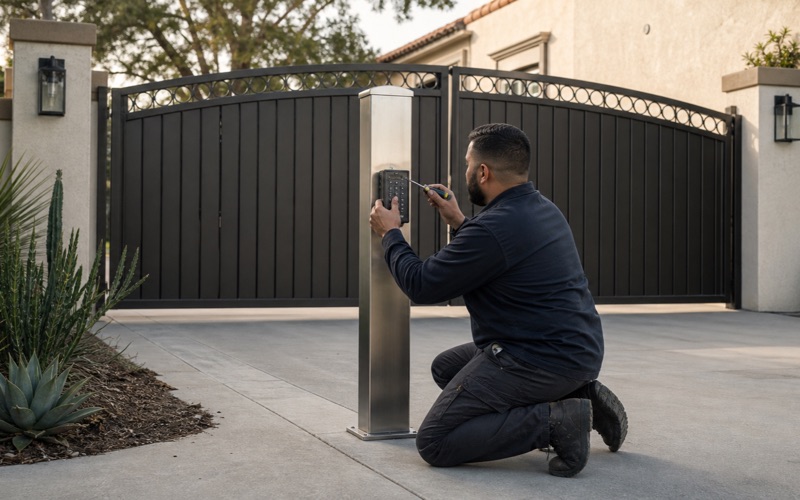
The Mount Wilson Trail draws walkers through the town, and properties on the routes up see foot traffic that most residential streets do not. A pedestrian gate there is used and looked at more than it would be elsewhere, and it is worth the hardware that makes it pleasant to operate rather than the cheapest mechanism that closes.
Repair on Long-Standing Installations
Many gates here have been in place for decades, and the pattern of failure is legible: hinges wear, a leaf drops, the gate begins catching, and an operator that was adequate starts working harder until it fails as well. Correcting the geometry rather than adjusting around the symptom is what ends that sequence rather than deferring it.
The Town and the Mountains
A Historic Foothill Settlement
The original mission site nearby is marked by a California Historical Landmark, and the first Mount Wilson trail was carved by the Gabrielino people, who used it to carry timber down from the mountains for the construction of the San Gabriel Mission in 1771; Benjamin Wilson expanded the trail in 1864 using Mexican and Chinese labor. That long association with the canyon above the town is still the defining feature of the place.
Living at the Edge of the Wildland
What matters practically is that the town ends and the mountains begin, without much transition. Properties on the upper streets are wildland-interface properties whatever their address says, and specifying a gate there as though it were on a valley street is the mistake worth avoiding.
Why the Requirements Come First Here
In most cities a gate is designed and then checked against the rules. Here the access requirements and the material constraints are settled first, and the design is drawn inside them. That order produces better outcomes and fewer surprises, and it is the single most useful thing we can explain to somebody planning a gate against the foothills.
Neighbors Who Share an Approach
A number of the upper properties share a private drive or an access easement, which means one owner’s gate decision affects several households and, in an emergency, the people trying to reach all of them. Where that is the arrangement we ask who else uses the route before proposing anything, since a gate that suits the property paying for it and complicates the approach for everybody behind it is not a good outcome for anyone.
Keeping Access Working Year to Year
Emergency access is not a thing that is achieved once. Batteries age, key switches seize, releases stiffen and codes get forgotten, and every one of those failures is silent until the day it matters. A short annual check of the access arrangement costs very little and is the difference between a system that exists on paper and one that will actually work at two in the morning with the power out.
- Licensed & Insured
- Free On-Site Measure
- Fixed-Price Quotes