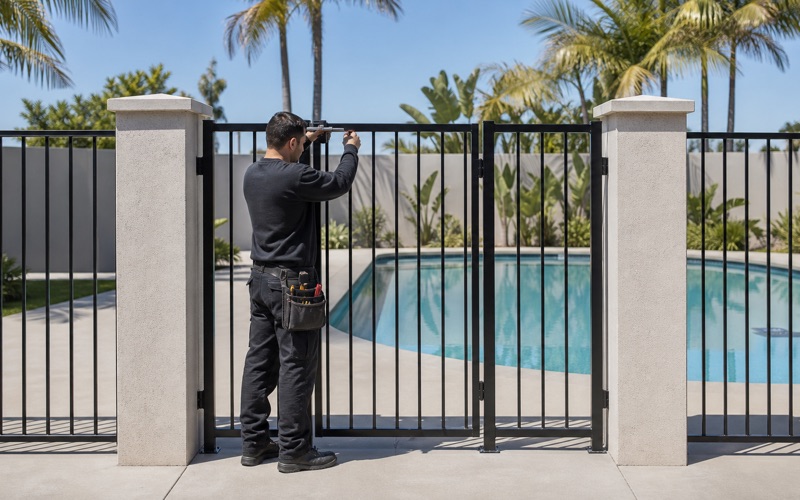
Salt decides everything about metal gates in Seal Beach. Paramount Metal Gates builds to a materially different specification here than we would use ten miles inland, because a gate on this coast is in direct marine exposure rather than the diluted version that reaches the cities behind it.
Inland, corrosion protection is a sensible precaution that shows its value over a decade. On the coast it is the difference between a gate that lasts and one that is visibly failing in a few seasons. Salt does not wait for a scratch: it settles on every surface, works into every joint and every fixing, and concentrates wherever moisture sits longest. A gate specified to an inland standard and installed here will disappoint its owner, and the failure will start at the welds.
Alongside that, the city has a substantial gated residential population. That brings a different kind of work again: community entrances, shared access, and the administration that comes with managing who passes through them.
Building for Direct Marine Exposure
Aluminum as the Default
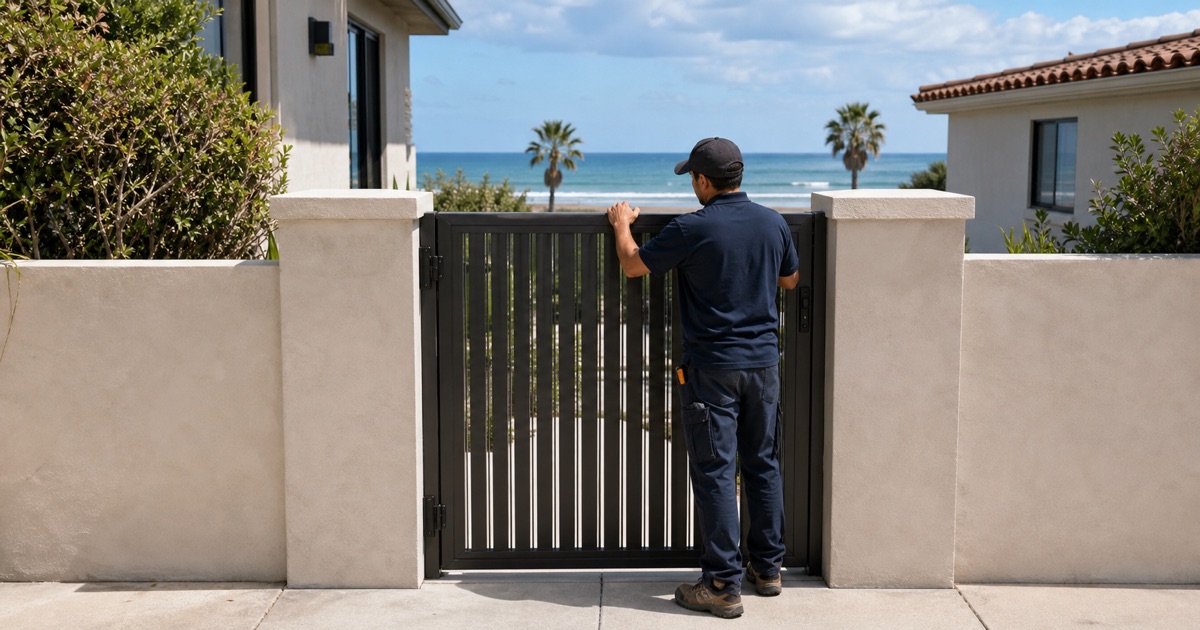
Where the water is close, aluminum extrusion is the honest first recommendation, because it does not corrode from the inside out at all. That removes the failure mode rather than slowing it. It costs more per foot than steel and marks more easily, so we specify heavier wall sections where vehicles maneuver close, but on a coastal property that trade is usually worth making and we will say so plainly.
Galvanizing Where Steel Is Needed
Where the design genuinely needs steel, whether for ornamental detail or impact resistance, hot-dip galvanizing rather than a paint system is what makes it viable here. Galvanizing protects sacrificially, so the zinc around a scratch continues defending the steel instead of allowing corrosion to creep beneath a film. On the coast that behavior matters far more than it does inland.
Fixings, Fasteners and Dissimilar Metals
The parts that fail first in marine air are rarely the ones people look at. Fasteners, hinge pins and anchors corrode before a frame does, and putting dissimilar metals in contact accelerates it considerably. We specify fixings appropriate to the exposure and isolate metals that should not touch, since a sound gate hanging on failed fixings is still a failed gate.
Finish Systems and Maintenance
Over galvanizing or proper pretreatment, a powder coat holds color and gloss under strong UV and resists chalking. What we are direct about is that no finish is permanent this close to the water: rinsing salt off periodically genuinely extends the life of a coastal gate, and it is a five-minute job rather than a maintenance contract. Saying so is more useful than implying a finish that never needs attention.
Looking for metal gates closer to Rolling Hills Estates? See Rolling Hills Estates Metal Gates.
Gated Community and Shared Access
Community Entrances
A shared entrance takes constant cycling by residents, visitors, deliveries, contractors and service vehicles, and hardware built for a household driveway will not survive it. We specify operators against real cycle counts, build heavier frames with hinges rated well beyond the leaf weight, and treat vehicle and pedestrian entries as separate problems because they carry very different traffic.
Access for a Changing Population
Shared developments need credentials that can be issued and withdrawn individually rather than one code everybody knows. That matters most where residents move, carers and visitors come and go, and contractors need temporary access. We set systems up so an administrator can add and remove users without calling us, and where the system supports it, entries are logged per credential.
Accessibility at the Gate
On property with older residents, the details that decide whether a gate is usable are unglamorous: how much force a pedestrian gate needs to open, whether a self-closer slams, whether a keypad can be read and reached comfortably, and whether there is somewhere to stand out of traffic while it opens. We specify closers and hardware with that in mind rather than to the heaviest available setting.
Emergency and Service Access
Gated developments have to admit emergency services, and a gate across a fire apparatus access road must be openable by the fire department with an arrangement that holds when power is gone. On property with a substantial older population, ambulance access matters just as much as fire access, so we confirm what the authority requires rather than assuming a standard fitting satisfies everybody.
Residential Gates Around the City
Driveway Gates on Coastal Lots
Away from the developments, Seal Beach has ordinary residential streets with the usual constraints: measure the usable depth and the fall, choose the configuration on geometry rather than preference, and size posts and footings against the finished weight. What changes here is not the method but the material and finish specification, which is set by exposure rather than by budget.
Wind Load Near the Water
Coastal properties see more wind than inland ones, and a solid gate presents a considerable surface to it. That loads the operator on every cycle, stresses hinges and posts, and on a windy day can make a gate genuinely hard to control by hand. A semi-private or staggered infill gives most of the privacy while letting air through, which is frequently the better answer within a few streets of the water.
Sand, Grit and Ground Hardware
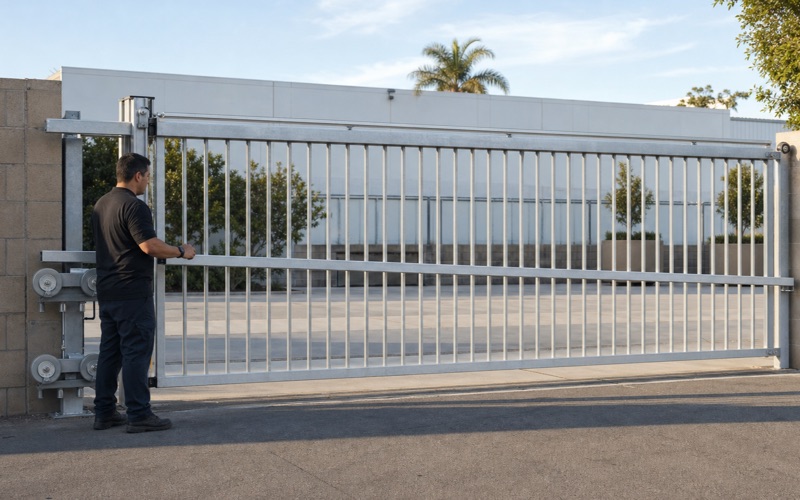
Sand finds its way into ground tracks with a persistence that inland grit does not match, and a V-track gate near the beach will need its track cleared far more often than the same gate elsewhere. Where that maintenance is unrealistic, a cantilever crosses with nothing on the ground at all, which removes the problem rather than asking somebody to manage it.
Pedestrian and Side Gates
Side and pedestrian gates take the most cycles on any property and, on the coast, the most exposure per square foot of anything except the driveway gate itself. Self-closing hardware is sized to the actual leaf weight, and we specify closers and latches rated for marine conditions, because a mechanism that seizes with salt has failed at the one thing it was fitted to do.
Repair and Maintenance
What Fails First on the Coast
Corrosion here follows a predictable order: fixings and hinge pins, then welds, then bottom rails, then the frame itself. Catching it at the first two stages is inexpensive and catching it at the last two is not. On a maintenance visit those are the things we look at rather than the paint finish, which is usually the last thing to show a problem despite being the first thing anyone notices.
Rebuilding Rather Than Replacing
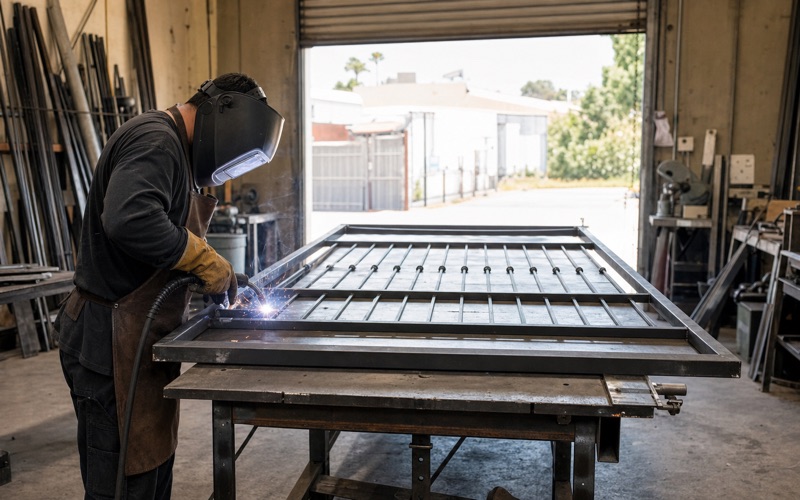
A gate with a corroded bottom rail on a sound frame is worth repairing, and the calculation is the same here as anywhere: cut out the failed steel, weld in new tube matched to the original section, treat the joints and refinish. What differs on the coast is that the repair has to be finished to a higher specification than the original if it is not to fail again in the same place.
Operator and Electrical Corrosion
Salt reaches electrical enclosures, connections and circuit boards as readily as it reaches steel, and a gate that behaves erratically near the water is often reporting a corroded connection rather than a failing board. We check enclosures, seals and terminations before condemning a unit, since replacing an operator on a circuit that is still corroding simply repeats the fault.
Planned Attention
Gate components wear predictably rather than randomly, and on the coast the intervals are shorter. Backup batteries age, closers weaken, sensors drift and fixings corrode. Each is far cheaper to address on a planned visit than at the point where the gate has stopped, and we are straightforward about which items are wear parts with a service life rather than presenting each visit as unforeseeable.
Seal Beach and the Water
A City on the Orange County Coast
Originally known as Bay City, Seal Beach was incorporated under its present name in October 1911 and sits at the northern end of the Orange County coast, with Huntington Harbour and Sunset Beach to the southeast and Westminster and West Garden Grove inland to the east. That position, water on one side and inland suburb on the other, is why exposure varies so much across a short distance here.
Exposure Varies Street by Street
A property a few blocks back from the water sees noticeably less salt than one facing it, and specifying every gate in the city to the harshest standard would be over-building most of them. We look at the actual exposure of the property rather than the city name on the address, because the right answer near the sand and the right answer half a mile inland are genuinely different.
Why the Specification Conversation Comes First
On most jobs the design conversation comes first and material follows. Here it is the other way around: what the gate is made of and how it is finished is decided by where it stands, and the design is then drawn within that. Owners occasionally find that inverted order surprising, and it is the single most useful thing we can explain about building a gate this close to the water.
- Licensed & Insured
- Free On-Site Measure
- Fixed-Price Quotes