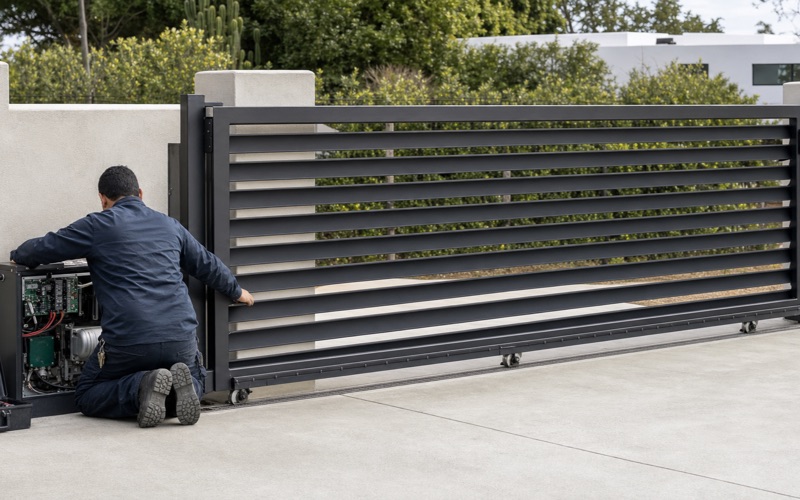
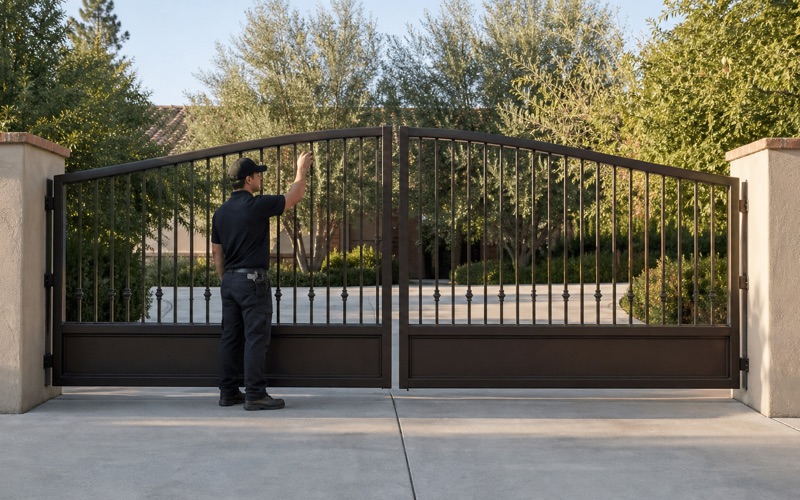
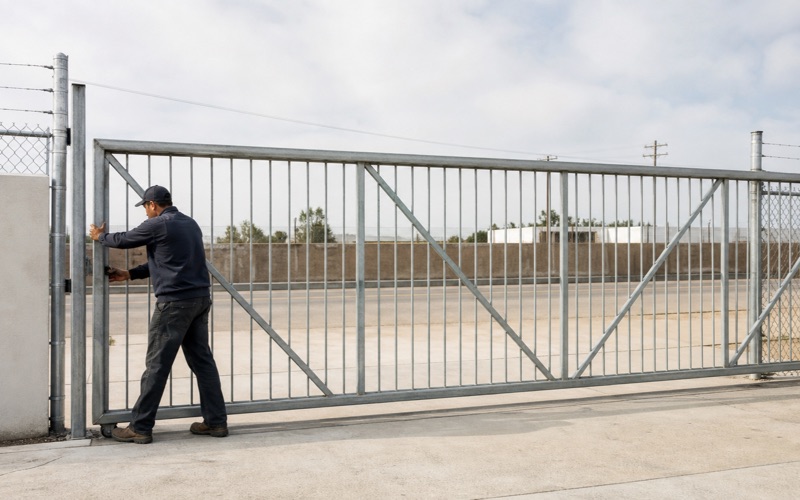
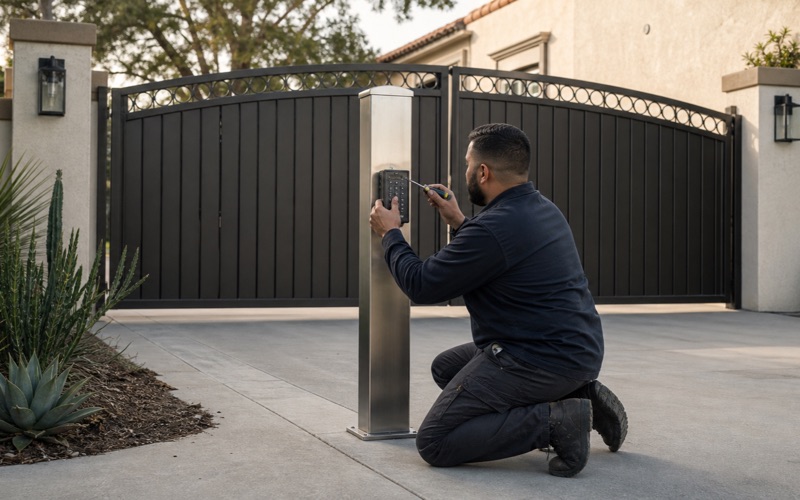
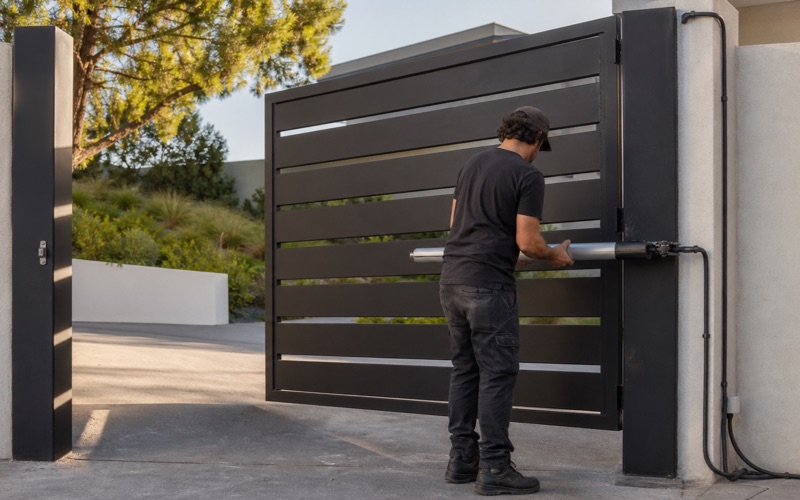
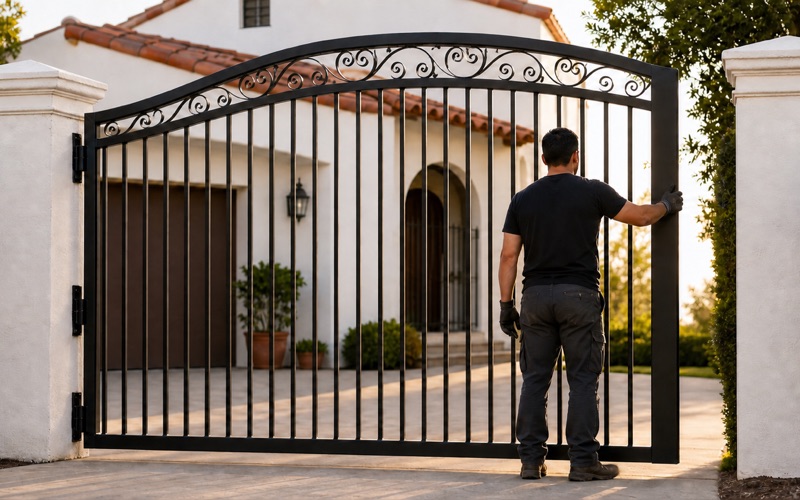
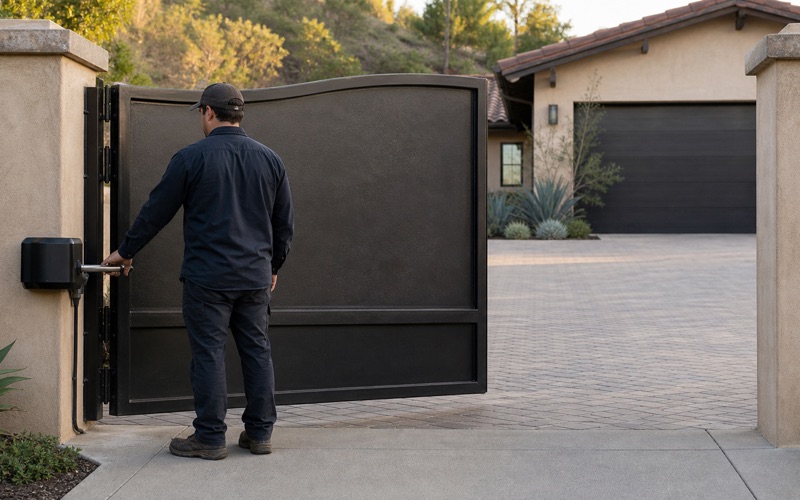
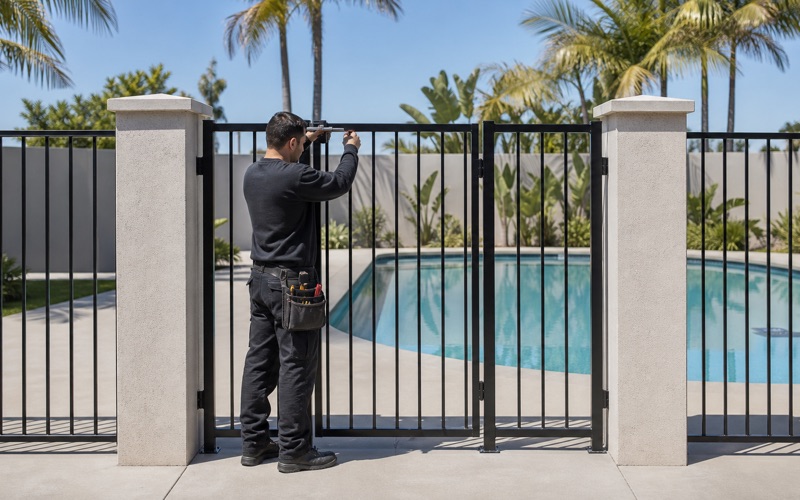
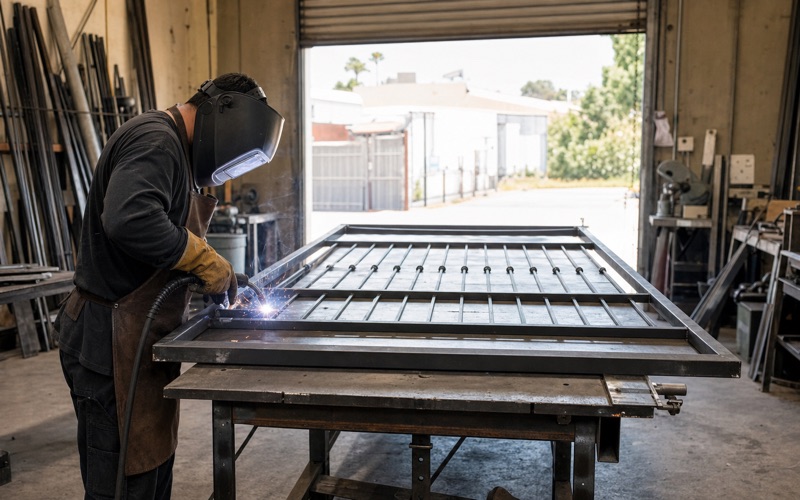
Paramount Metal Gates builds and services metal gates in Santa Fe Springs, working almost entirely on industrial and commercial property: cantilever slide gates across yard entrances, perimeter gates on distribution and manufacturing sites, rolling steel and scissor gates on commercial frontages, and the operators, sensing and access control that keep them cycling. Fabrication happens in our own shop, which on this kind of work means non-standard openings are built to rather than packed out, and a damaged frame is rebuilt rather than replaced.
Santa Fe Springs is one of the most concentrated industrial cities in the region, laid out around rail access and built for the movement of goods. That character sets the specification. A gate here is not opened a few times a day; it cycles continuously through a shift, is crossed by tractor-trailers and forklifts, and is the single point where a secure perimeter can be defeated.
Everything follows from that. Frames sized for the load rather than the span, galvanizing instead of paint, operators rated for a real duty cycle rather than a residential one, and sensing that reliably detects a trailer still sitting in the opening.
Cantilever and Slide Gates
Why Cantilever Suits Yard Traffic
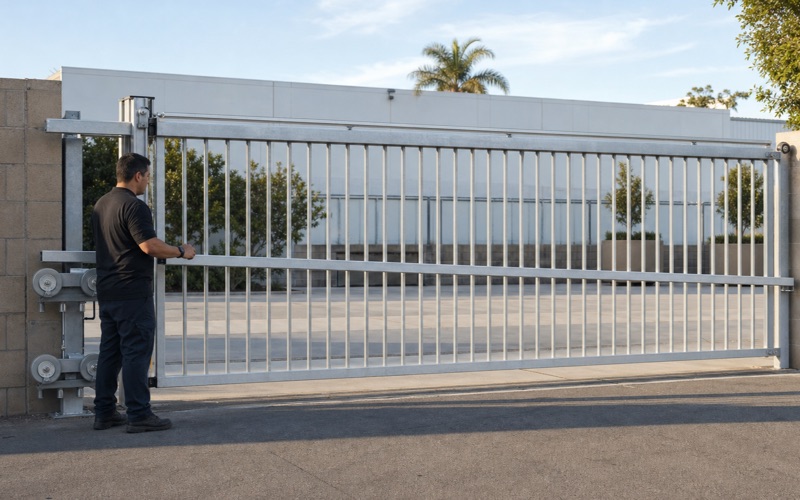
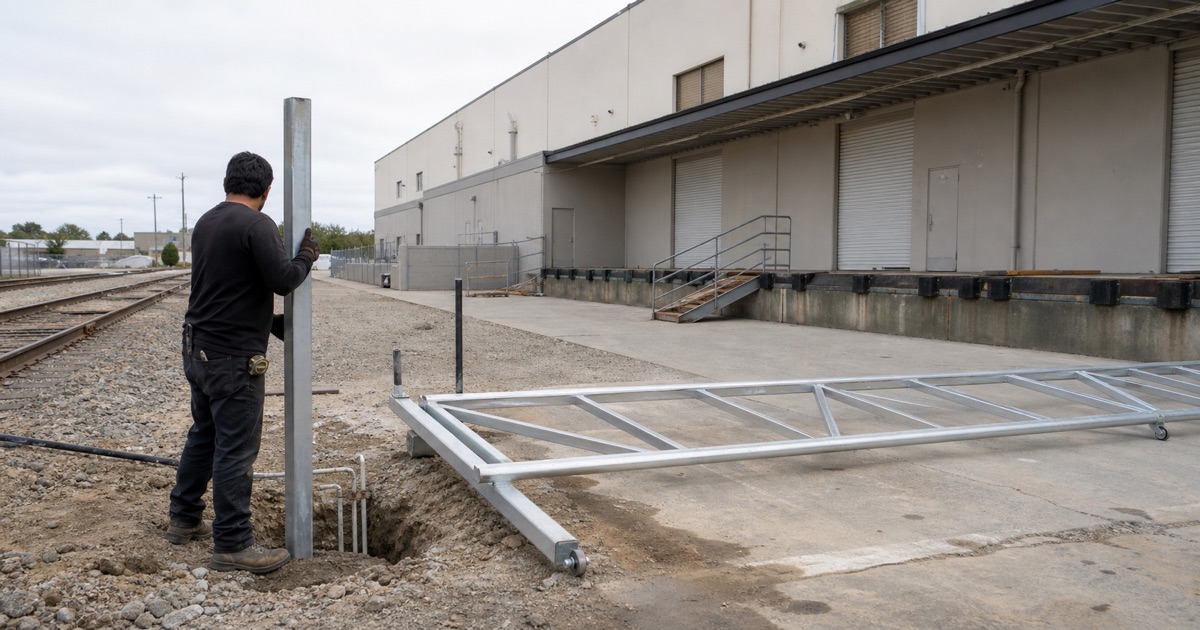
A ground-track slide gate in a yard crossed by trailers fills with grit and gravel, takes wheel strikes, and destroys its own rollers and then its track. A cantilever gate carries its entire weight on truck assemblies set back beside the opening and crosses the entrance with nothing on the ground at all. On a site with heavy vehicle movement that is not a preference, it is the configuration that survives.
Counterbalance and Side Room
The specification that decides whether a cantilever is possible is its counterbalanced tail, which needs meaningful run beyond the opening. A gate built with too short a tail sags at the leading edge, runs badly and chews through truck assemblies, and no quality of hardware compensates for it. We measure the available run before proposing the configuration rather than discovering the shortfall when the gate is already fabricated.
Truck Assemblies and Wear
Wear on a cantilever shows up as sag at the leading edge and a gate that no longer clears cleanly, and it is progressive rather than sudden. We replace worn four-wheel and eight-wheel assemblies, reset the counterbalance and check the tail is genuinely adequate, because where the original build is the problem, fitting a third set of trucks into an under-tailed gate simply repeats the failure at the owner’s expense.
Aluminum Cantilever Systems
Modular aluminum cantilever systems in single and dual track give a very light gate for their span, which reduces load on trucks, posts and operator alike and removes corrosion from the equation. That suits long commercial openings particularly well. Steel remains the answer where impact resistance matters more than weight, such as entrances where vehicles maneuver tightly and contact with the gate is a matter of when rather than if.
Looking for metal gates closer to Signal Hill? See Signal Hill Metal Gates.
Perimeter Security
Where a Perimeter Actually Fails
Breaches happen at openings rather than through fence line, which makes the gate the item worth over-specifying. We build heavy galvanized frames with anti-lift detailing at the hinges, control ground clearance so nothing passes underneath, and fit hardware that resists forcing rather than merely appearing substantial. On unattended sites we prioritize getting a failed gate closed and secured over waiting for an ideal part.
Anti-Climb and Topping
Where a site needs more than a closed gate, the leaf and the fence line either side have to be treated together, since an easily climbed gate beside a well-protected fence achieves nothing. We detail gates so there is no convenient foothold at the hinge or latch stile and coordinate any topping across gate and fence so the line is continuous rather than interrupted exactly where somebody would choose to cross it.
Crash Rating and What It Means
Where a site genuinely needs to stop a vehicle rather than deter one, the requirement moves to barriers tested to a defined impact standard, and what that rating delivers depends on approach speed and standoff distance. Most industrial sites do not need one and are better served by a well-built perimeter gate. Where a site does, we say what the rating actually covers rather than describing a heavy gate as though it were a barrier.
Trash and Storage Enclosures
Outdoor trash and storage areas on industrial land generally require enclosure by a solid masonry wall with a matching solid gate, and those gates take relentless abuse from bins, forklifts and service vehicles. We build them from heavy galvanized frame with solid infill on hinges rated well beyond the leaf weight, because a trash enclosure gate is hit more often than any other gate on a site and is specified as though it never will be.
Operators, Sensing and Access
Duty Cycle Above Everything
A gate cycling dozens of times through a shift and a residential gate cycling four times a day can weigh the same and need entirely different operators. Duty cycle is the specification most often ignored and the one that decides service life. We size with genuine headroom above the load and fit units we stock and service, so a fault is a same-visit repair rather than a parts order and an open gate overnight.
Loops That Handle Long Vehicles
Vehicle sensing on a yard gate has to account for tractor-trailers, which occupy the opening far longer than a car and can leave a gap between tractor and trailer that fools a poorly configured system. Safety and shadow loops are placed and tuned for the vehicles that actually cross, and loop cuts are sealed properly, because a loop that has taken on water produces intermittent behavior that reads convincingly as an operator fault.
Credentials and Contractor Access
Sites running more than one shift need access that changes with the clock rather than staying open all day, and most systems can restrict a credential to particular hours as easily as they can issue it. That is worth setting up properly, because a yard that unlocks at six and stays unlocked until the last person remembers is effectively unsecured for the quietest part of the day. We configure schedules alongside the credentials themselves.
Fire Access on Gated Industrial Property
Sites laid out around rail spurs frequently have long single approaches with no second way in, which raises what emergency access is worth here. Beyond the key switch or Knox box the department controls, the width of the approach has to stay clear along its whole length, and a gate that opens into a lane already narrowed by parked trailers has not solved the problem. We look at the whole approach rather than only the opening.
Commercial Frontages
Rolling Steel and Loading Bays
Rolling steel curtains suit loading bays and service openings with headroom above but no side room beside them. Balance is the safety-critical element: a curtain whose spring tension has drifted is heavy, awkward and dangerous to operate manually, and it punishes its operator on every cycle. We service springs, drums, guides and bottom bars, and replace impact-damaged slats individually where damage is localized.
Scissor Gates on Trade Counters
Side-folding scissor gates protect trade counters, parts departments and interior openings while letting light and visibility through, then stack aside during working hours. They are common across the commercial units here and almost always ignored until one jams. We install, repair and re-track them, and replace worn lattice pivots and locks rather than treating a stuck gate as an automatic replacement.
Office and Visitor Entrances
Industrial sites still have visitors, and a pedestrian entrance beside a vehicle gate needs different treatment from the yard gate itself: an intercom or call station reachable without leaving a vehicle, self-closing hardware where the gate must not stand open, and egress arrangements that do not compromise the perimeter. We treat the two openings as related but separate rather than scaling one down into the other.
Scheduling Around Operations
Replacing a gate on a working site has to happen without stopping the site, which is a sequencing problem as much as a fabrication one. We prepare and finish off site so the on-site phase is short, stage the work so an entrance is never left unsecured overnight, and agree in advance which periods access will be restricted so shipping and receiving can plan around it.
Santa Fe Springs and the Rail Corridor
Named for the Springs, Built on the Railway
The city takes its name from mineral springs purchased by the Atchison, Topeka and Santa Fe Railway, and rail is the reason the area developed as it did. Sites here were laid out for goods movement from the beginning, with the large parcels, wide entrances and heavy vehicle access that follow from it, and that is why the gate work is so consistently industrial in character.
Large Parcels and Wide Openings
Because the land was never subdivided into house lots, entrances here are wide by residential standards and the gates that close them are correspondingly large. Span drives weight, weight drives the choice of configuration, and that is why cantilever and aluminum systems appear so much more often in this city than in the residential ones a few minutes away.
Neighboring Cities and Continuous Industry
The city borders Pico Rivera, Downey, Norwalk, Cerritos and La Mirada, and the industrial land does not stop neatly at its boundaries, which is why the same specification decisions carry across the whole corridor. A gate built for a yard here would be over-specified on a residential street and is exactly right for the site it stands on.
- Licensed & Insured
- Free On-Site Measure
- Fixed-Price Quotes