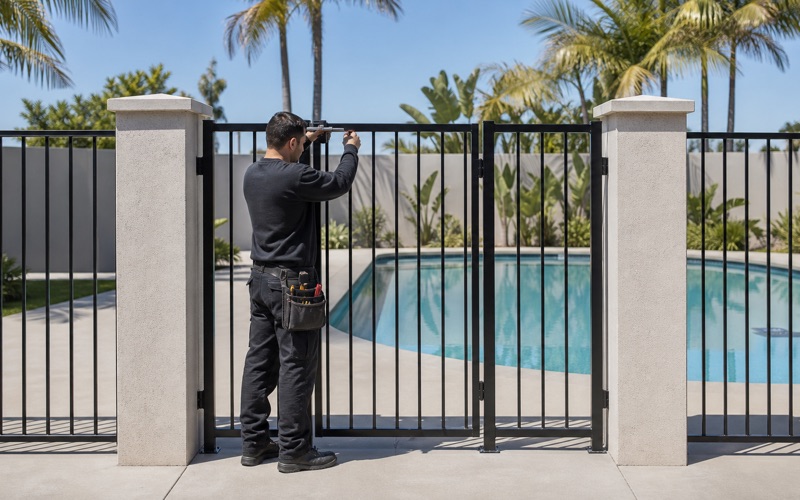
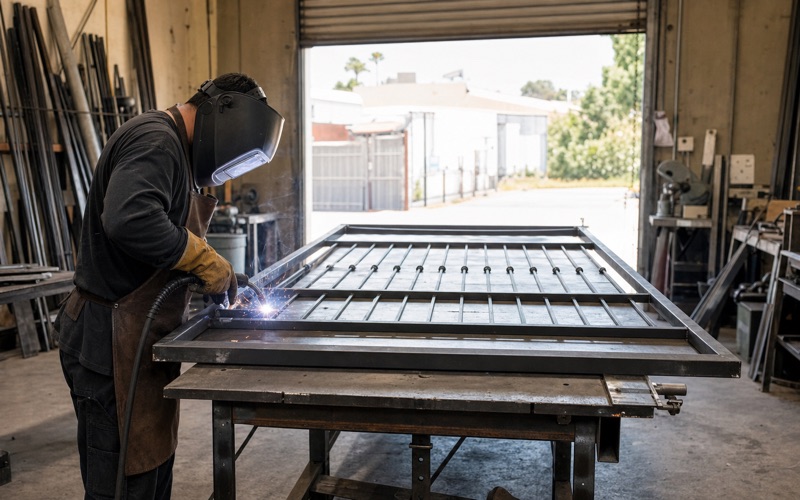
Formality is the defining requirement in San Marino. The entrances here are drawn to axes and symmetry rather than assembled from convenient parts, and a gate that is merely well made will still look wrong if its proportions do not resolve against the house behind it. Paramount Metal Gates fabricates ornamental estate entries, pedestrian and courtyard gates and the automation behind them for properties across the city.
That formality is not decoration for its own sake. On a large frontage with a centered approach, the entrance is the first element of a composition that ends at the front door, and everything about it — the height of the leaves, where the pattern centers, how the arc of the top relates to the pillars either side — is read against that. Getting it slightly wrong is more noticeable here than getting it very wrong somewhere less ordered.
So the drawing stage carries real weight here. We spend time resolving it properly before anything is cut, because a proportion that is slightly off cannot be corrected once the steel exists.
Drawing a Formal Entrance
Symmetry and Where the Pattern Centers
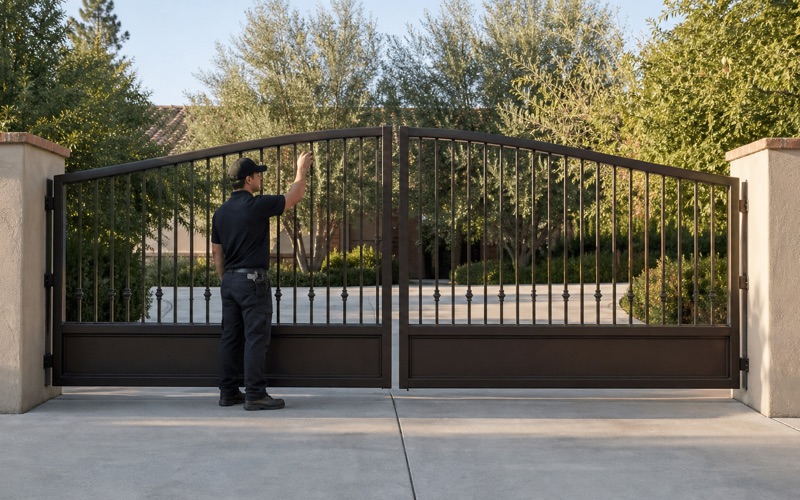
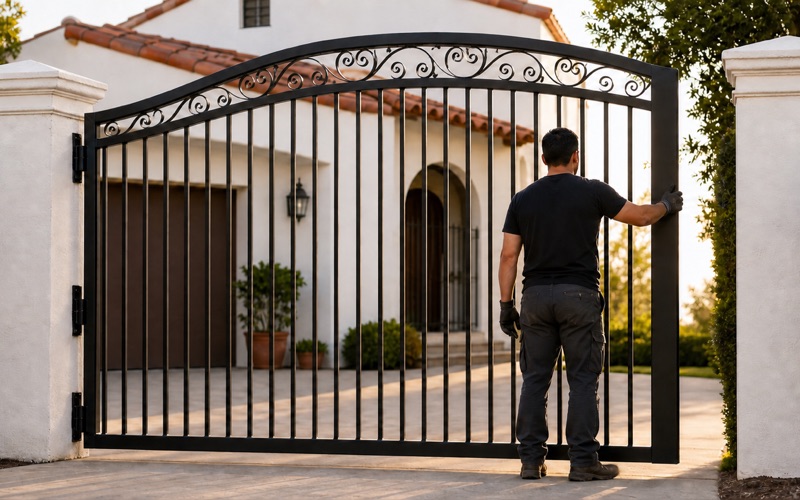
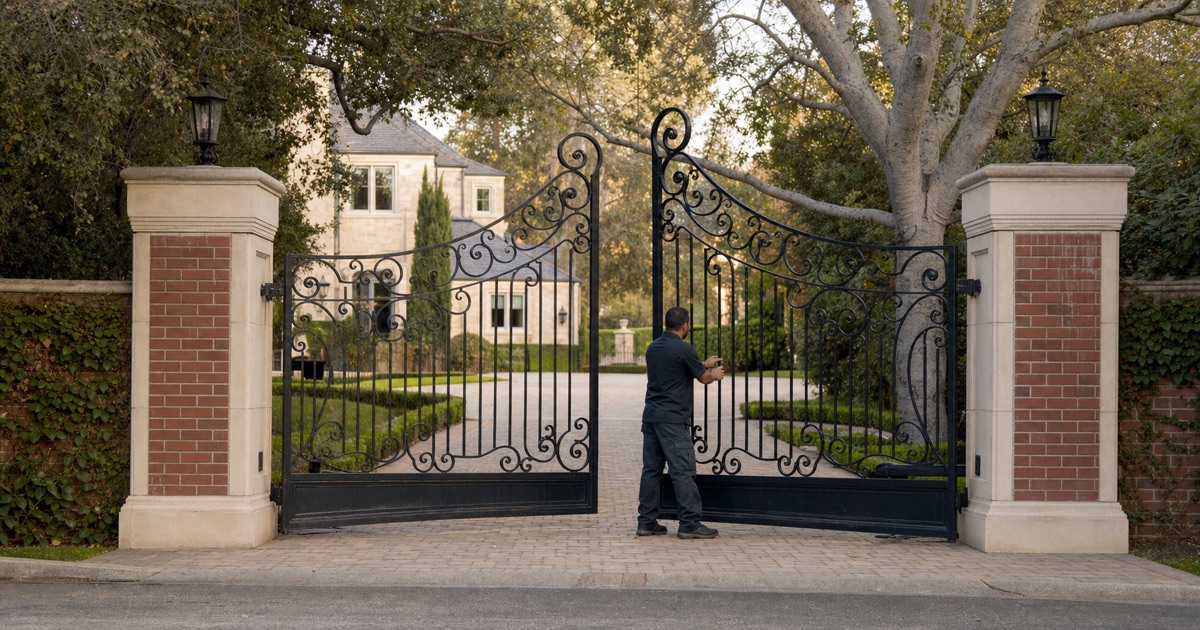
On a double gate the pattern has to resolve at the center line, with repeats landing evenly to either side rather than being cut short at the edges. That sounds obvious and it is the single most common failure on ornamental work, because it requires setting the design out against the measured opening rather than scaling a drawing to fit. We draw to the actual dimension first and adjust the pattern to it.
Proportion Against the House
The gate is read against the elevation behind it and the pillars either side of it, not in isolation. Leaf height, rail positions and the weight of the top treatment all have to relate to what they sit within. A gate correctly proportioned to its pillars looks intentional even when it is plain; one drawn without that reference looks bought regardless of how much ornament it carries.
The Top Line
Arched, bell-curve, flat and split-arch tops each set a different character, and on a formal entrance the top line does more work than any other element. An arch wants to relate to something already present, whether the entry roofline, a window head or the caps of the pillars. Importing a stock radius that answers to nothing on the property is what makes an expensive gate look generic.
Pillars and the Whole Composition
Most entrances here sit within masonry, and the gate is one part of the composition rather than the whole of it. Where pillars are being built or rebuilt alongside, we would far rather coordinate the two than be handed a finished opening and asked to fill it, because the relationship between leaf and pillar is exactly what decides whether the entrance resolves.
Looking for metal gates closer to Palos Verdes Estates? See Palos Verdes Estates Metal Gates.
Fabrication and Detail
Frame and Concealed Bracing
The ornament everybody looks at hangs on a frame nobody sees, and that frame keeps the gate square for its whole life. On a formal gate a visible cross-brace across the face is unacceptable, so bracing is built into the frame where the pattern conceals it. A leaf that flexes when pushed will rack over time, and racking is what eventually stops a gate meeting cleanly at the center.
Ornamental Elements and Craft
Scrollwork, quatrefoil panels, twisted pickets, finials and cast elements each carry a different weight, and mixing too many vocabularies on one gate is a more common error than using too few. We tend toward fewer, better-executed elements, because on a formal entrance the quality of a repeated detail matters more than the number of different details present.
Weight, Hinges and Posts
Ornamental iron is the heaviest common gate material, and almost every failure on this kind of work traces to that weight being underestimated. Hinges are ball-bearing or heavy weld-on units rated well beyond the actual load with grease fittings where the gate cycles often, and post and footing are sized to the leaf rather than inherited from whatever preceded it.
Finish on a Gate Meant to Last
A formal entrance is expected to look right for decades, which makes the finish a structural decision rather than a cosmetic one. Welds get zinc-rich primer before anything else, and over that a powder coat on properly pretreated steel holds color and gloss under strong San Gabriel Valley sun far longer than wet paint, and resists the chalking that ages an entrance visually long before anything fails.
Automation on a Formal Entrance
Hiding the Hardware
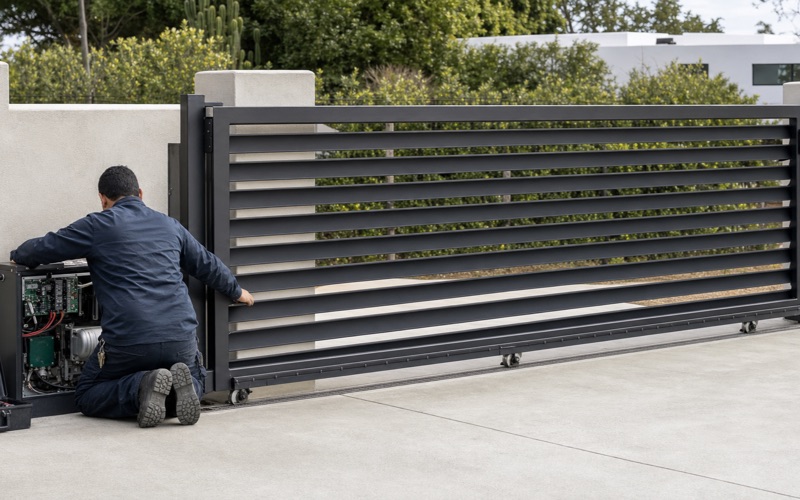
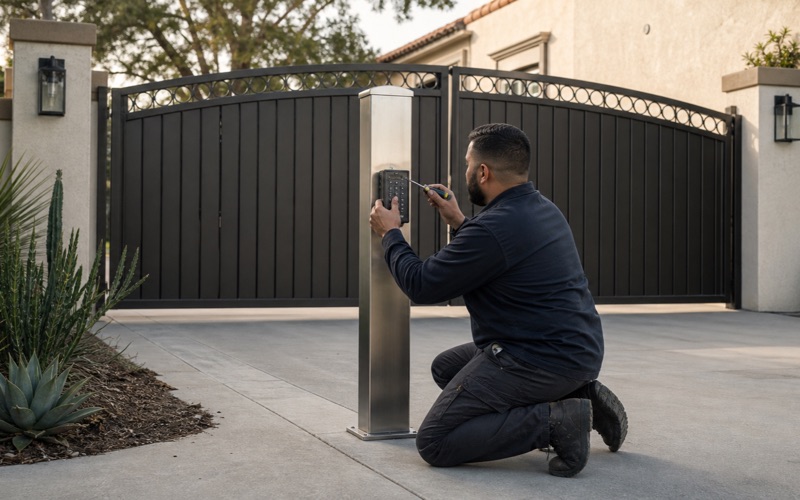
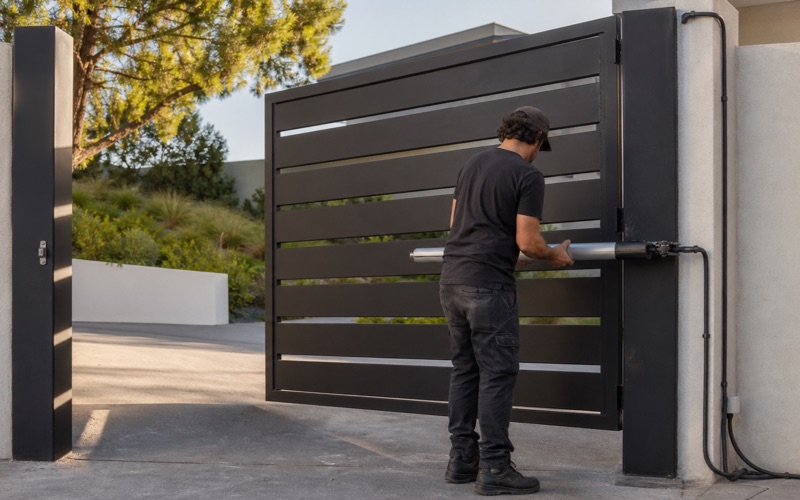
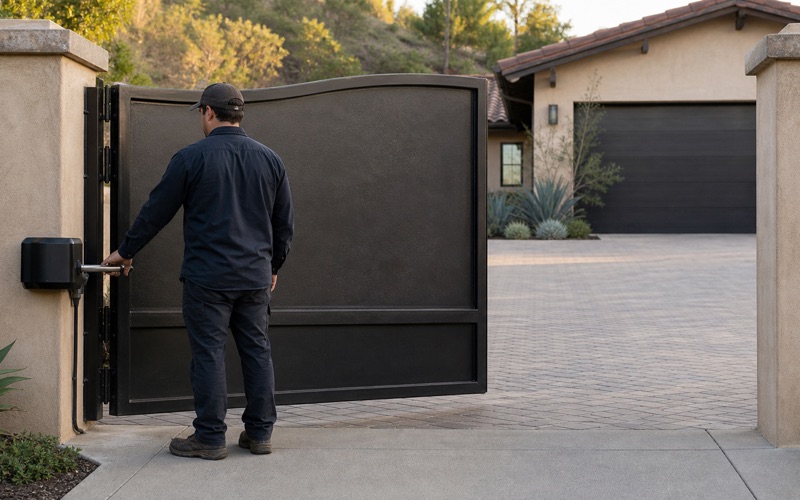
Automation equipment is visually blunt, and on a formal entrance that matters. Operators go underground or behind pillars where the design allows, cabling runs out of sight, and keypads and call stations sit on a pilaster or a discreet pedestal rather than on the gate itself. The entrance should read as an entrance rather than as a control panel with ironwork attached.
Sizing for a Heavy Leaf
A substantial ornamental leaf demands an operator with genuine headroom above the load, since a unit working at the top of its rating on every cycle fails early and takes its mounting hardware with it. We specify against the real finished weight, which is one of the reasons we calculate that weight during design rather than estimating it afterward.
Safety Without Visual Clutter
Automated gates need monitored entrapment protection, and on a formal entrance the challenge is placing photo eyes and safety edges where they genuinely cover the hazard without becoming the thing you notice. That is a siting exercise done properly at design stage, not a set of devices added to a finished gate wherever there happens to be room.
Access for a Household and Its Staff
Properties here frequently have regular staff, gardeners, deliveries and household members needing different levels of access. Credentials issued per person rather than a single code let one be withdrawn without disturbing anyone else, and where an estate has more than one entrance, we set them up so removing somebody’s access removes it everywhere rather than at whichever gate came to mind.
Approvals and Working on Site
Design Review Before Fabrication
Exterior work here attracts scrutiny, and a submission with elevations, dimensions, material and finish properly specified progresses where a verbal description stalls. We prepare that documentation as a matter of course, since it is the same information we need to build from. Building precisely what was approved matters as much as getting the approval.
Height and Setback Limits
Underlying limits apply regardless of any design approval: restricted height in the required front yard, more behind the front-yard line, and clear sightlines at corners. Those are established before a design is drawn, because a formal gate reduced in height afterward loses exactly the proportions that made it formal in the first place.
Coordinating With Other Trades
Estate work usually runs alongside masonry, landscaping, lighting and irrigation, and the gate depends on all of them. Agreeing the sequence early avoids the familiar outcome where a footing position turns out to be occupied by an irrigation main, or pillars get built to a height that no longer suits the leaf drawn for them.
Working Around a Household
Work on a private property means being around a home rather than on a site: keeping to agreed hours, leaving the approach clean each day, and not treating a drive as a materials yard. Where the entrance being replaced is the only vehicle access, we stage the work so the household can come and go and the opening is never left unsecured overnight.
San Marino’s Character
An Affluent City With a Long Continuity
San Marino is an affluent city in the San Gabriel Valley, incorporated in April 1913, and it celebrated its centennial in 2013 with a published history by the local historical society. That continuity shows in the streets: large lots laid out early and kept largely intact, which is why so many entrances here are original compositions rather than later additions.
Large Lots and Formal Frontages
The lot pattern is what makes formal entrances appropriate here in a way they would not be a few miles away. On a generous frontage with a centered approach, a symmetrical entrance is simply the right answer, whereas the same gate on a narrow suburban lot would look pretentious. We design to the frontage rather than to a budget.
Why the Drawing Matters Most
The practical summary is that on this kind of work the fabrication is rarely the hard part. Resolving the proportions, centring the pattern, relating the top line to the house and hiding the hardware are what separate an entrance that looks inevitable from one that looks purchased, and all of that happens on paper before any steel is cut.
Repair and Existing Entrances
Restoring an Original Entrance
Many entrances here are original to the property and worth restoring rather than replacing, because the composition already resolves and reproducing that detailing new would be substantially more expensive. We cut out failed sections, weld in matched material, treat the joints and refinish the whole leaf, so a repaired gate does not carry a visible patch across a face designed to be symmetrical.
Matching Detailing No Longer Made
Ornamental elements used on entrances of this age are frequently out of production, and an approximation on a formal gate is more noticeable than it would be on a plainer one because the eye is already following a repeat. Where an exact match cannot be achieved we say so before starting and propose a deliberate variation rather than something almost right.
Correcting a Gate That No Longer Meets
On a double gate the failure everybody notices is the leaves no longer meeting cleanly at the center, and the cause is nearly always hinge wear or a post that has moved rather than the gate itself. Adjusting the latch hides it briefly and worsens the underlying droop. We correct the geometry, which is the only version that ends the problem.
Bringing Older Automation Up to Standard
Entrances automated years ago frequently run hardware that predates current sensing expectations, and the sensible upgrade path is usually to keep the gate and modernize the operator and its protection rather than replace a composition that works. We assess whether the leaf and its hinges will take a current operator before proposing one.
- Licensed & Insured
- Free On-Site Measure
- Fixed-Price Quotes