Rolling Hills Estates is threaded with horse paths, and that changes where a gate can go as much as what it should be. Paramount Metal Gates builds estate entrances, trail-adjacent gates, pedestrian and courtyard gates and the automation behind them across the city, and on a substantial number of properties the first question is not about the gate at all — it is about what the trail beside it needs.
The bridle paths here are a shared network rather than a feature of individual properties. They run along and between lots, cross driveways, and carry riders past entrances at times nobody schedules. A gate that swings out across a path, or that surprises a horse as it opens, creates a hazard for somebody who has no relationship with the property at all.
That is a siting and behavior problem before it is a hardware problem. It is also the thing most often overlooked by a contractor who has not worked in this city before.
Gates Alongside the Trails
Where a Leaf Can Travel
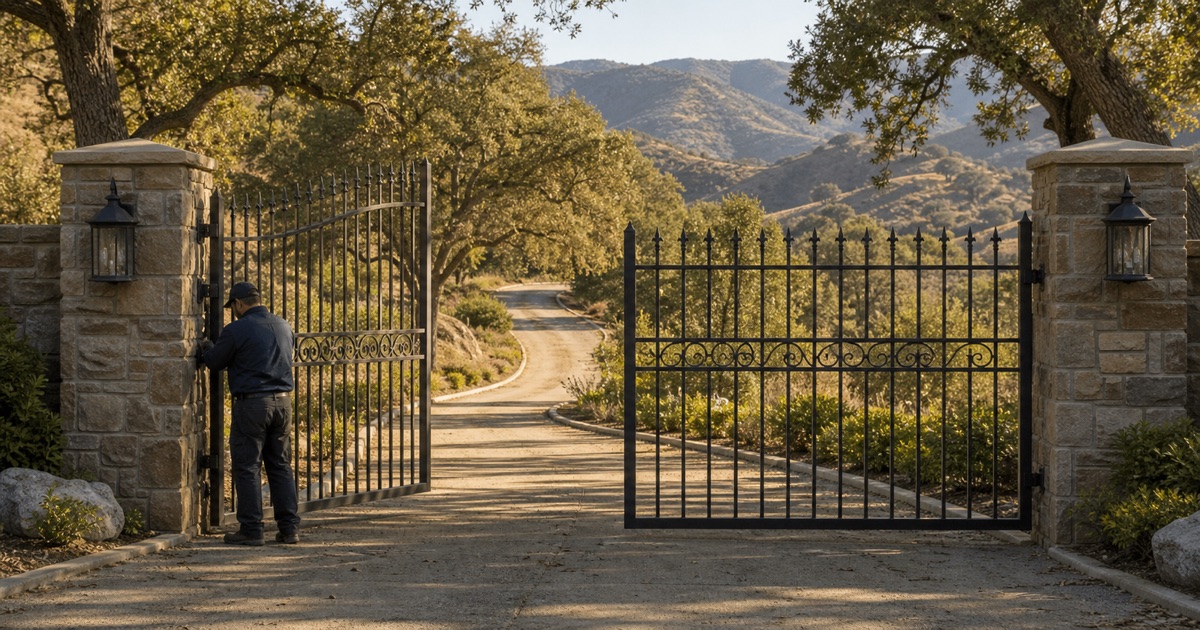
A gate that opens outward across a bridle path is a hazard however well it is built, because a horse and rider passing at the wrong moment have nowhere to go. Where the arc would reach a path, the gate has to open inward or travel sideways instead, and that constraint is settled before anything else about the design. It frequently rules out the arrangement an owner arrived expecting.
Movement, Noise and Horses
Horses react to sudden movement and to noise, and an automated gate produces both. A leaf that starts abruptly, a chain drive that rattles, or a warning device that sounds without notice will unsettle an animal passing at exactly the wrong moment. Softer start and stop, quieter drive types and sensible siting of any audible warning all help, and they cost nothing to specify at the outset.
Sightlines Where a Trail Meets a Drive
Where a path crosses a driveway, both the driver and the rider need to see each other before either commits. A solid gate and a solid wall at that junction remove the sightline entirely, which is why an open or partly open face is frequently the better answer at the crossing point even where the owner wants privacy elsewhere along the boundary.
Trail Gates and Shared Access
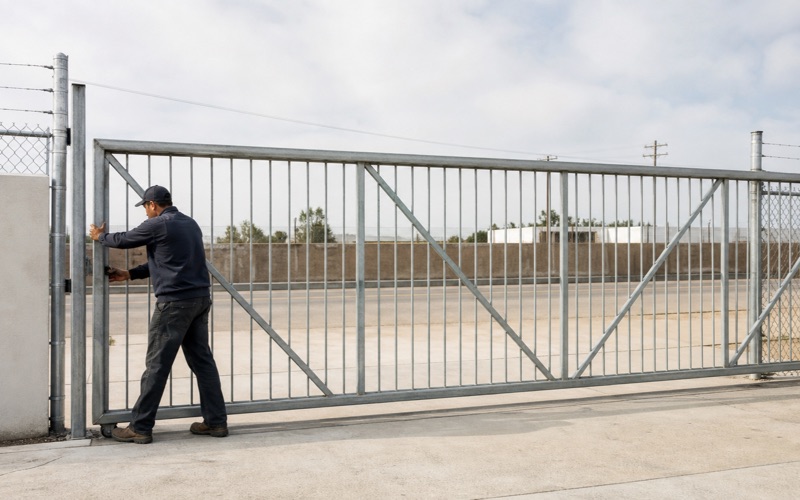
Some properties carry a trail gate as well as a vehicle entrance, and those want hardware suited to being worked by somebody on horseback or on foot rather than from a car. Latches that operate cleanly one-handed, leaves that stay where they are put, and nothing projecting at the height of a passing leg are the details that matter, and they are the ones a standard entrance specification does not consider.
Looking for metal gates closer to South El Monte? See Metal Gates in South El Monte.
Estate Entrances
Scale Against a Large Lot
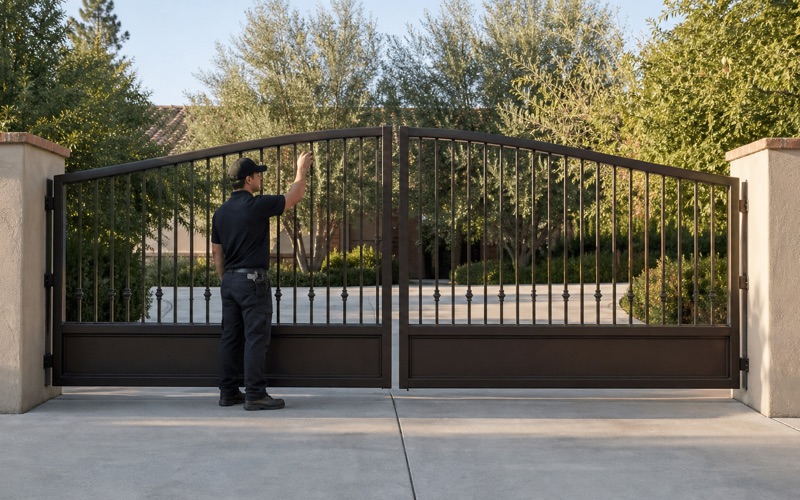
Entrances here sit on generous lots and are frequently approached along a curve rather than head-on, so an entrance is read at distance and in motion. A pattern drawn for close inspection can disappear entirely at that range, and one drawn for impact can feel coarse when somebody is standing at it. We ask how the property is actually arrived at before drawing anything.
Pillars, Walls and Composition
Most substantial entrances here sit within masonry, and the gate is one part of that composition rather than the whole of it. The proportion between leaf and pillar does more for how an entrance reads than the detailing on either, so where masonry is being built alongside we would rather coordinate the two than be handed a finished opening and asked to fill it.
Style Across the Peninsula
The housing runs from Ranch and mid-century through Mediterranean to substantial contemporary work, and each takes a different vocabulary. What is consistent is restraint: on lots this size an entrance does not need to work hard to register, and the ones that try tend to age worse than the ones that do not.
Secondary and Service Gates
Larger properties usually have more than one way in, and access granted at one entrance and forgotten at another is how a property becomes less secure than its owner believes. We map every opening before adding to it, and set credentials up so that revoking somebody’s access removes it everywhere rather than at the gate somebody happened to think of.
Long Approaches and Practicalities
Power at a Distance
Where an entrance sits well away from the house, trenching a supply means excavation through mature planting and hard landscaping. A solar operator with battery backup avoids that, provided panel and battery are sized against real winter daylight under the tree cover actually present rather than against an annual average that assumes open sky.
Identifying Callers From the House
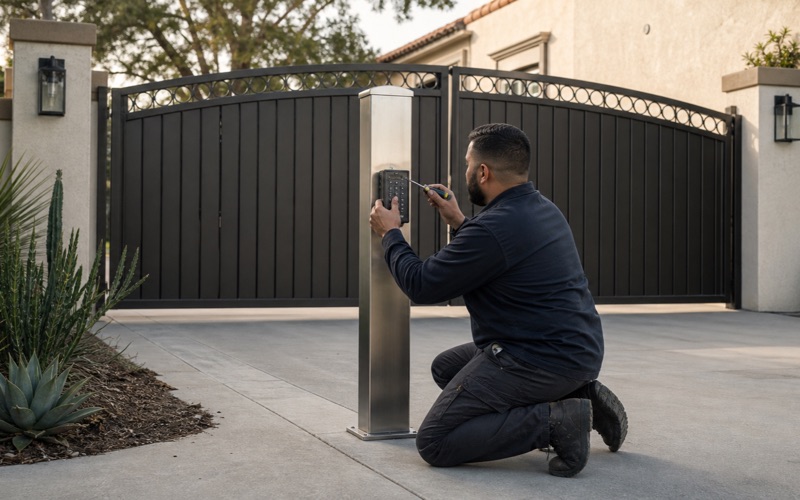
At distance the household cannot see who is at the gate, so identification has to be carried to them. Video entry and cellular controllers do that in different ways and at different ongoing costs, and the right choice depends on how often deliveries, staff and contractors actually attend rather than on which system lists the most features.
Ground, Grade and Drainage
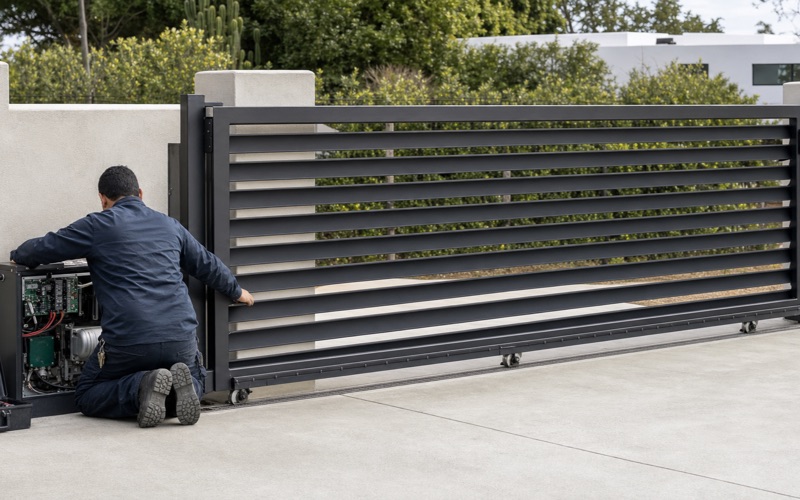
The peninsula has slope almost everywhere, and a drive that rises will catch a swinging leaf partway through its arc. Water running down that drive carries grit into anything at ground level. Both point toward gates that travel rather than swing and toward arrangements with nothing sitting on the ground for debris to find.
Coordinating With Landscape Work
Gate work on properties like these usually runs alongside landscaping, masonry and irrigation, and the gate depends on all of them. Agreeing the sequence early avoids the common outcome where a footing position turns out to be occupied by an irrigation main, or a wall gets built to a height that no longer suits the leaf that was designed for it.
Approvals and Neighbors
Design Review Before Fabrication
Exterior work here frequently attracts review, and applications fail for vagueness far more often than for being unacceptable. Dimensions, elevations, material and finish specified properly are what let an application progress, and it is the same information needed to build, so preparing it is not additional work. We treat it as part of the job rather than as the owner’s separate problem.
Height, Setback and Sightlines
Underlying limits still apply regardless of what a review body approves: restricted height at the front of a lot, more behind the front-yard line, and clear sightlines at corners. Those are settled first, because a design drawn at the wrong height cannot be reduced without destroying the proportions that made it work.
Trails That Cross Boundaries
Where a path runs along or across a property line, what may be built and where is constrained by an easement rather than by the owner’s preference. We establish what actually applies before proposing anything, since a gate or wall placed across an easement is not a design problem to be negotiated but something that has to come out.
Working Around Neighbors and Riders
Installation here affects people who are not paying for it: neighbors on shared approaches and riders using the trails. We stage work so paths stay usable, keep materials off the routes people need, and give notice where access will be interrupted. It is ordinary courtesy and it is also what keeps a job from becoming a complaint.
The City and Its Character
Incorporated With the Paths Already There
Rolling Hills Estates was incorporated in 1957 and has many horse paths, and that network is not a later amenity but part of how the city was laid out. Historically the land formed part of Rancho San Pedro, and the pattern of large parcels that followed is why the trails could be threaded between properties in the first place.
An Affluent City That Stayed Rural in Character
The city is affluent and the properties substantial, but the character it has kept is closer to rural than suburban, which is unusual this close to the coast and this deep into the county. For gate work that means an entrance which reads as a country gate frequently suits better than one which reads as a city entrance, whatever the budget.
Why the Trail Comes First
The practical summary is that on a great many properties here the trail network constrains the gate rather than the other way around. Establishing what the path beside a boundary needs, and designing the entrance within that, is the difference between an installation that fits the city and one that has to be revisited.
Materials and Long-Term Finish
Peninsula Air and Coating Choice
The peninsula sits high and open with the ocean on one side, which means salt reaches properties that feel a long way from the water. Corrosion starts at joints and fixings rather than on visible faces, so protection has to be sacrificial rather than a coating hoping not to be scratched. Galvanizing beneath a powder finish is the sensible build here, and aluminum removes the question altogether.
Wind on an Exposed Ridge
Exposure here is considerable, and a solid gate is a substantial sail. That loads the operator on every cycle, stresses hinges and posts, and makes a leaf awkward to control by hand on a bad day. Where privacy is wanted we would rather stagger the infill or use a partly open face than build something that fights the wind for its whole life.
Hardware That Keeps Working
The components that fail first in this exposure are the small ones: hinge pins, fasteners, latch mechanisms and the springs inside closers. A gate can look entirely sound while what holds it together is well advanced in failing, which is why those are worth specifying properly at the outset rather than economizing on the parts nobody looks at.
Maintenance Somebody Will Actually Do
We are direct that nothing here is maintenance-free, and equally direct that a maintenance regime nobody follows is worse than a specification that tolerates neglect. Where an owner is unlikely to be rinsing salt off a gate, we specify accordingly rather than assuming a schedule that exists only in a handover document.
- Licensed & Insured
- Free On-Site Measure
- Fixed-Price Quotes