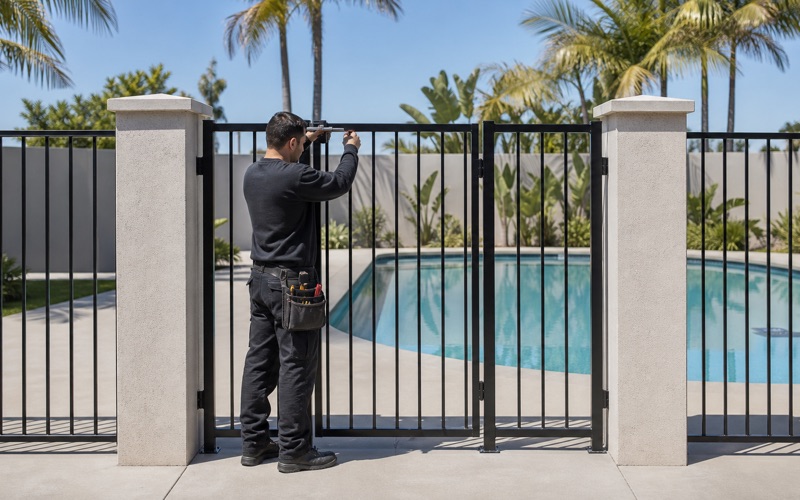
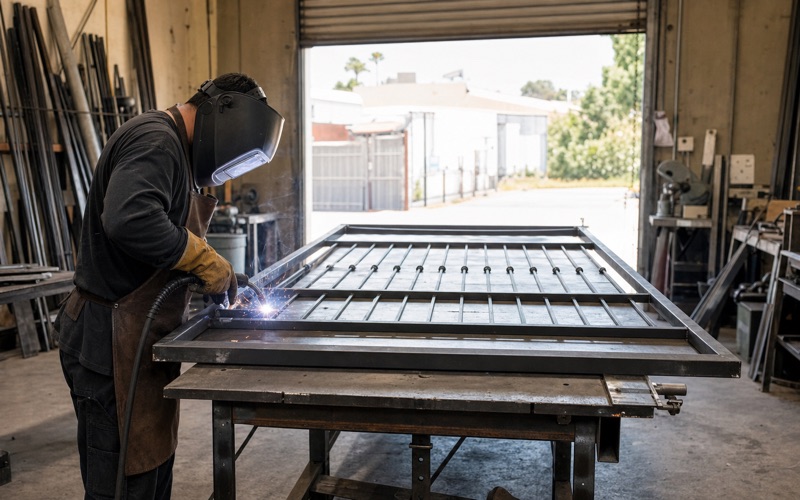
Paramount Metal Gates installs and repairs metal gates in Norwalk, covering driveway gates, entry and side-yard gates, security screen doors, commercial perimeters and the automation and access control that runs them. Gates are fabricated to measured openings in our own shop, and the approvals that a gate near the street actually needs are prepared and submitted by us rather than handed back to the property owner as homework.
That second part is not a courtesy. A gate is one of the few residential improvements that routinely interacts with the public right of way, because the thing it closes off is a driveway that crosses a sidewalk and meets a public street. Depending on where a gate sits and what it is fixed to, that can bring height limits, setback rules, corner sightline requirements and driveway approach or encroachment approvals into play at the same time.
None of that is difficult once it is being handled deliberately. What causes trouble is discovering it late, because a gate built to the wrong height or set in the wrong place is not something that can be adjusted afterward. We establish what applies to the specific property before anything is fabricated.
Approvals, Setbacks and the Right of Way
Height Limits Front and Back
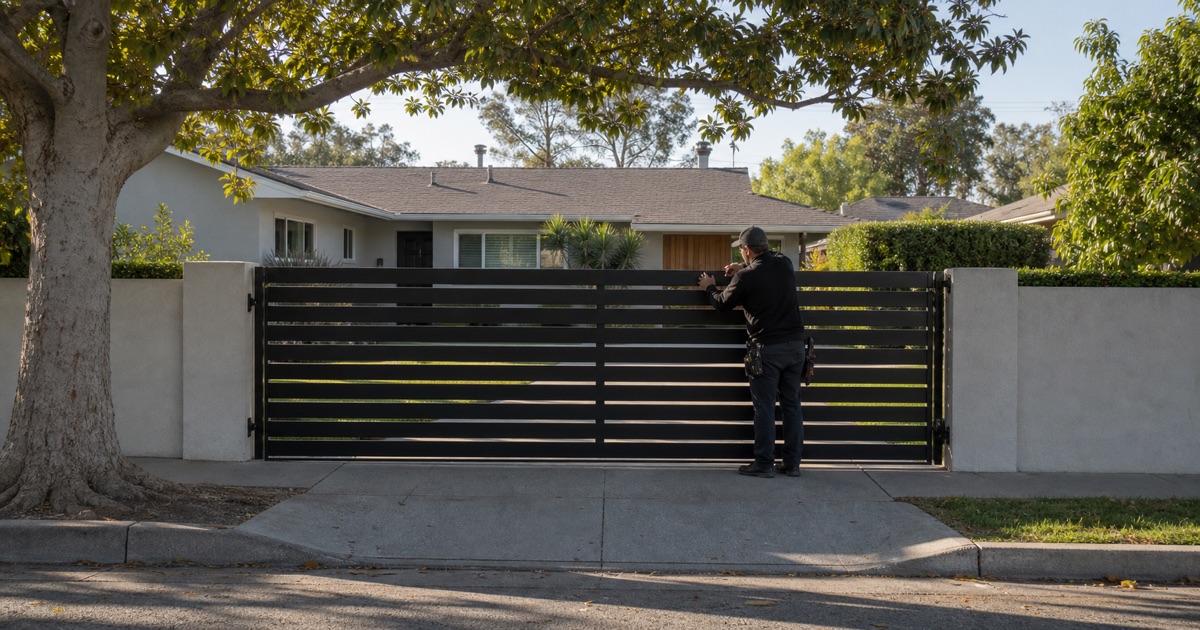
Anything standing in the required front yard is limited in height, and the allowance increases once you are behind the front-yard line. That single rule shapes more designs than any other, because it determines whether an entry can be a full-height gate at all or whether it has to sit lower at the street and rise further back. We establish which applies to the property before drawing anything, since a pattern designed at the wrong height rarely survives being cut down.
Corner Lots and Sightlines
Corner and reverse corner lots carry an additional requirement: a triangular area at the intersection kept clear of anything that would obstruct a driver’s view. Nothing above a limited height may stand within it, which frequently rules out exactly the solid gate a corner property wants for privacy. Where that applies we design around it with an open picket face at the affected end rather than proposing something that will not be approved.
Driveway Approach and Encroachment
Where a gate installation involves work at the point the driveway crosses the sidewalk, or anything fixed within the public right of way, that generally needs its own approval separate from anything to do with the gate itself. We identify whether the work touches it, prepare the submission and schedule what needs inspecting. It is the single most common reason a straightforward gate job stalls, and it is entirely avoidable.
Which Approvals a Gate Actually Triggers
Not every gate needs every approval, and quoting as though it does is as unhelpful as ignoring the question. A leaf hung between two existing posts well inside the property line is a different proposition from one requiring new footings near the sidewalk on a corner lot. We work out which category the job falls into during the site visit and say plainly what will be required, so the schedule reflects it from the start.
Looking for metal gates closer to Artesia? See Metal Gates in Artesia.
Driveway Gates on Norwalk Streets
Long Frontages and Straight Boulevards
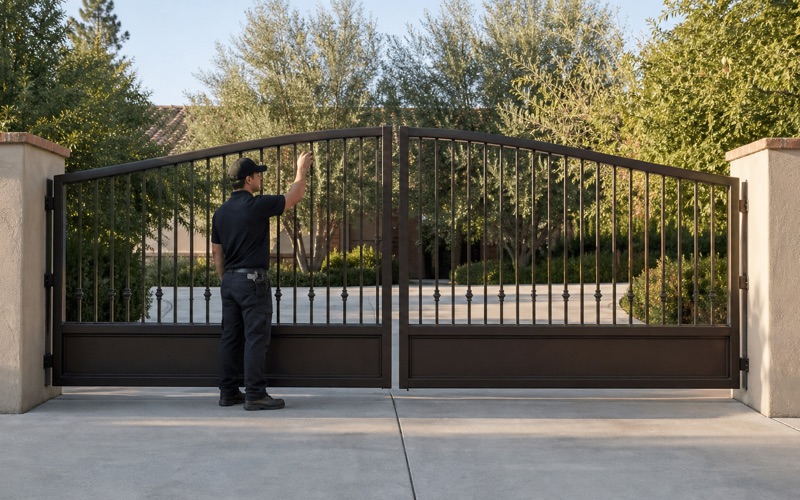
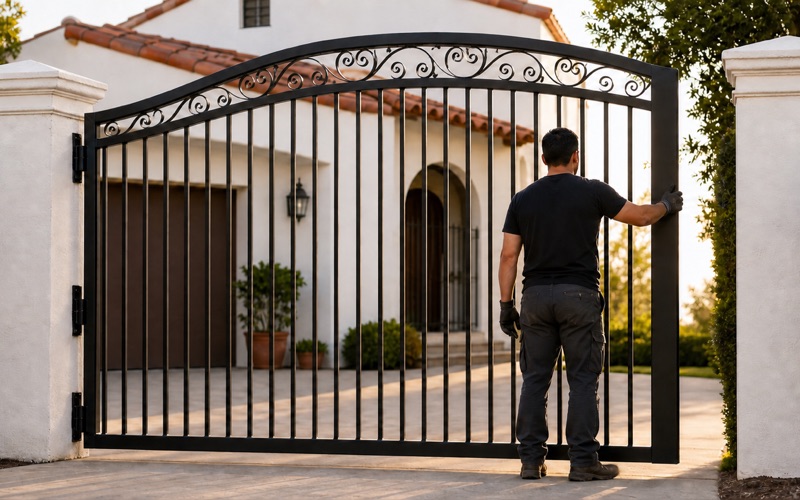
Norwalk’s residential streets run to long straight blocks with generous frontages by comparison with the denser cities nearby, which frequently leaves enough depth for a pair of swing leaves where elsewhere a slide would be forced. That is worth knowing because a double swing gate presents an ornamental pattern as a single composition across both leaves, which is how most iron designs are meant to be read.
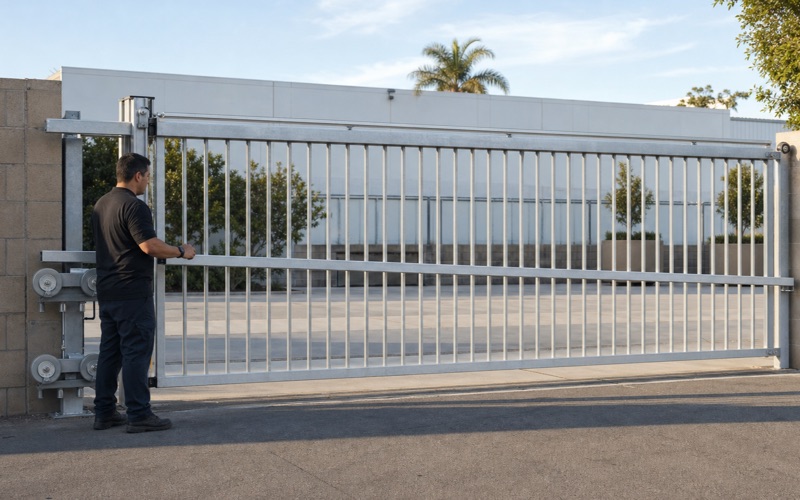
Where a Slide Is Still the Answer
Depth is not the only variable. A driveway that rises from the street will catch a swinging leaf partway through its arc regardless of how much room there is, and a property where vehicles park close to the gate line has that arc occupied whether or not it exists on paper. We measure the fall and look at how the driveway is actually used before recommending a configuration, rather than defaulting to a swing because the frontage looks generous.
Posts, Footings and What Carries the Gate
Whatever configuration is chosen, the gate is only as good as what holds it. Post section and footing depth are sized against the finished leaf weight and the ground rather than to a standard hole, and hinges are rated well above the actual load. A post that rotates a degree at grade presents as several inches of drop at the latch, which is why we would rather set a proper footing once than return to adjust a gate that keeps moving.
Automation and Vehicle Sensing
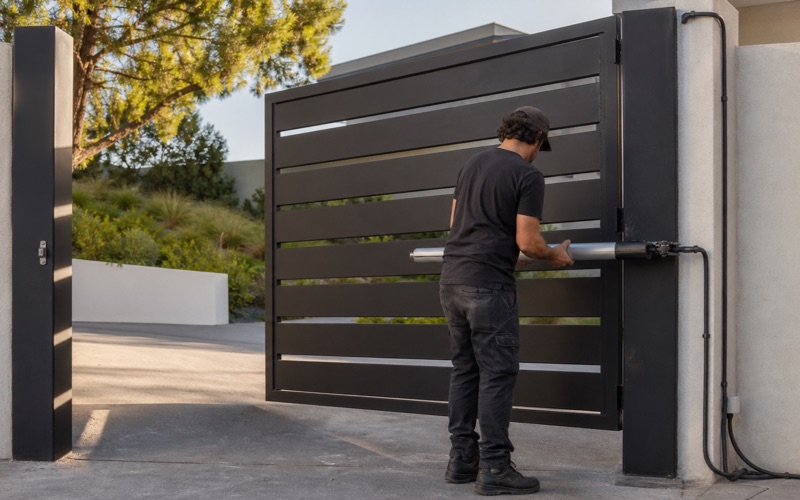
Automating a gate makes it a powered machine and brings the associated construction and safety requirements into effect at that moment. We size operators against the real weight and cycle count, fit monitored entrapment protection with photo eyes and safety edges, and cut and seal inductive loops so a vehicle in the opening is detected reliably rather than intermittently.
Commercial and Institutional Work
Business Frontages and Yards
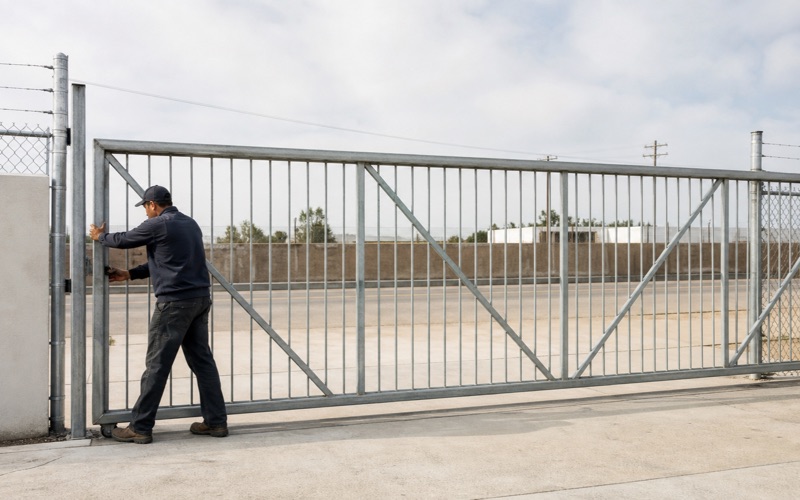
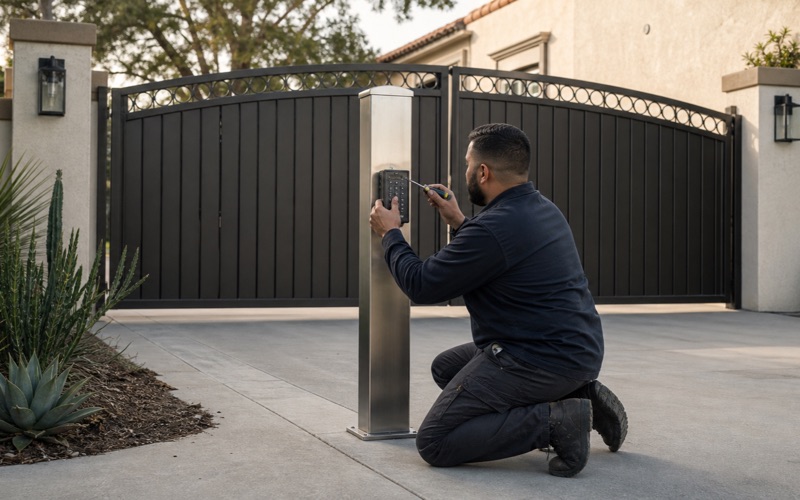
Norwalk carries commercial frontage along its main corridors and yards behind them, and both need gates rated for daily use rather than occasional. We build heavier frames, specify operators against a genuine duty cycle, and fit access control that can be issued and revoked per person rather than as a single shared code that ends up written on the wall beside the keypad.
Fire Access on Gated Sites
Any gate across a fire apparatus access road has to be openable by the fire department, which in practice means a Knox box or a key switch wired so it still works when power is gone. It is the item most often missing on otherwise well-built gated sites, and the one most likely to be raised at an inspection. We confirm the local requirement rather than assuming a standard arrangement satisfies it.
Parking and Multi-Unit Entrances
Shared residential and commercial parking entrances cycle far more often than a household driveway and are used by people who did not choose the system. That calls for hardware rated for the real traffic, vehicle sensing that reliably holds the gate open while a car occupies the opening, and credentials that can be withdrawn individually when somebody leaves.
Scheduling Around Access
Replacing a gate on a property where it is the only vehicle access is a sequencing problem as much as a fabrication one. We prepare and finish off site so the disruptive on-site phase is short, stage the work so an opening is not left unsecured overnight, and set out clearly which periods access will be restricted.
Norwalk’s Layout and History
Founded on the Rail Line
Norwalk was founded in the late nineteenth century and incorporated as a city in 1957, and the railroad that arrived in the 1870s shaped how the land was divided, with a passenger stop written into the deed of the land given for it. That early rail geometry is why the street grid runs so straight and the blocks so long, which in turn is why frontages here tend to be more generous than in the cities that filled in later.
El Camino Real and the Older Routes
The area sits along the historic El Camino Real corridor, and the through-routes that followed it carry commercial frontage today while the residential streets sit behind them. That separation is unusually clean here, and it is why commercial gate work and residential gate work in Norwalk tend to be genuinely different jobs rather than variations on one another.
Coastal Air and Finish Specification
Norwalk is close enough to the coast for salt-laden air to reach welds and fixings, and corrosion begins where coating is thinnest, at welded joints and along the bottom rail. Every weld gets zinc-rich primer before any topcoat, with hot-dip galvanizing or a TGIC polyester powder coat over pretreated steel above it. That specification decides how a gate looks in ten years far more than the pattern does.
Choosing a Gate Style
Ornamental Iron on Pillar Entries
Where a property already has masonry pillars, ornamental iron is what those pillars were built to carry, and a light panel between them always reads as temporary. We draw the picket profile, scroll pattern and top treatment against the measured opening so repeats land evenly, and size the frame to the finished weight rather than the nominal width. Iron rewards good detailing and punishes thin section, which is why the structural decision comes before the decorative one rather than after it.
Horizontal Slat and Contemporary Faces
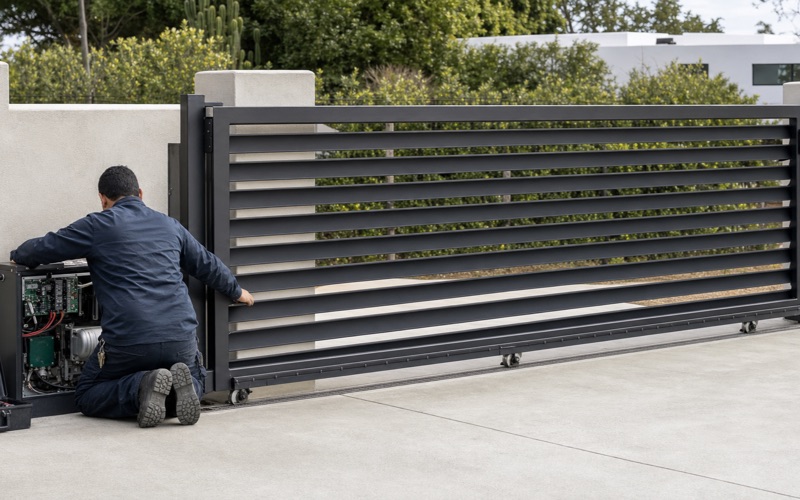
On the lower, wider elevations common through the postwar streets, horizontal emphasis sits better than a tall ornate face. Slat gates in matte black, bronze or a wood-look powder coat suit those houses, and slat spacing is the decision that matters most: closer spacing screens the property but catches wind and loads the operator harder on an exposed frontage, while wider spacing gives a lighter face and easier travel for the same leaf.
Solid, Semi-Private and Open Faces
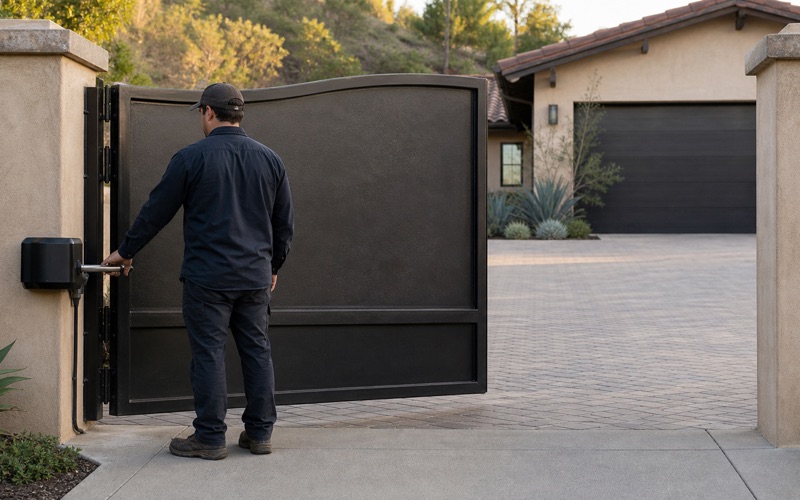
How much a gate hides is a functional choice as much as an aesthetic one. A solid face gives privacy and takes full wind load, which on a long straight boulevard is a real force rather than a theoretical one. A semi-private arrangement with staggered infill gives most of the privacy while letting air through. An open picket face gives none but is lightest on hardware and keeps sightlines clear where a corner lot requires it.
Matching Gates to Existing Fencing
A driveway gate is usually one element in a longer boundary that already includes a wall, a fence run or a pedestrian gate installed at some other time. We work from a single pattern and finish across all of it, scaling detail rather than repeating it at the same size, since a design drawn for a wide leaf becomes crowded when compressed into a narrow one and looks like an afterthought.
- Licensed & Insured
- Free On-Site Measure
- Fixed-Price Quotes