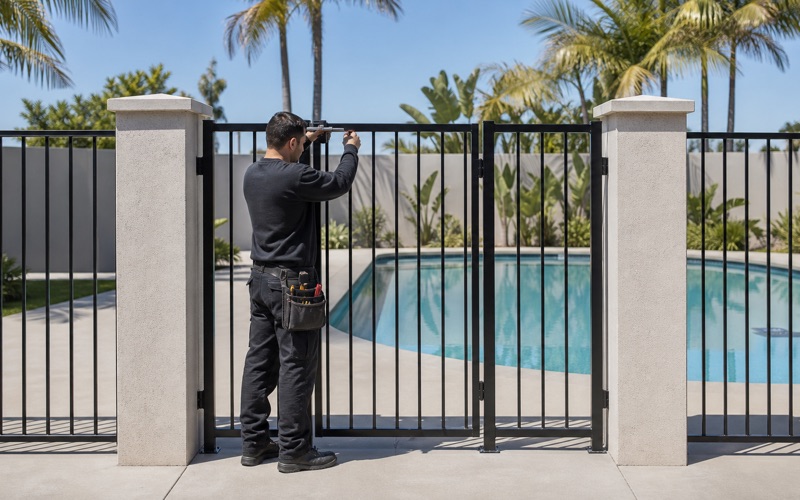
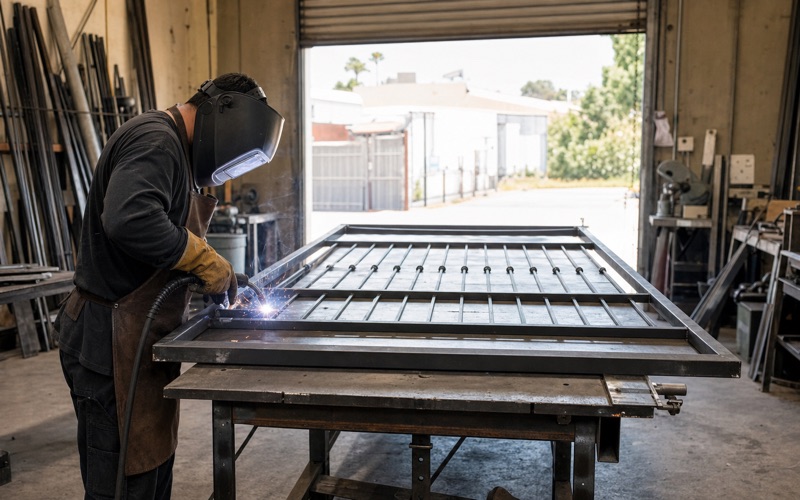
Horses change what a gate has to be, which is why Paramount Metal Gates builds metal gates in Los Alamitos for stables, paddocks and trailer access as well as for ordinary driveways. The equestrian work here differs from the residential work enough and the equestrian work here is different enough from the residential work that treating them the same is how somebody’s animal gets hurt.
Los Alamitos has kept a working equestrian character that most of the surrounding cities lost, and the gates that go with it are their own discipline. Hardware that is entirely sensible on a house frontage becomes a hazard around livestock: protruding latches at chest height, sharp finials, gaps that catch a hoof or a halter, and drop rods left standing proud have all caused injuries that better detailing would have prevented.
The rest of the work is what you would expect of a small settled city: driveway gates, side access, security doors and repair. What stays constant is that trailers move through here regularly, and openings have to accommodate them.
Equestrian Gates
Hardware That Is Safe Around Animals
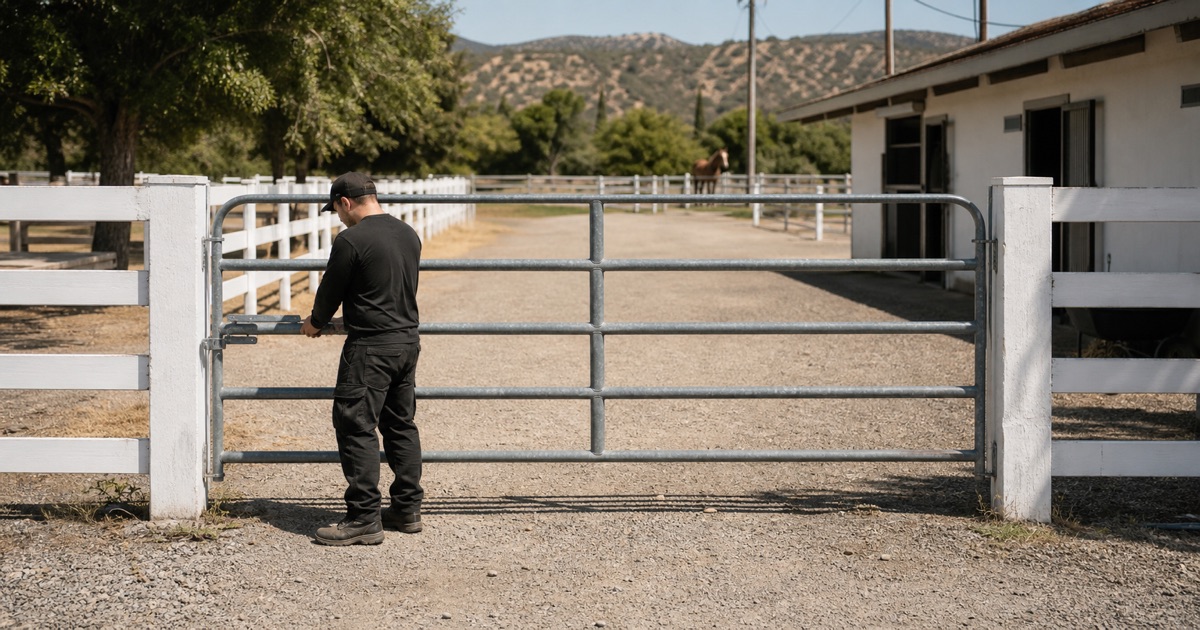
Everything a horse can reach has to be smooth, flush and free of anything that projects. We specify recessed or shrouded latches, avoid finials and spear tops anywhere an animal moves, and grind and dress welds rather than leaving a proud bead at rubbing height. A horse leaning on a gate is not an accident; it is what horses do, so the gate is detailed on the assumption that it will happen daily.
Gaps, Bars and Spacing
Spacing is the detail that causes the worst injuries. A gap wide enough for a hoof to enter and narrow enough to trap it is genuinely dangerous, and the same applies to anywhere a halter or a rug strap can hook. We set bar spacing deliberately against what the gate encloses rather than to a standard picket pitch, and close off the corners and junctions where a leg can wedge.
Latches You Can Work From Horseback
A gate somebody has to dismount to open is a gate that ends up propped open, which defeats the point of having it. Where a rider genuinely needs to work a latch from the saddle, we specify hardware that can be operated one-handed at that height and that will not swing back into the horse. It is a small specification choice that decides whether the gate is used as intended.
Paddock, Stall and Arena Gates
Each of those does a different job. A paddock gate takes leaning and weather and wants a galvanized finish chosen for durability rather than looks, while a stall gate is handled constantly and needs smooth action and quiet hardware. An arena gate has to open wide, latch positively and present nothing a rider passing at speed could catch. We build each to its own requirement rather than scaling one design across all three.
Looking for metal gates closer to Whittier? See Whittier Metal Gates.
Trailer and Vehicle Access
Wide Openings for Trailers
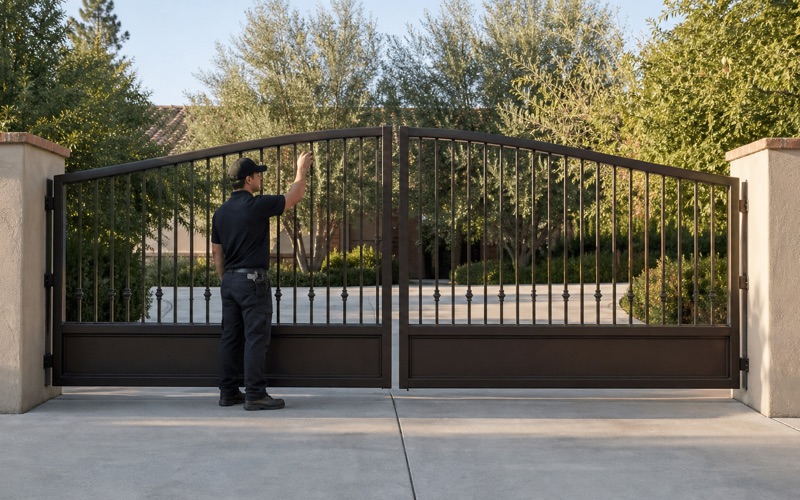
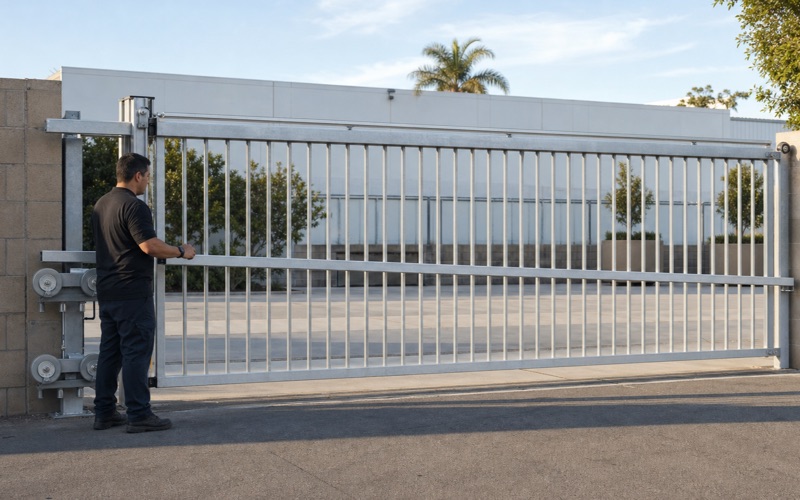
A gate that has to admit a horse trailer, a truck and trailer combination or a hay delivery is a structural problem before it is anything else, because span and leverage rise together. Beyond a certain width a single leaf concentrates enormous load at its hinge and drops out of square within a season. We split wide openings into double leaves or specify a slide where the run allows, and size the frame against finished weight.
Turning Room and Where the Gate Sits
An opening wide enough for a trailer is useless if the gate blocks the only space the trailer needs to turn into. We look at how vehicles actually maneuver on the property before deciding which way a leaf swings and where the operator sits, since a gate that clears the ground perfectly and takes away the turning circle has solved the wrong problem entirely.
Surfaces That Are Not Paved
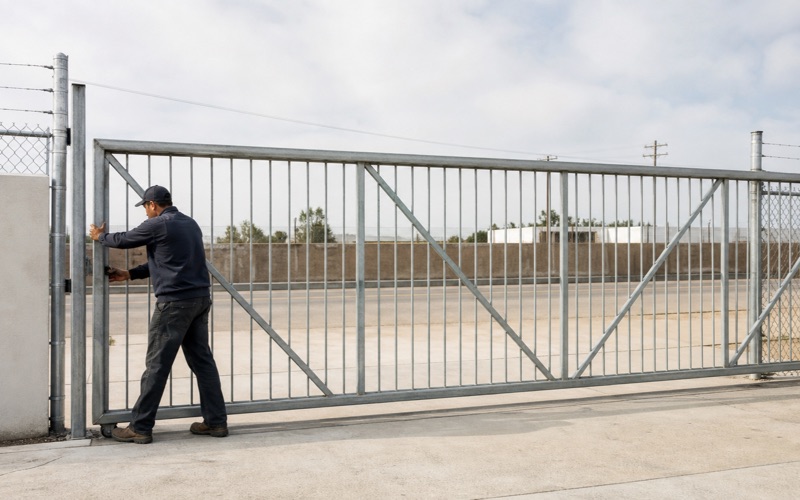
Equestrian properties frequently have gravel, decomposed granite or dirt where a residential property would have concrete, and that rules out most ground-track sliding arrangements immediately. A cantilever crosses with nothing on the ground, and a well-hung swing pair copes provided ground clearance accounts for a surface that moves and settles rather than staying flat.
Gates That Take Knocks
On a working property gates get hit: by a trailer swinging wide, by a tractor, by an animal. We build frames that take a knock without racking and repair damage by cutting out and rebuilding the affected section rather than replacing a whole leaf, which on a wide gate is the difference between a morning’s work and a long wait for a replacement.
Residential and Everyday Work
Driveway Gates on Suburban Streets
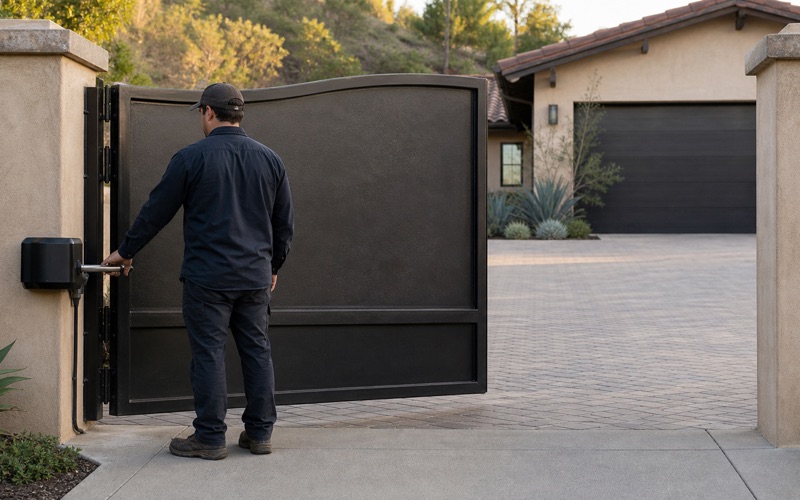
Away from the equestrian ground, Los Alamitos is a settled suburban city with ordinary frontages. The work there is ordinary too: establishing what the driveway can take, choosing between a swing and a slide on geometry rather than preference, and sizing posts and footings so the gate stays true rather than dropping after a few years.
Side, Rear and Pedestrian Gates
Side access matters on properties that store a trailer, a boat or a work vehicle, and the recurring failure is a standard gate widened without reinforcement. We build wider leaves on heavier frames with real diagonal bracing and drop rods into ground sockets. Pedestrian gates take the most cycles of any opening and get closers sized to the actual leaf rather than fitted generically.
Security and Repair
Ornamental security doors and window guards make up part of the residential work, fabricated to the opening and anchored into structure rather than render. On repair, the useful question is which part has actually failed: a perforated bottom rail on a sound frame is a cut-and-weld job, while a frame that has racked past latching is a gate nearing the end of what repair can sensibly achieve.
Automation for Long Approaches
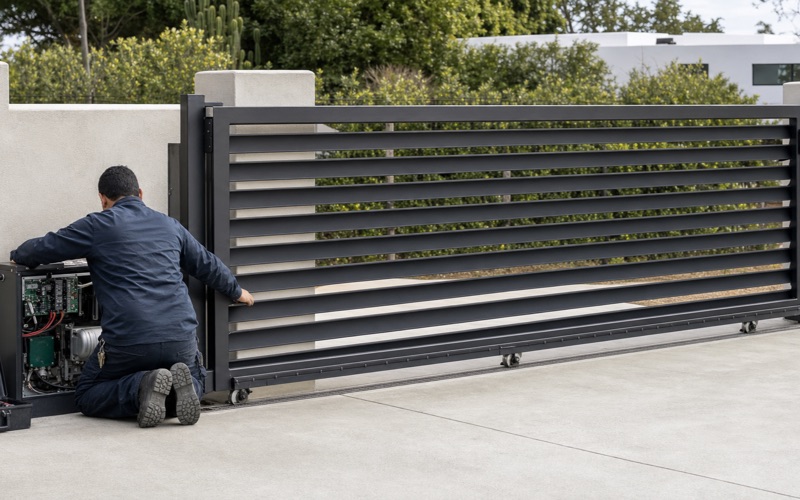
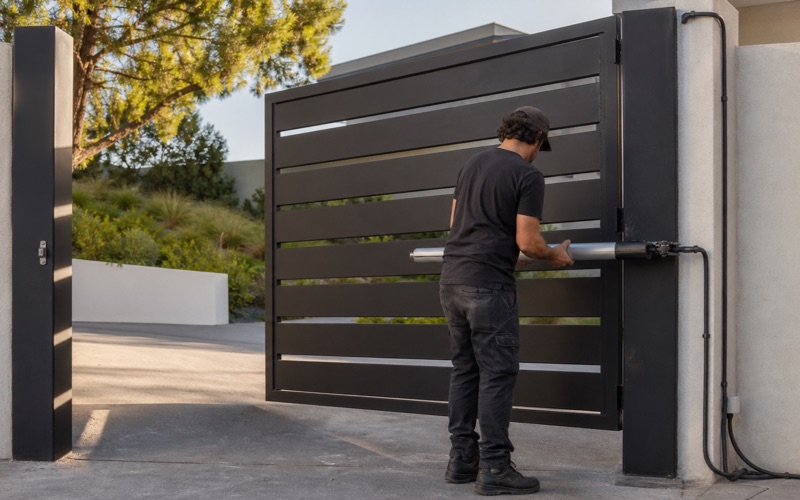
Where a gate sits well away from the house and further still from a power supply, trenching a supply across a working property is disruptive and expensive. A solar operator with battery backup removes the excavation entirely, sized against real winter daylight rather than a summer average, since an undersized array works for six months and then leaves somebody standing at the gate on an overcast afternoon.
Materials and Finish
Galvanized Steel for Working Gates
Around animals and vehicles, what a gate survives matters more than how it photographs. Hot-dip galvanized frames tolerate weather, manure, dust and constant knocks far better than a painted finish, and where a coating is damaged the surrounding zinc keeps protecting the steel rather than letting corrosion creep beneath the film. It is our default on anything equestrian.
Aluminum Where Weight Is a Problem
On very wide openings, or where existing posts cannot easily be upgraded, aluminum spans further for a fraction of the weight and will not corrode from the inside out. That reduces load on hinges, posts and operator alike. It marks more readily than steel, so we specify heavier wall sections wherever vehicles or animals make contact likely.
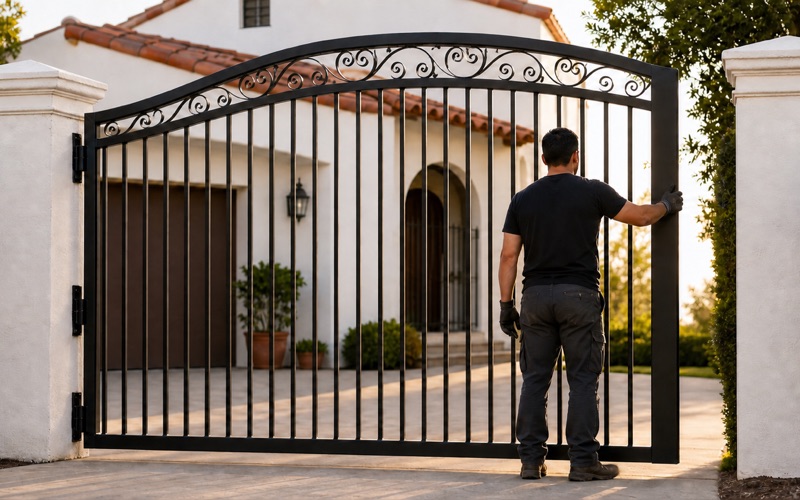
Ornamental Iron Where Appearance Leads
On a property that keeps animals but also fronts a suburban street, the entrance gate and the working gates behind it want different treatments, and running one specification across both serves neither. The front gate can carry ornament and a finish chosen for appearance. Everything past it is a working gate and should be detailed as one, which is a distinction owners are usually glad to have drawn for them.
Coastal Air This Far Inland
Los Alamitos sits close enough to the coast for salt-laden air to reach welds and fixings, which compounds the wear a working gate already takes. Every weld gets zinc-rich primer before any topcoat, because a coating applied straight onto a bare weld is only a slower path to the same corrosion.
Los Alamitos and Its Ground
Founded on the Sugar-Beet Factory
The town was established in 1896 by Lewellyn Bixby to support a new sugar-beet factory built by the Clark brothers, and the crop sustained the area until economics, the removal of a protective tariff and a 1921 insect infestation ended the industry across Orange County. The city incorporated in March 1960, long after that agricultural beginning had shaped how the land was held.
Land That Stayed Open
Because much of the surrounding ground was never subdivided into small house lots, parcels here remained large enough to keep animals when the equestrian character took hold. That is the direct reason a gate contractor in this city needs a horse-safe vocabulary that would be entirely unnecessary a few miles away.
A Small City With Two Kinds of Work
The practical effect is that we are frequently on a paddock gate and a suburban driveway in the same day, minutes apart. Those are genuinely different engineering problems sharing a name, and specifying one as though it were the other is how a gate ends up unsafe on one property and over-built on the next.
The Training Base and Its Neighbors
The Joint Forces Training Base occupies a substantial part of the city, and properties adjoining it deal with aircraft movement, controlled ground and boundaries that are not negotiable in the way a neighbor’s fence line is. Where a gate ties into or runs alongside that kind of boundary, we establish what may and may not be fixed to what before fabricating, rather than treating it as an ordinary property line.
Race Ground and Horse Traffic
The presence of a working race course and the horse traffic around it means animals move along routes that ordinary suburban streets never see, and a gate opening onto or near one of those routes has to account for it. A leaf that swings out across a path used by a led horse is a hazard regardless of how well it is built, which is a siting decision rather than a hardware one.
- Licensed & Insured
- Free On-Site Measure
- Fixed-Price Quotes