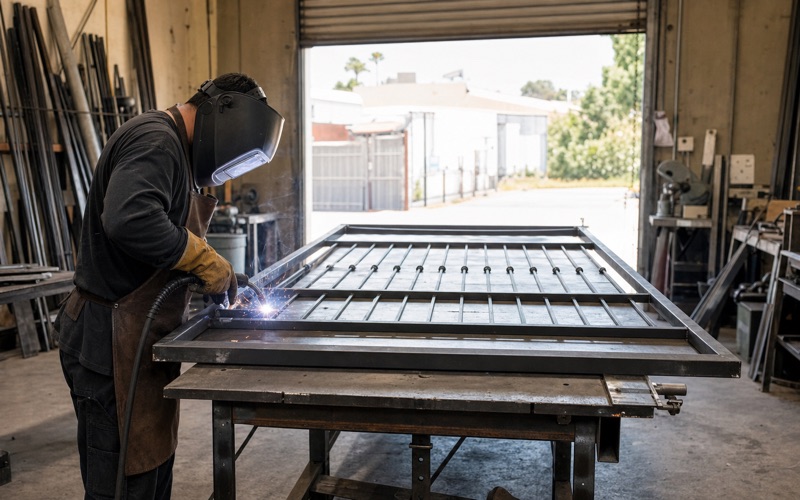
Paramount Metal Gates builds and repairs metal gates in Lakewood, covering driveway gates, entry and courtyard gates, side-yard and RV gates, security doors and the operators and access control that run them. Gates are fabricated to measured openings in our own shop, and on Lakewood’s streets that measurement is unusually predictable, which changes what is possible in a way worth explaining.
Lakewood was built as one of the largest planned developments in the country, laid out between 1949 and 1953, and its residential streets were designed as a system rather than assembled lot by lot over decades. The frontages, the setbacks and the driveway widths all repeat. Where most cities present a different geometry at every address, here a configuration that works well on one property will very often work on the one next door.
That has two practical consequences. Design decisions transfer, so a gate style proven on a similar frontage can be shown to work rather than imagined. And where several neighbors want gates, they can be built to match without any of them compromising on fit, because the openings genuinely are comparable.
Driveway Gates on a Planned Street Grid
Consistent Frontages and What They Allow
Because the tract was laid out to a small number of house plans, the relationship between the sidewalk, the driveway and the garage repeats along most streets. That means the swing-versus-slide decision usually resolves the same way for the same house type, and we can be confident about arc clearance before a design is drawn. We still measure every property, since driveways have been widened and garages converted over seventy years, but the starting point is far more certain than in a city that grew piecemeal.
Boulevards, Medians and Frontage Roads
Lakewood’s main thoroughfares are mostly boulevards with landscaped medians and frontage roads running alongside them in the residential districts. Properties addressed on a frontage road have a different approach geometry from those on an interior street: a shorter run from the roadway, and traffic passing closer to the gate. On those we pay particular attention to where a vehicle waits while the gate opens, because a gate that requires a driver to stop in a live traffic lane is a poor gate regardless of how well it is built.
Matching Gates Along a Street
Where several properties on a street install gates, the result reads far better when the designs relate to each other rather than competing. We can build variations on a single pattern, keeping proportion and finish consistent while altering detail per property, so each gate belongs to its own house and to the street at the same time. This is only realistic because the openings are genuinely similar, and it is one of the few places where a planned tract is an advantage rather than a constraint.
Looking for metal gates closer to Bell Gardens? See Metal Gates in Bell Gardens.
Style and Material Choices
Horizontal Slat and Modern Gates
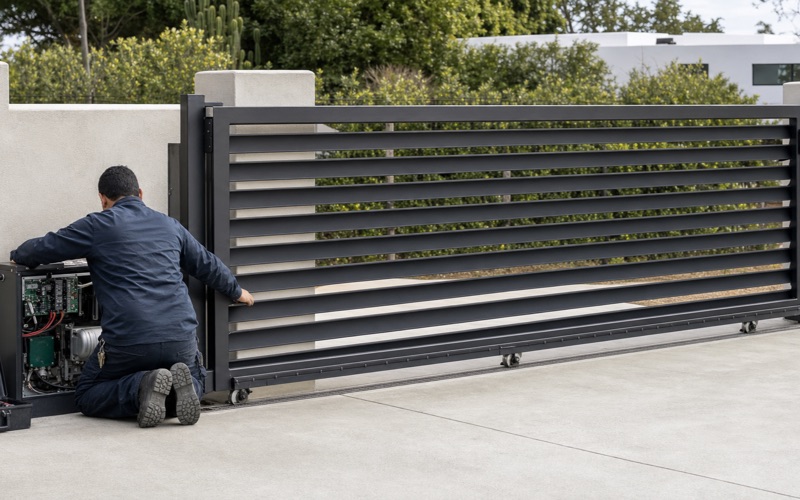
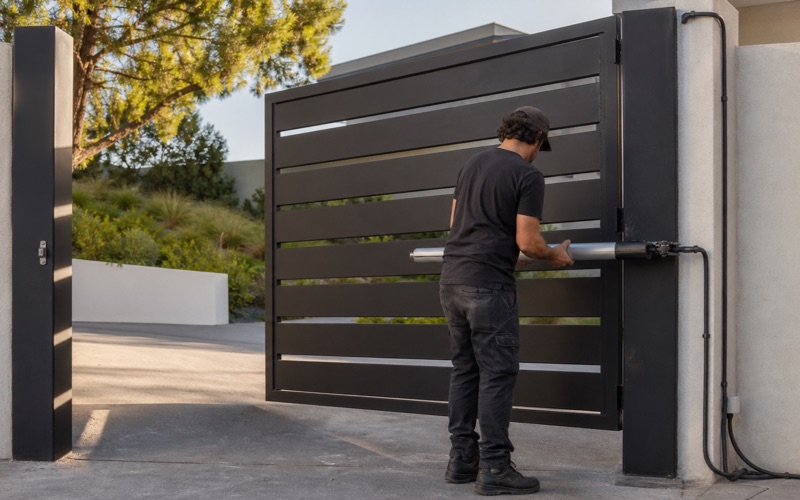
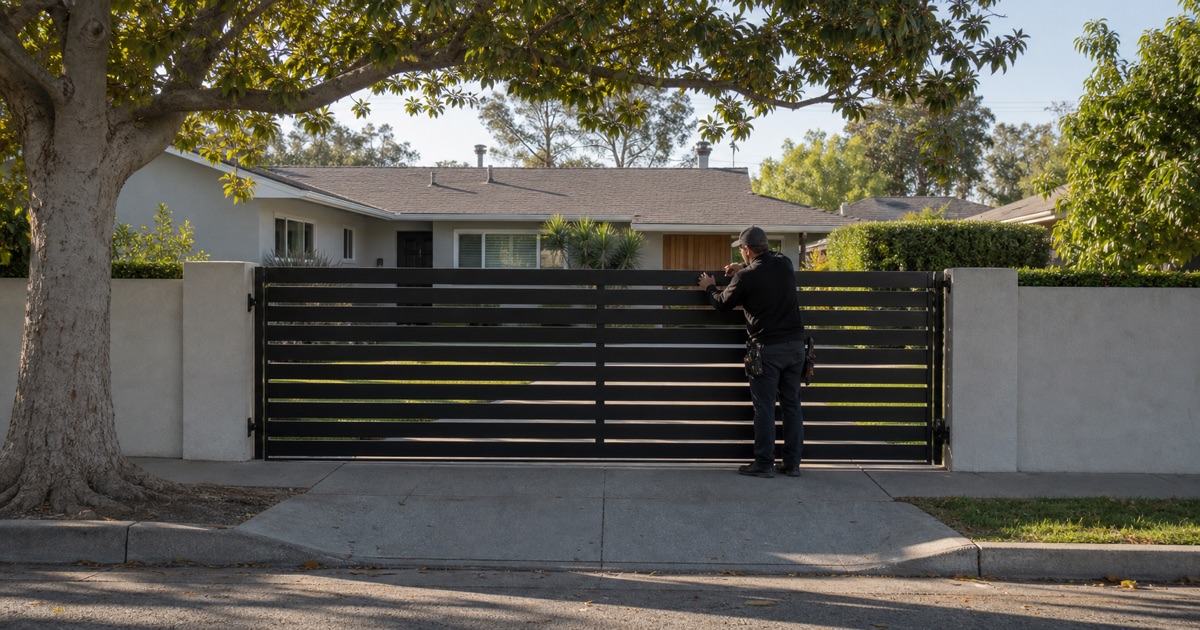
The low, wide postwar elevations here suit horizontal emphasis, which is why slat gates in matte black, bronze or a wood-look powder coat sit so well on these houses. Slat spacing is the decision that matters: tight spacing gives privacy and screening but catches wind and increases the load the operator has to overcome, while wider spacing gives a lighter face and easier travel. We set it against what the property actually needs rather than copying a spacing from a photograph.
Ornamental Iron on Updated Elevations
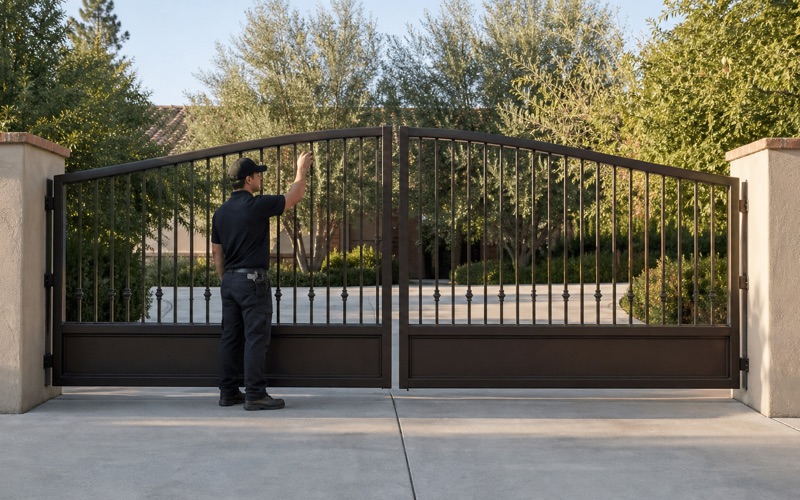
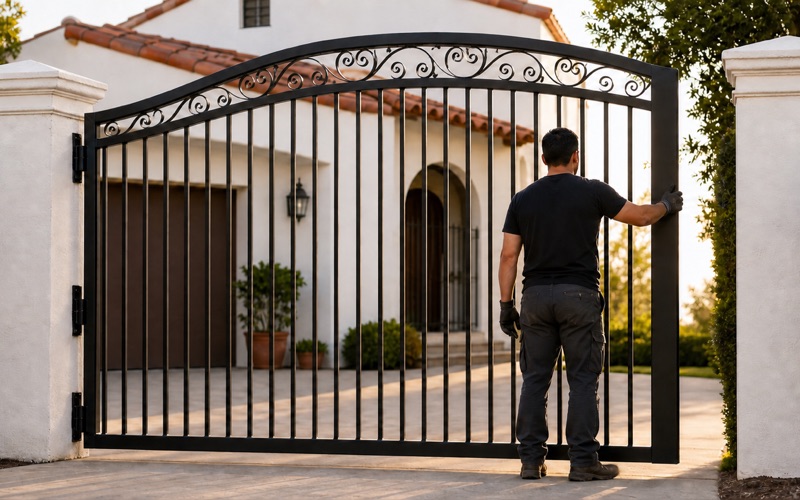
Where a house has been substantially remodeled toward a Spanish or Mediterranean elevation, which is common across the tract, ornamental iron with arched tops, scrollwork and iron strapping suits it far better than the original scheme would have. We draw the pattern to the measured opening so repeats land symmetrically, and size the frame to the finished weight, since iron is the heaviest common material and that weight sets the hinge, post and footing specification.
Aluminum for Wide Openings
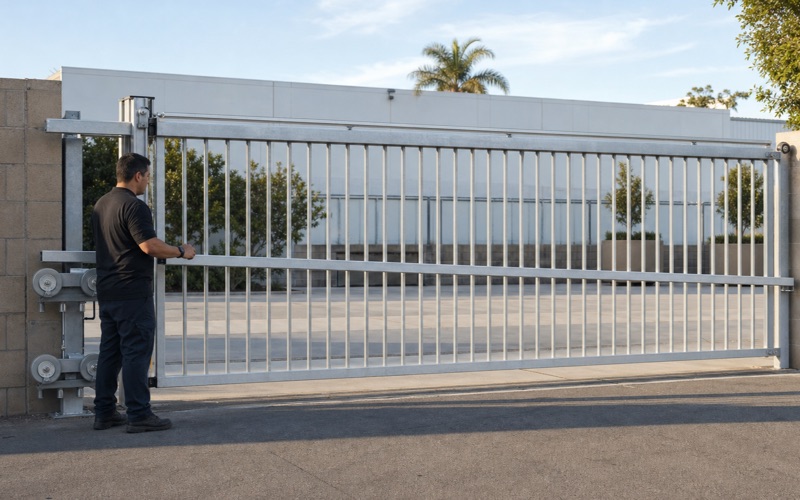
Where a driveway has been widened, or where a double garage frontage means a long span, aluminum extrusion carries further for a fraction of the weight and will never corrode from the inside out. That reduces load on hinges, posts and the operator, which matters when the existing posts are being reused. It costs more per foot and dents more readily than steel, so we specify heavier wall sections where vehicles maneuver close to the leaf.
Automation, Safety and Service
Operators for Residential Cycling
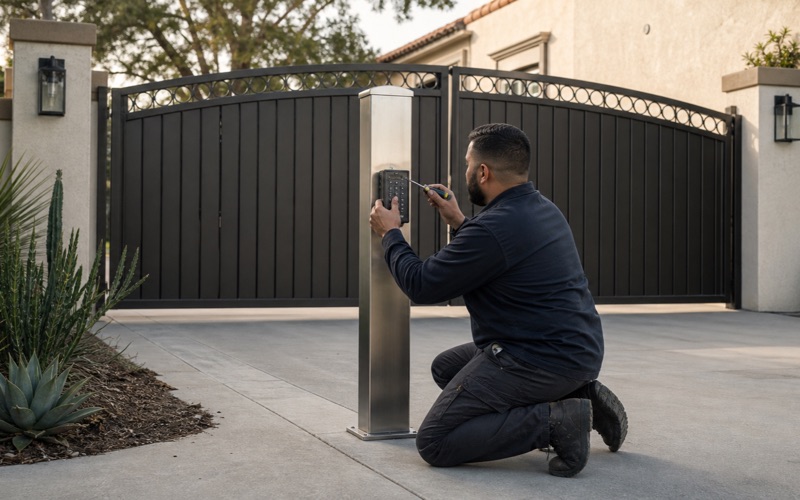
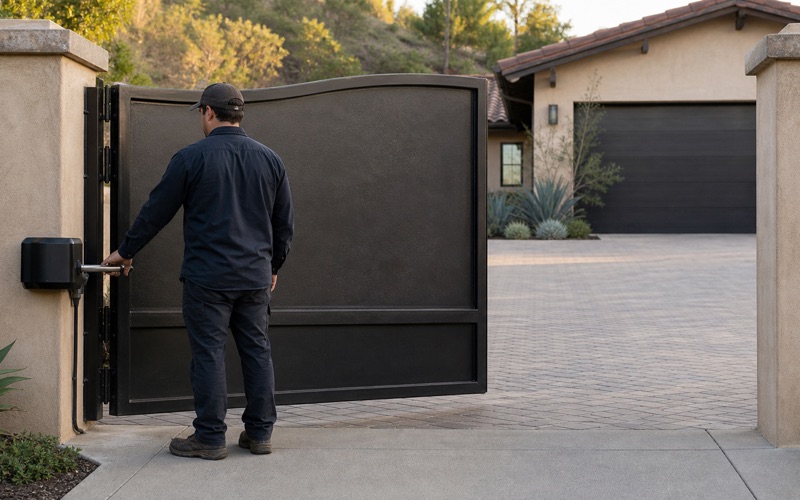
A residential gate cycles a handful of times a day, but it does so for years, and an operator running at the top of its rating on every open will not last. We size against the real weight and length of the leaf with genuine headroom above it, and fit units we stock and service so a fault does not turn into a parts order. Battery backup is specified as standard, because the most common apparent failure is simply a power cut nobody has accounted for.
Sightlines Where Driveways Sit Close Together
On a street where driveways repeat every few dozen feet, a gate opening across the sidewalk is doing so where children walk and cyclists pass, often with a parked car limiting what a driver can see. We set travel speed and warning devices with that in mind, position photo eyes to cover the footway rather than only the driveway, and where the frontage road pattern brings traffic close, we discuss whether the gate should open inward at all rather than sweeping any part of the public way.
Repairs on Ageing Installations
Many gates here are now on their second or third decade, and the failures are predictable: hinges worn until the leaf drops and catches the driveway, bottom rails corroded through where water sits, operators long past their rating, and sensing that has quietly stopped working. We re-hang on properly sized hinges, cut out and replace failed steel rather than painting over it, and restore sensing to a state where a failed device stops the gate instead of being ignored.
Lakewood’s Origins and Street Character
A City Planned All at Once
The development begun in late 1949 and completed in 1953 is credited with altering the map of Southern California, and the community grew past seventy thousand residents while still unincorporated before its municipal needs forced the question of cityhood. That history explains the uniformity: houses, streets and services were laid out together to a plan rather than accumulating over generations, which is exactly why gate work here is so repeatable once the pattern is understood.
Seventy Years of Individual Changes
The counterweight to that uniformity is everything owners have done since. Driveways have been widened, garages converted, front walls added and elevations remodeled, so the original plan is a reliable starting point rather than a substitute for measuring. We measure every opening on its own terms and treat the tract pattern as useful context, because the gate has to fit the property as it stands today rather than as it was drawn in 1950.
Side-Yard, Pedestrian and RV Gates
Boats, Trailers and Motorhomes
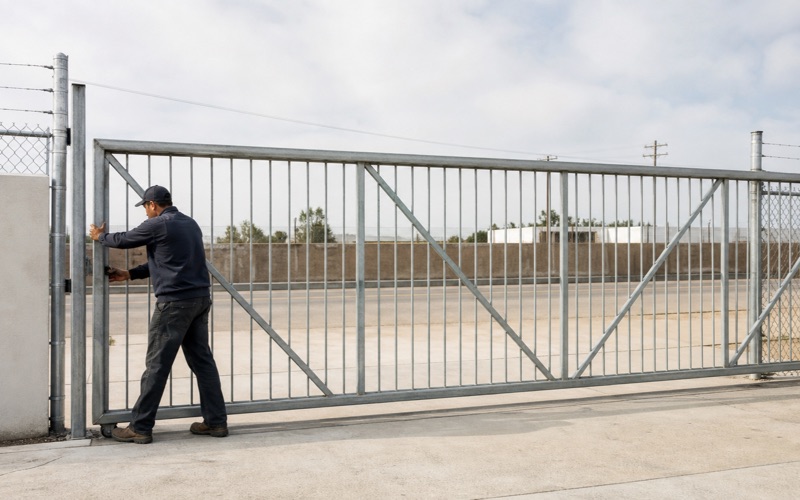
The deep rear lots typical of the tract make the side-yard gate genuinely useful, and it is where most oversized vehicles end up stored. Clear width and clear height matter, but so does what holds the leaf straight across a long unsupported span. We build wider gates on heavier frames with real diagonal bracing and drop rods into ground sockets, because a standard side gate simply widened without reinforcement drops out of square within a season and then fouls the driveway.
Pedestrian Gates and Self-Closing Hardware
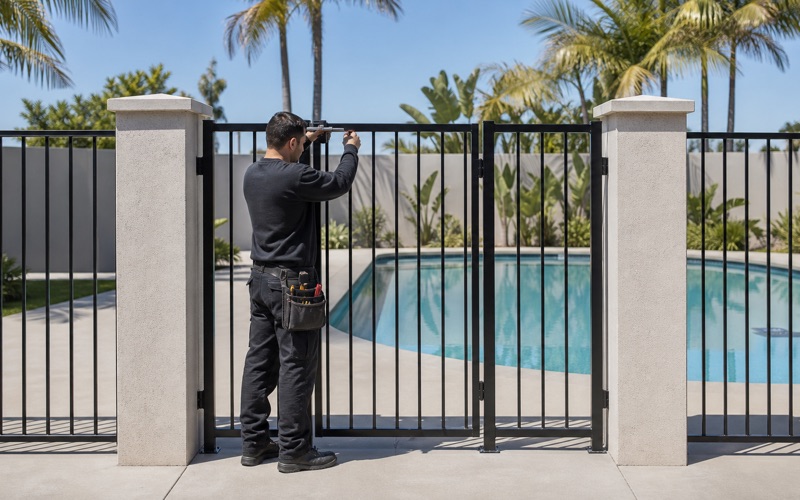
A pedestrian gate beside the driveway is usually the one that gets used every day, so it takes more cycles than the vehicle gate does and wears faster. Where a gate must not be left standing open, whether for a pool barrier, a dog or simple security, self-closing hinges are sized to the actual leaf weight rather than fitted generically. A closer specified for a light gate and hung on a heavy one moves the leaf most of the way and leaves it resting against a latch that never catches.
Matching the Rear Gate to the Front
Where a property has a driveway gate at the front and a side or rear gate behind it, the two want to read as one installation rather than as separate purchases made years apart. We work from a single pattern and finish specification across both, scaling detail rather than repeating it at the same size, since a design drawn for a wide leaf becomes crowded when compressed into a narrow one.
Posts, Footings and Long-Term Fit
Assessing Existing Posts
On a seventy-year-old tract, many properties already have posts, pilasters or a front wall, and whether those can carry a new gate is the first question rather than an afterthought. We check for rotation at grade, corrosion at the base, and whether the footing suits the weight now being hung, because a post that has moved a degree at ground level presents as several inches of drop at the latch. Replacing a marginal post during the same visit is far cheaper than returning to it afterward.
Footings Sized to the Gate
Where a post is being set, the footing is what determines whether the gate stays true for decades or begins dropping within a year. We size depth and diameter against the finished leaf weight and the ground it is going into rather than to a standard hole, and allow proper cure time before any leaf is hung. Hanging a heavy gate on green concrete is a shortcut that shows up as sag long after anybody remembers taking it.
- Licensed & Insured
- Free On-Site Measure
- Fixed-Price Quotes