Distance is what makes metal gates in La Cañada Flintridge different from the work a few miles down the hill. On many properties here the entrance sits at the foot of a drive that climbs and turns before it reaches anything, and every decision follows from that separation: how power gets there, how somebody at the gate is identified, what happens when the drive is icy or the power is out, and how a vehicle waits while the leaf opens.
Paramount Metal Gates builds estate entrances, secondary and service gates, courtyard and pedestrian gates and the automation and access that run them across the city. The gates themselves are frequently substantial, but the hard engineering is usually in the approach rather than the leaf.
The city was formed in 1976 from two distinct communities, and the character still differs noticeably across it. That is worth registering before proposing a design that suits one part and sits awkwardly in the other.
Long Drives and Distance
Getting Power to the Gate
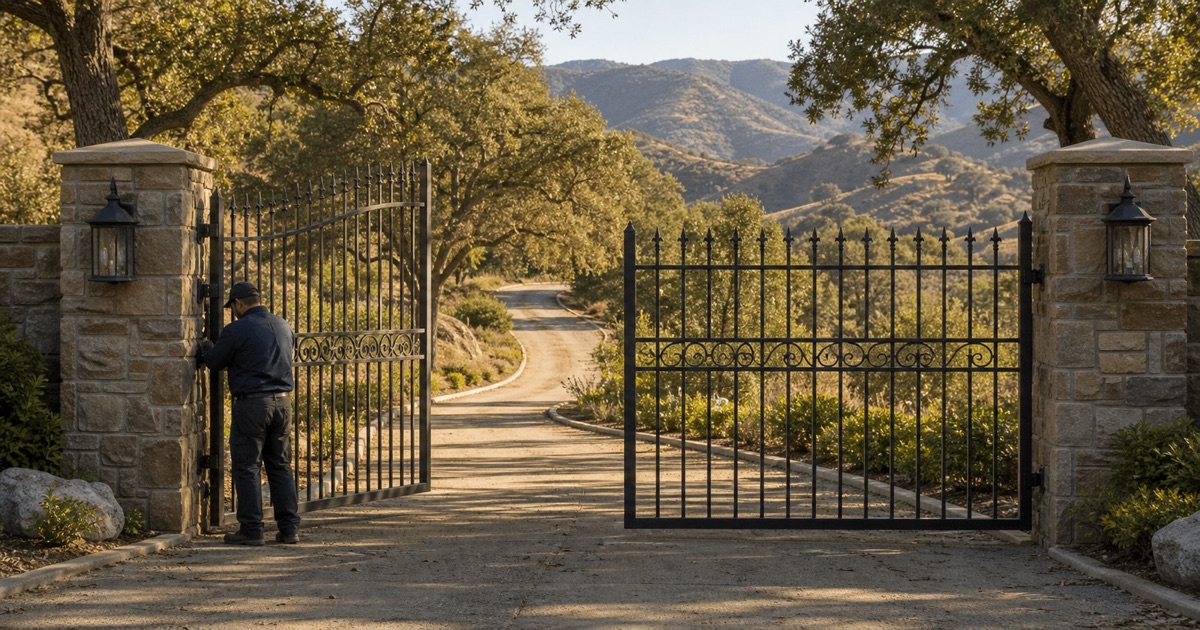
Where the entrance is a long way from the house, trenching a supply down a drive means excavation through mature planting, hard landscaping and sometimes a retaining structure. A solar operator with battery backup removes that entirely. Panel and battery have to be sized against real winter daylight under whatever tree cover is actually there, since a canopy that is pleasant in August is the reason an undersized array fails in January.
Knowing Who Is at the Gate
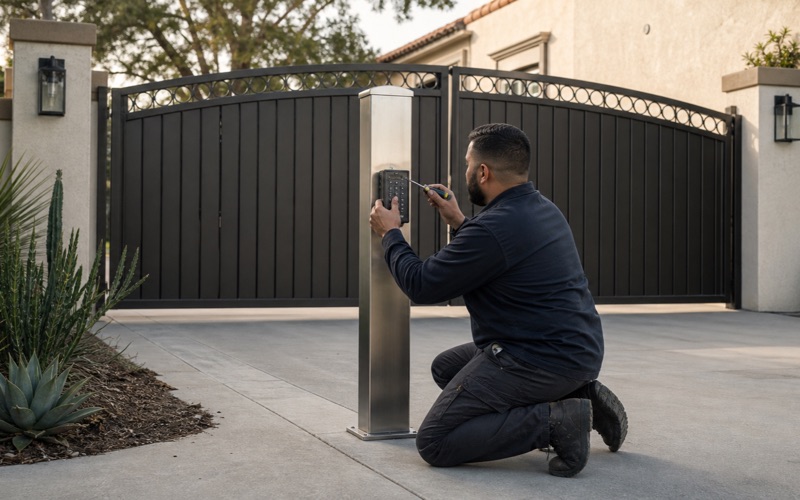
At distance, the household cannot see the entrance, so identification has to be carried rather than observed. Video entry, cellular controllers and app-based access all solve it in different ways and at different ongoing costs. What matters is choosing on how the household actually lives — how often deliveries come, whether staff or contractors attend regularly — rather than on the feature list.
Where a Vehicle Waits
A gate set back from the road gives room for a car to pull clear while it opens; a gate close to the roadway does not, and on a road with any speed that is a genuine hazard rather than an inconvenience. We look at where a vehicle can actually stand, and where the answer is nowhere safe, we would rather propose opening on approach than fit a keypad that obliges somebody to stop in a traffic lane.
Secondary and Service Entrances
Larger properties frequently have more than one way in: a main entrance, a service or staff gate, sometimes a rear access onto a different street. Those want to be considered together, because access issued at one and not withdrawn at another is how a property ends up less secure than the owner believes. We map what exists before adding to it.
Looking for metal gates closer to Bellflower? See Metal Gates in Bellflower.
Grade and Ground
Driveways That Climb
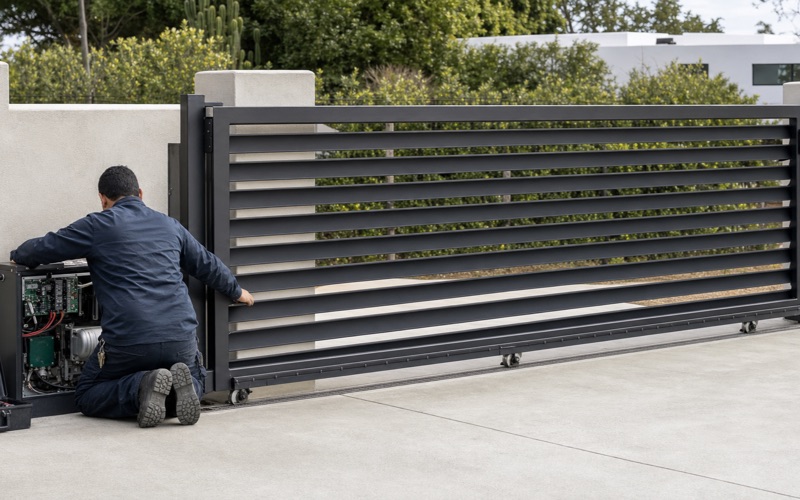
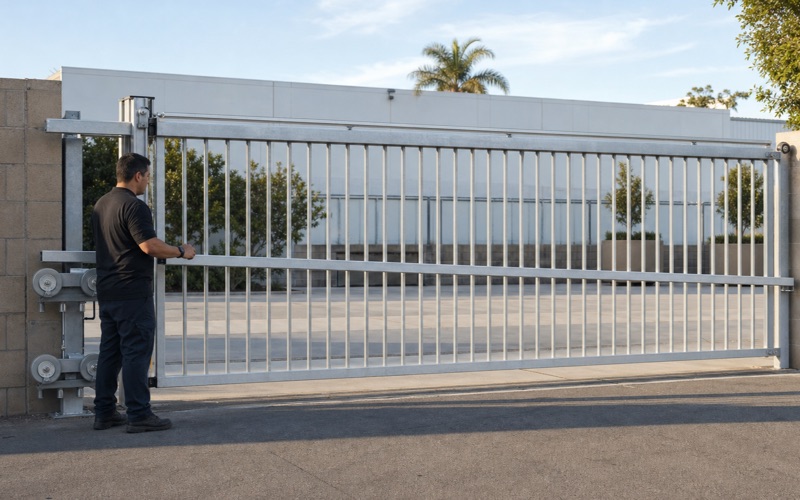
A drive rising from the roadway will catch a swinging leaf partway through its arc, and raising the gate to clear the rise leaves a gap beneath that undoes the point of it. Where the fall is real, a leaf that travels sideways is the honest answer. On the steeper approaches here that is less a preference than the only configuration that works properly.
Turning, Camber and Long Vehicles
Estate drives frequently turn immediately after the entrance, sometimes tightly, and a delivery vehicle or a moving truck needs more room to make that turn than a car does. The width of the opening is only half of it; the geometry beyond it decides what can actually get through. We look at the first fifty feet inside the gate as carefully as the gate itself.
Retaining Walls and Cut Slopes
Properties here are full of retaining structures built at different periods to hold back cut and fill, and their capacity to take a sideways gate load is rarely documented. We establish what a wall actually is and how it is founded before anchoring to it, because a gate quietly levering a retaining structure out of true creates a problem of an entirely different order.
Drainage Down a Drive
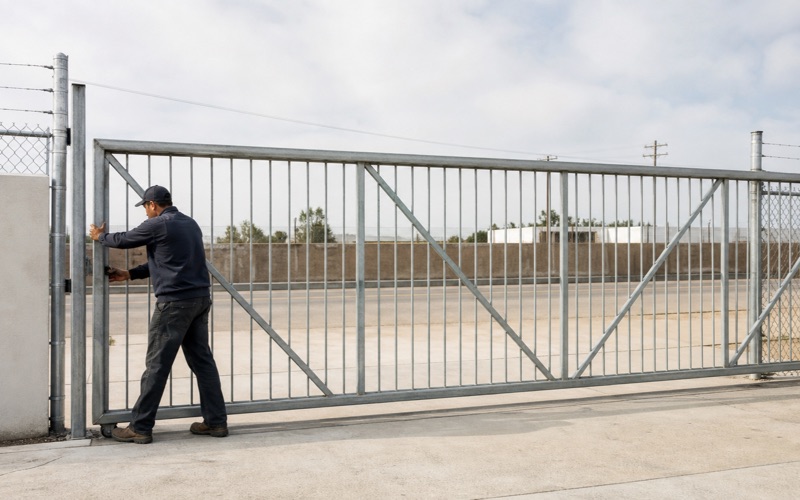
Water arrives concentrated here and runs the length of a drive picking up grit. A gate at the bottom stands in that flow, and any ground track will silt up. Where that is the situation a cantilever crossing with nothing on the ground removes the maintenance burden rather than transferring it to an owner who will not be clearing a track in the rain.
Estate Entrances
Scale and the Approach
An entrance seen from a distance down a straight approach reads differently from one encountered at a turn, and the design should account for how it is actually arrived at. A pattern that resolves beautifully at three feet can disappear at forty, while one drawn for distance can feel coarse close up. We ask how people arrive before drawing anything.
Pillars, Walls and What the Gate Belongs To
Most substantial entrances here have masonry pillars or a wall the gate sits within, and the gate is one element of that composition rather than the whole of it. Proportion between leaf and pillar matters more than the detailing on either, and where the masonry is being built at the same time we would rather coordinate than be handed an opening and asked to fill it.
Style Across Two Communities
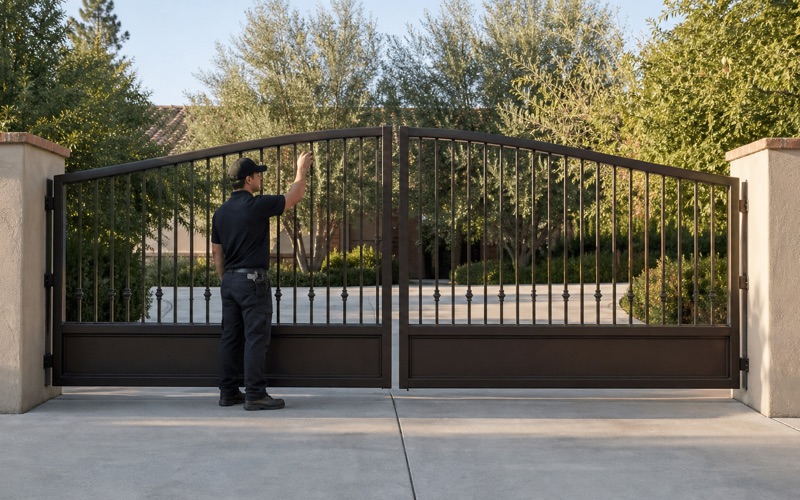
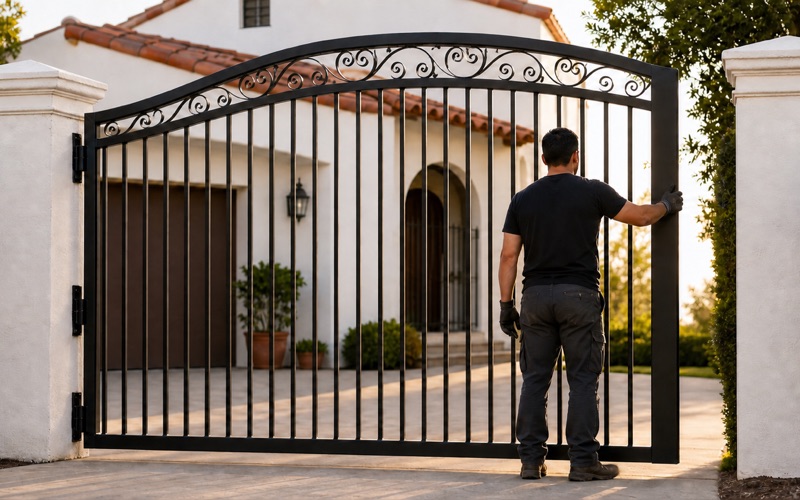
The housing runs from Mediterranean and Spanish through Ranch to substantial contemporary building, and the right vocabulary differs accordingly. Arched tops, iron strapping and clavos suit the first; low horizontal emphasis suits the second; clean section and restraint suit the third. Working from the elevation rather than a preferred house style is what keeps an entrance from looking imported.
Pedestrian and Courtyard Gates
Alongside the main entrance most properties want a pedestrian gate, and sometimes a courtyard or garden gate further in. Those are handled at close range and daily, so latch action and finish quality matter more on them than on the vehicle gate. We scale the pattern rather than reproducing it at full size, since detail drawn for a wide leaf crowds a narrow one.
Working on Large Properties
Coordinating With Other Trades
Gate work on an estate frequently runs alongside landscaping, masonry, electrical and irrigation, and the gate is usually the item that depends on all of them. We would rather agree the sequence early than arrive to find a footing position now occupied by an irrigation main or a wall built to a height that no longer suits the leaf.
Keeping the Property Accessible
Where the gate being replaced is the only vehicle access, the household still has to come and go. We prepare and finish off site so the disruptive phase is short, keep the opening usable, and set out clearly which periods access will be restricted rather than leaving people to discover it.
Discretion and Household Routine
Work on a private property means being around a household rather than on a site, and that is a different discipline: keeping to agreed hours, leaving the approach clean at the end of each day, and not treating a drive as a materials yard. It is ordinary courtesy and it is also most of what decides whether a client recommends a contractor.
Long-Term Service
At distance from the house, small faults go unnoticed until they become large ones: a backup battery aging, a solar array losing output under a growing canopy, a photo eye drifting, a release stiffening. Those are cheap to catch on a planned visit and expensive to meet at the moment the gate stops with a car behind it.
The City and Its Two Halves
Formed From Two Communities
Before incorporation on 30 November 1976, the area consisted of the two distinct communities of La Cañada and Flintridge, which were merged into a single city under the combined name. That history is still legible in how the two parts of the city feel, and a design conversation that assumes a single character across all of it tends to miss.
Older Routes Through the Valley
Local villages including Tejungna, now Tujunga to the west, and Hahamongna, now a watershed park to the east, were connected by a network of trails that passed through what is now the city. The valley has been a route between places for a very long time, and the roads that resulted are why some properties sit on through-routes with real traffic while others sit on quiet dead ends.
Why the Approach Matters More Than the Gate
The practical summary is that on most properties here the gate itself is the straightforward part. Getting power to it, identifying who is standing at it, giving a vehicle somewhere to wait and making sure a long drive works for a delivery truck are the questions that actually decide whether an installation is a success.
Emergency Access on a Private Drive
A long private approach still has to be reachable by emergency services, and on a drive that climbs and turns, the constraint is frequently the route rather than the gate. We check that the arrangement the local authority requires is actually fitted and working, and that the approach behind it has kept the width it had when the house was built, since mature planting narrows a drive by degrees over years.
Snow, Ice and the Occasional Bad Day
The higher ground here sees conditions the basin does not, and a steep drive that is entirely straightforward for most of the year behaves differently on the few days it is not. A gate that opens slowly, or one that needs a vehicle to stop on the steepest part of the approach while it does, is a nuisance for most of the year and a genuine problem on those days.
- Licensed & Insured
- Free On-Site Measure
- Fixed-Price Quotes