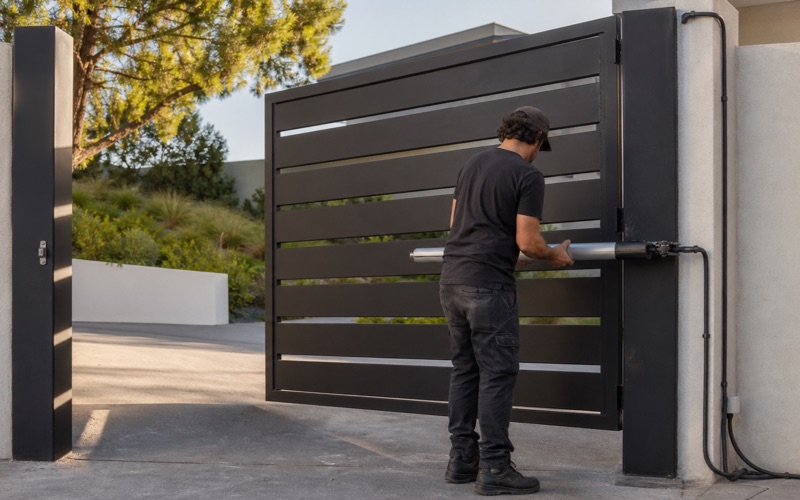
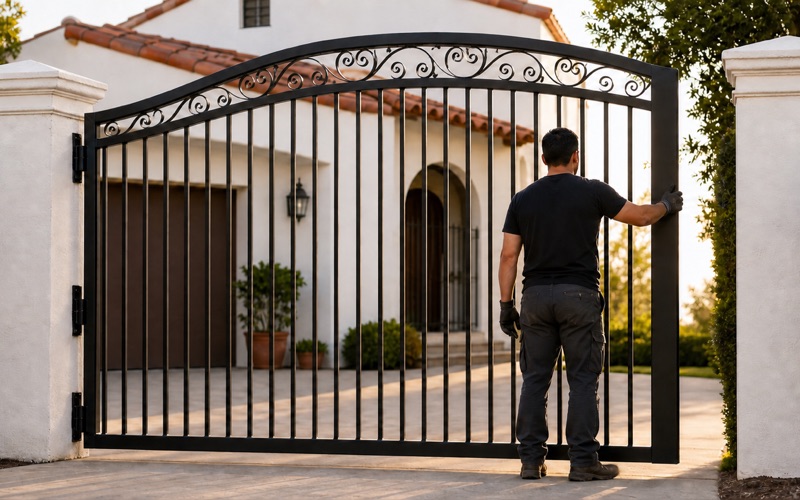
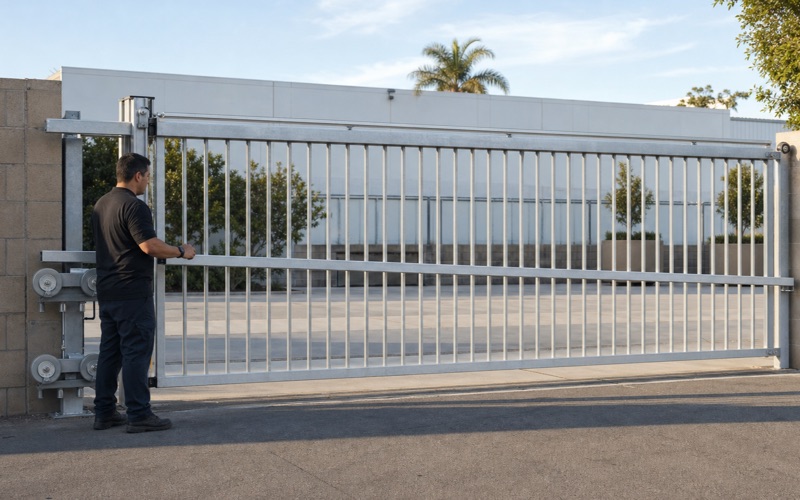
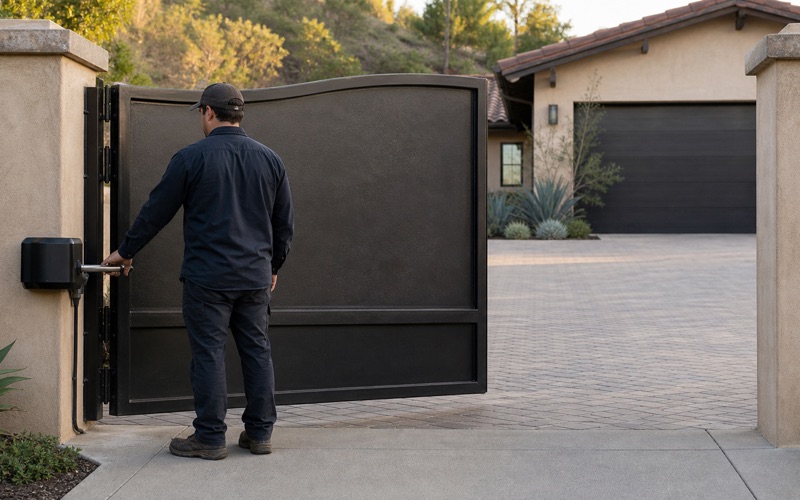
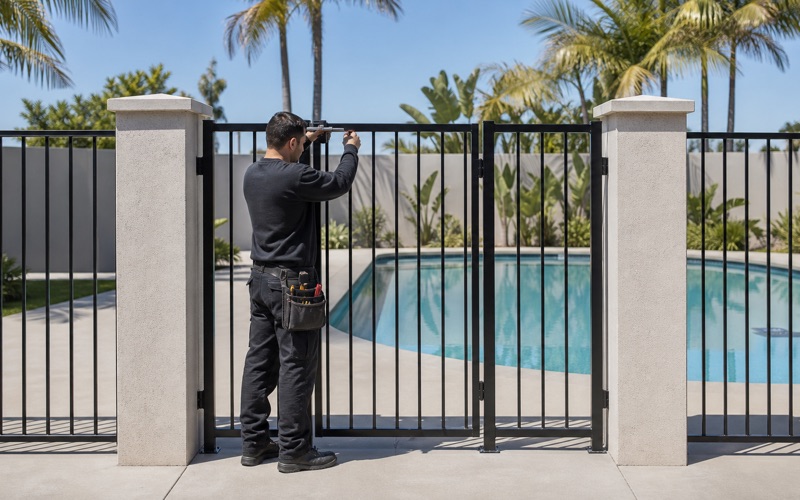
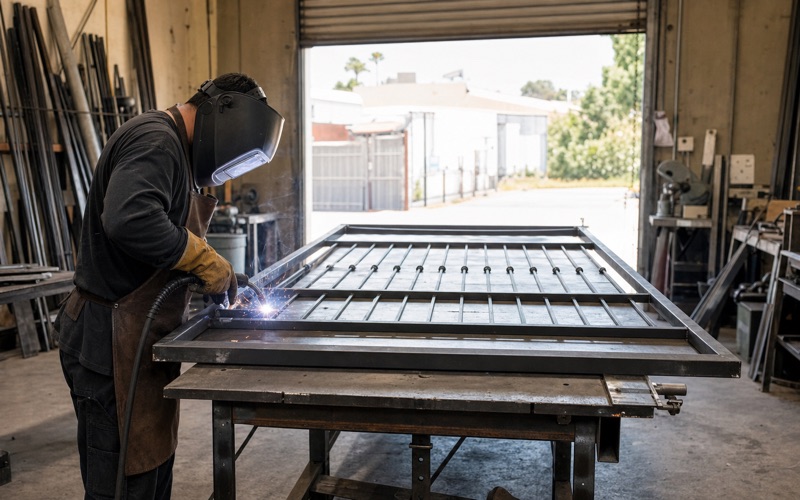
Many properties in Hermosa Beach have no driveway at the front at all, and that single fact makes gate work here unlike anywhere else we serve. Paramount Metal Gates builds pedestrian gates, courtyard and stair gates, alley-access gates and the security ironwork that goes with living this densely, this close to the water.
On the walk streets the front of a house faces a pedestrian way rather than a road. Nothing drives up to it. The gate at the front is a garden or courtyard gate that people pass through on foot dozens of times a day, and it is looked at from a few feet away rather than from a passing car. Where a vehicle is kept at all, it is reached from the alley behind, and that rear opening is a separate job with entirely separate requirements.
So the usual hierarchy inverts. The pedestrian gate is the important one, the vehicle gate is secondary where it exists, and the details that matter are the ones you notice at arm’s length.
Walk-Street and Pedestrian Gates
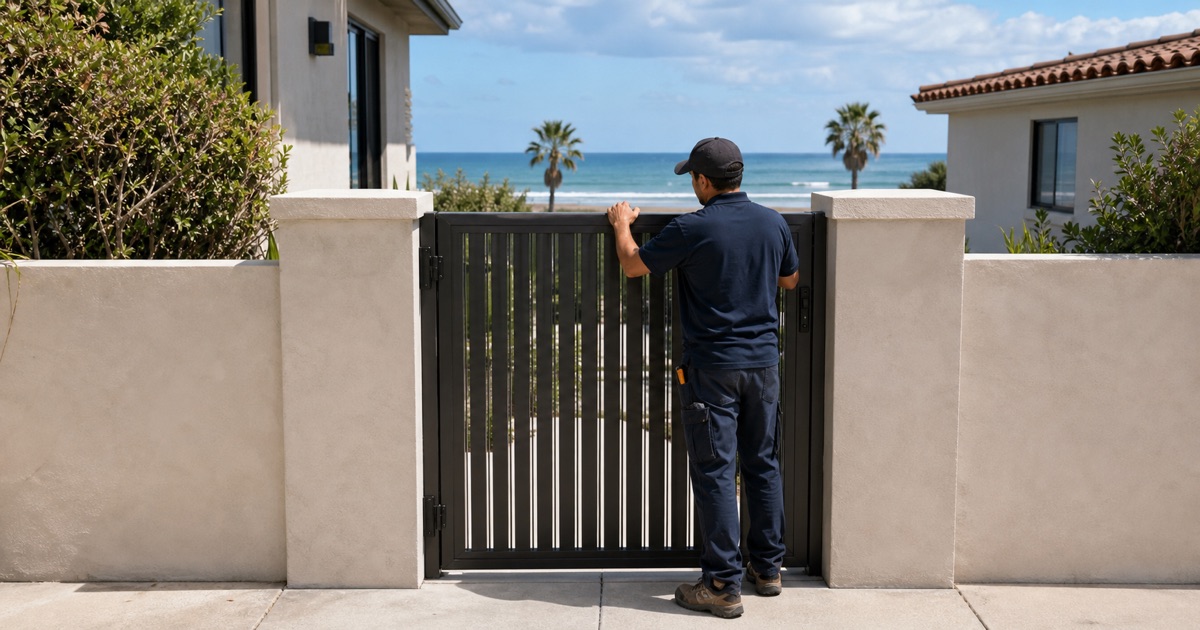
A Gate Seen From Two Feet Away
On a walk street, nobody views the gate from a car at twenty feet. They stand at it, touch the latch, and pass through it several times a day. That changes what is worth spending on: the feel and action of the latch, how the leaf swings and stops, whether the finish is pleasant to the hand, and whether the joints are clean. Detail that would be invisible from a roadway is the whole experience here.
Latches, Handles and Daily Feel
A latch on a gate used this often is the single most touched component on the property, and a poor one becomes a daily irritation. We specify mechanisms that operate cleanly with one hand and a shopping bag in the other, with returns that close positively rather than needing persuasion, and we set them at a height that works for everybody in the household rather than to a default.
Courtyard and Garden Gates
The small enclosed spaces between a walk street and a front door are frequently the most-used outdoor room a property has, and the gate is part of that space rather than a boundary at the edge of it. It should feel like a garden object rather than a security measure, which argues for lighter section, more open faces and finishes that will not look industrial in a small courtyard seen from a living room.
Stair and Split-Level Gates
The lots step down toward the water in places, and gates on or beside stairs are common. A gate at the head of a flight has an obvious safety role, and it needs a closer that works reliably rather than one that hesitates, since a gate that fails to latch beside a staircase is a genuine hazard rather than an inconvenience. Handrail and gate frequently want detailing together.
Looking for metal gates closer to South Pasadena? See South Pasadena Metal Gates.
Alley Access and Vehicles
The Rear Opening
Where a property has parking, it is generally reached from the alley behind rather than from the street in front, and the alley is narrow. A vehicle turns into it from a constrained angle and often has to stop square to the opening rather than approaching straight on, which rules out configurations that need a long approach and puts a premium on a gate that opens quickly and clears fully.
Gates in a Narrow Alley
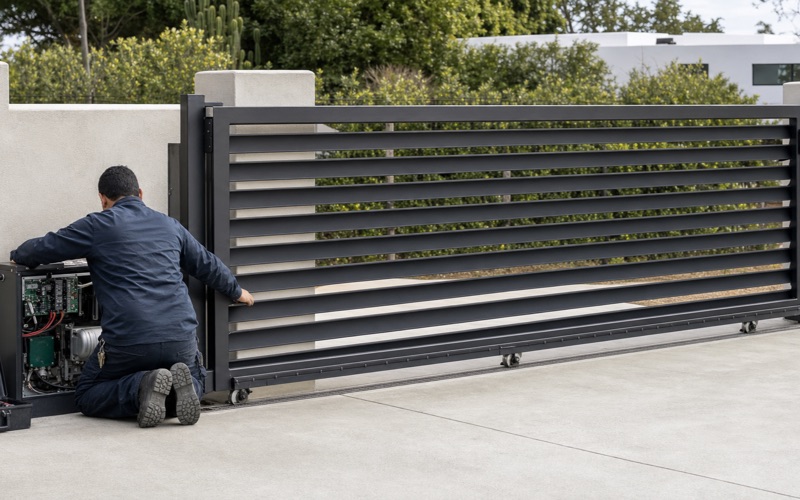
An alley leaves almost no room for a leaf to swing outward, and swinging out into a shared alley is inconsiderate at best and obstructive at worst. That pushes most rear openings toward a roll-up, a slide with the run inside the property, or an upward-lifting arrangement where headroom allows. Which one is possible is set by what is behind the opening rather than by preference.
Sharing an Alley With Neighbors
Alleys serve every property on the block, so a gate installation there affects people who are not paying for it. We stage work so the alley is not blocked longer than necessary, keep the opening usable overnight, and check that a gate does not swing into the path a neighbor needs. That is ordinary courtesy and it is also what keeps a straightforward job from becoming a dispute.
Compact Garages and Clearance
Rear garages here are frequently smaller than modern vehicles assume, and every inch of clear opening matters. Where a gate or door reduces the usable width, that reduction is felt on every single arrival. We look at the vehicle that actually has to fit before deciding on hardware, since a specification that costs two inches of clearance can make a garage unusable for the car parked in front of it.
Building Close to the Sand
What the Air Does Here
This close to the water, salt settles on everything and works into joints, fixings and any surface that stays damp. It is not a slow background process; it is the main thing determining how long a gate lasts. Aluminum sidesteps it entirely, which is why it is our usual first recommendation here, and where steel is genuinely needed the protection has to be sacrificial rather than a coating sitting on top hoping not to be scratched.
Small Components Fail First
On a beach property the parts that go first are the small ones: hinge pins, fasteners, latch mechanisms and springs. A gate can look perfectly sound while the hardware holding it together is well advanced in failing. Those components are cheap to specify properly at the outset and disproportionately expensive to deal with once a leaf has dropped because a pin corroded through.
Wind Off the Water
Wind is a constant here rather than an occasional event, and a solid gate presents a considerable surface to it. On a light pedestrian gate that means a leaf that snatches out of a hand, slams and eventually damages its own hinges. Open or partly open faces behave far better, and where privacy is genuinely needed we would rather stagger the infill than build a sail.
Salt and Simple Maintenance
We are direct that nothing fitted here is maintenance-free. Rinsing salt off a gate periodically genuinely extends its life, and keeping a latch mechanism lubricated is the difference between hardware lasting years and seizing in a season. Saying so plainly is more useful than implying a specification that never needs attention, because the owner is the one who benefits from knowing it.
Hermosa Beach’s Layout
The Pier and Pier Avenue
Pier Avenue runs from the beach as the main shopping, dining and entertainment spine of the city, ending at the Hermosa Beach Pier, and the commercial life of the city concentrates along it. The gate work on that strip is storefront security rather than residential, and it shares almost nothing with the walk streets a block away except the salt air both have to survive.
Streets Built Before the Car
The city was served early by the Los Angeles Pacific Railway trolley running the length of Hermosa Avenue, and the lot pattern that grew up around that era assumed people arrived on foot or by rail rather than by private car. That is the origin of the walk streets and the rear alleys, and it is why so much of the residential fabric here has no front driveway to gate.
Small Lots and Vertical Living
Because the lots are small and the demand for space is not, properties here build upward and use every foot of ground, which leaves gates in tight positions with little room to swing and neighbors close on both sides. Every installation is therefore a question of what will physically work in the space available, and the design conversation follows that rather than leading it.
Security in a Dense City
What a Gate Here Actually Deters
On a walk street the gate is not stopping a vehicle and it is rarely stopping a determined attempt; what it does is remove the casual opportunity and mark a boundary that is otherwise ambiguous. That is worth being honest about, because a homeowner who believes a courtyard gate is a security installation will be disappointed by it, while one who understands it as a boundary with a good latch generally is not.
Short-Term Rentals and Changing Occupants
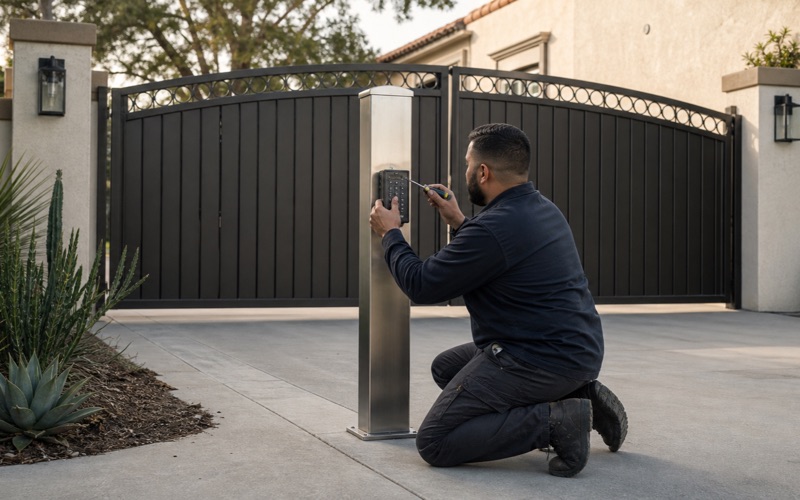
A meaningful share of property near the beach turns over constantly, whether let short-term or shared between several households, and keys distributed to a rotating population stop being a control almost immediately. A coded or app-based entry that can be reissued between occupants solves that without rekeying anything, and it also removes the standing problem of a key that was never returned.
Bikes, Boards and What Gets Stolen
The things that actually go missing here are the things left in a courtyard or a side passage: bicycles, boards, scooters and equipment. A gate that closes and latches reliably every time does more to prevent that than a heavier gate that is awkward enough that people stop pulling it shut behind them. Reliability of closing beats mass, and it is the cheaper specification.
Lighting, Visibility and Overlooking
A gate in a dark recess between two buildings invites exactly what it is meant to prevent, and no amount of steel compensates for a corner nobody can see into. Where the position allows we prefer an open or partly open face so the space behind stays visible from the walk street, and we will say when a solid gate would make a property less secure rather than more.
Coordinating With Neighbors
Where buildings sit this close, one property’s gate frequently ties into another’s wall, and the boundary between them is often less clear on the ground than on paper. We establish what belongs to whom and what may be fixed to what before anything is built, because a gate anchored into a neighbor’s structure is a problem that surfaces at the worst possible moment, usually when one of the properties changes hands.
- Licensed & Insured
- Free On-Site Measure
- Fixed-Price Quotes