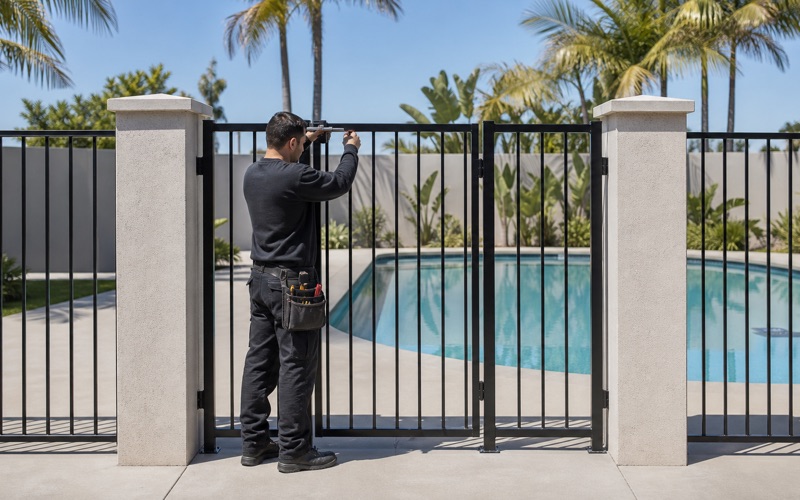
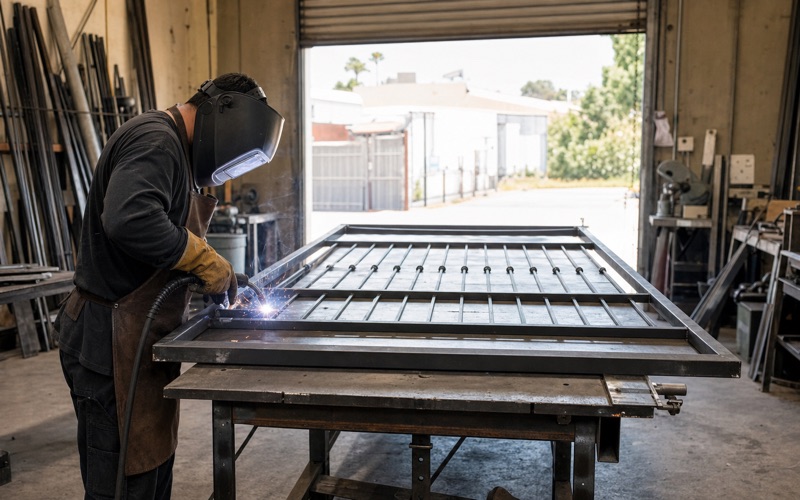
Small industrial units are what Gardena is built around, and they are where most of our work in the city happens: roll-up doors on shop fronts, gates across compact yards, security on machine shops and fabricators, and the operators and hardware that all of it runs on. Paramount Metal Gates builds metal gates in Gardena for those units and for the residential streets that sit directly alongside them.
The distinguishing feature here is scale rather than type. Gardena’s industrial land is subdivided into a great many modest units rather than a handful of large parcels, which means openings are narrower, yards are shorter and the businesses behind them are smaller operations for whom a gate failure is a direct cost that day rather than a line item somebody else deals with.
That changes the priorities. Speed of repair matters more than specification depth, hardware has to be serviceable rather than exotic, and a solution that keeps a unit working today usually beats a better one that arrives next week. We carry common parts for exactly that reason.
Small Industrial Units
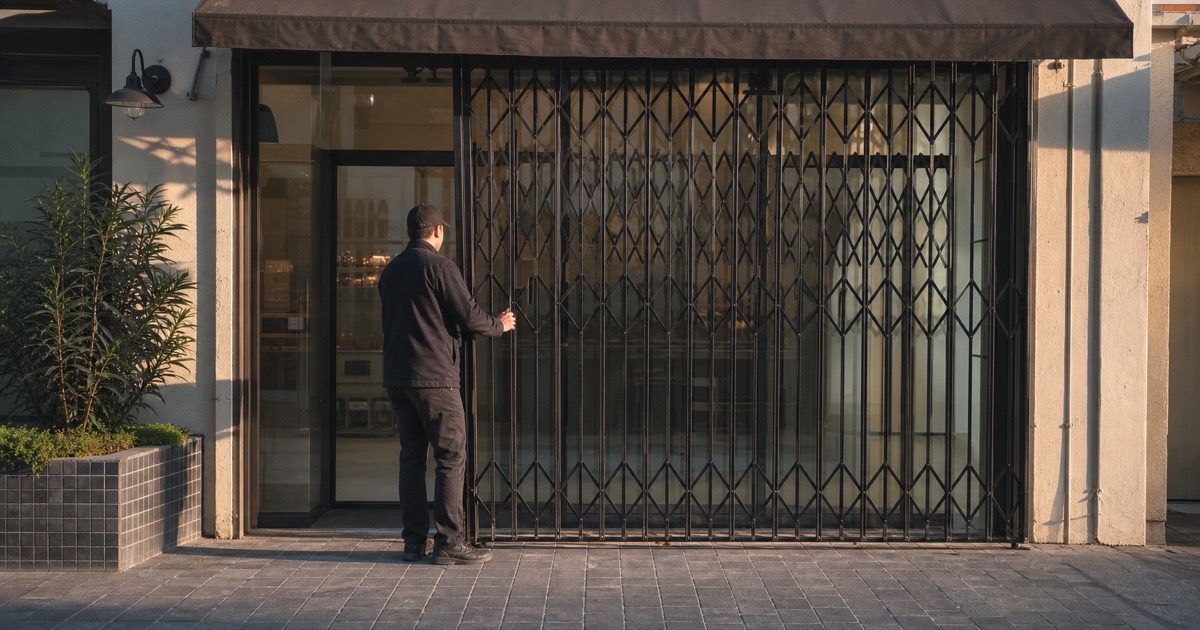
Roll-Up Doors on Compact Frontages
Rolling steel curtains dominate the unit frontages here because they need headroom above the opening rather than room beside it, which is the one thing a narrow unit has. Balance is the safety-critical element rather than strength: a curtain whose spring tension has drifted is heavy and awkward to work by hand and punishes its operator on every cycle. We service springs, drums, guides and bottom bars and replace damaged slats individually.
Yard Gates on Short Runs
The yards behind these units are frequently barely deeper than a vehicle, which rules out most sliding arrangements and makes a well-built swing pair the practical answer where a swing can be accommodated at all. We measure the usable depth against how vehicles actually maneuver in the yard, because a gate that clears the ground perfectly and blocks the only turning space has solved the wrong problem.
Security on Machine Shops and Fabricators
Units holding tooling, stock and machinery need a perimeter that resists a determined attempt rather than a casual one. We build heavy galvanized frames, avoid convenient footholds at hinge and latch stiles, and control ground clearance so nothing passes underneath. Where a roller shutter is the main opening, the pedestrian door beside it is usually the weaker point and gets the same attention.
Keeping a Unit Trading
For a small operation a jammed gate or a stuck shutter is lost hours rather than an inconvenience, so the useful measure is how quickly a unit is working again. Common transmitters, receivers, keypads, sensors, springs and hardware travel on the vehicle, and where a part genuinely has to be ordered we secure the opening in a usable state before leaving rather than departing with it standing open.
Looking for metal gates closer to Los Alamitos? See Metal Gates Services in Los Alamitos.
Residential Streets Alongside
Driveway Gates on Modest Frontages
The residential streets carry compact postwar frontages with limited depth between sidewalk and house, which constrains configuration before style is discussed. A swing leaf needs arc room that a parked vehicle may already occupy. We measure the usable depth and the fall across the driveway and specify a slide where the geometry demands it rather than forcing a swing into a space that cannot take it.
Security Doors and Window Guards
Ornamental security doors and window guards are a substantial share of the residential work, and they sit on housing of a similar age throughout the city. The aim is a barrier that belongs to the building rather than one applied across it, so we fabricate to the opening, anchor into structure rather than render alone, and design egress in from the start rather than treating it as a compromise.
Side and Rear Access
Lots here run back far enough that a side gate is genuinely useful, particularly where a work vehicle is kept at home, which is common in a city with this much light industry. The recurring failure is a standard gate widened without reinforcement. We build wider leaves on heavier frames with real bracing and drop rods into ground sockets so the inactive leaf stays put.
Where Residential Meets Industrial
Because units and houses sit close together here, a number of properties back onto commercial land, and those boundaries need a gate specified for the harder side rather than the softer one. We treat a residential gate on an industrial boundary as an industrial gate that happens to face a garden, since it will be judged by what happens on the other side of it.
Materials and Fabrication
Galvanized Steel as the Default
On a working gate, appearance matters less than what the gate survives, and galvanizing decides that. Hot-dip galvanized frames tolerate weather, knocks and constant handling far better than paint, and where a coating is damaged the surrounding zinc keeps protecting the steel rather than letting corrosion creep beneath the film. It is our default wherever a gate is a tool.
Coastal Air Reaching Inland
Gardena sits close enough to the coast for salt-laden air to reach welds and fixings, and corrosion begins where coating is thinnest, at joints and along bottom rails. Every weld gets zinc-rich primer before any topcoat regardless of what goes over it, because a topcoat applied straight onto a bare weld is simply a slower route to the same failure.
Building to Odd Openings
Unit frontages here were formed at different times to different dimensions and rarely match a manufactured size. Fitting the nearest standard product and packing out the gap loads filler hardware that was never designed to carry it, and that packing is where the installation fails. Fabricating to the measured opening costs no more in material and removes the weak point.
Making Parts That Are No Longer Sold
Older shutters and gates frequently need a component out of production: a bottom bar section, a bracket for a discontinued operator, a lattice pivot in an unusual size. Fabricating the part is regularly quicker and cheaper than redesigning an opening around something currently available, and it keeps a serviceable installation working rather than replacing it for the want of one piece.
Access and Automation
Operators for Commercial Cycling
A unit gate opened and closed several times daily, plus every delivery, is a different specification from a residential gate cycling four times a day even at the same weight. Duty cycle is the figure most often ignored and the one that decides service life. We size with headroom above the load and fit brands we stock, so a fault is a same-visit repair rather than a parts order.
Credentials for Small Teams
On a small operation everybody tends to know the code, which is convenient until somebody leaves. Credentials issued per person can be withdrawn individually without disturbing anyone else, and the administrative effort is trivial once it is set up. We configure it so an owner can add and remove users themselves rather than calling us every time the staff changes.
Sensing Where Vehicles and People Mix
Unit yards are places where forklifts, delivery vehicles and people on foot share a small space, which means entrapment protection matters more here than the compact scale might suggest. We place photo eyes and safety edges against how the opening is actually used and confirm the operator is genuinely monitoring its sensors rather than merely wired to them.
Fire Access on Gated Units
A gate across a fire apparatus access road has to be openable by the fire department with an arrangement that holds when power is gone. On a site subdivided into many small units with shared access lanes, working out which route that applies to is less obvious than on a single large parcel, so we confirm it with the authority rather than assuming.
Gardena’s Development
Subdivided for the Railway
Gardena proper began in 1887 when the Pomeroy and Harrison developers subdivided the ranch in anticipation of the Los Angeles and Redondo Railway, and railroads put the town on the map during the Southern California real estate boom of the 1880s. That early subdivision into modest parcels is the direct ancestor of the small-unit industrial pattern the city still has.
From Berries to Light Industry
The area supported a substantial berry industry that suffered during the First World War as other crops were favored by the war economy, and the agricultural land gave way over time to the light industrial and residential mix present today. That sequence is why industry and housing sit so closely interleaved here rather than being separated into distinct zones.
Small Parcels, Short Distances
The practical consequence of all that subdivision is a city of short distances and many small properties, which suits a contractor who can be on site quickly and carries the parts that fix most faults. It is also why gate work here spans a residential driveway and a machine shop shutter within the same afternoon.
Japanese-American Heritage on the Streets
Gardena has one of the most established Japanese-American communities in the region, and that shows up in the built environment as gardens, entries and boundary treatments detailed with more care than a standard tract elevation would suggest. Where a property has that character, a stock gate reads badly against it, and matching proportion and restraint matters more than adding ornament. We look at what the entrance is already doing before proposing anything.
Working Around Two Kinds of Client
A small manufacturer needs a gate back in service today and cares very little what it looks like. A homeowner two streets away cares a great deal what it looks like and can wait a fortnight for the right one. Those are opposite briefs, and the mistake is running one process for both: quoting the shop as though appearance mattered, or the house as though it did not.
- Licensed & Insured
- Free On-Site Measure
- Fixed-Price Quotes