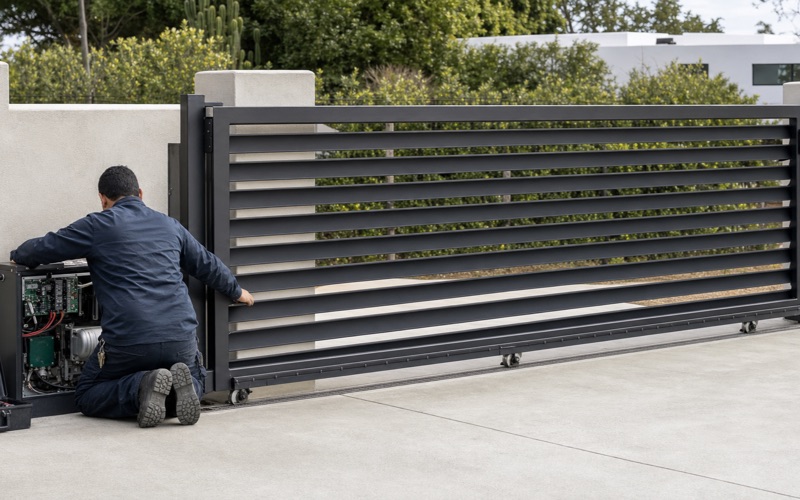
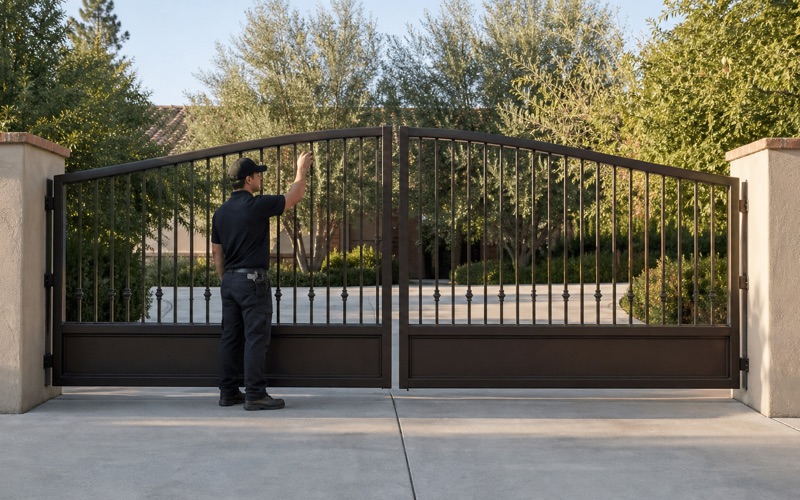
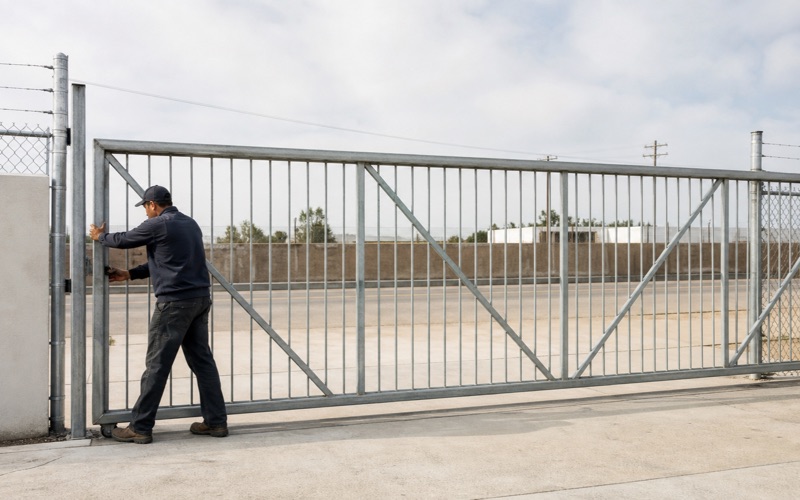
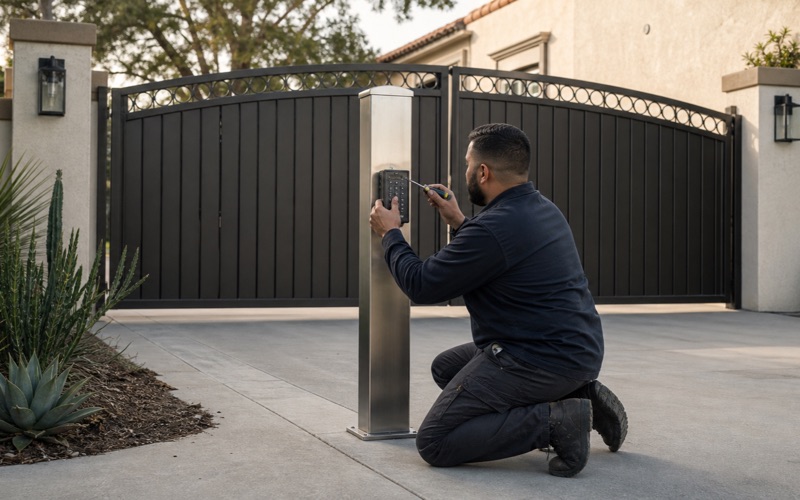
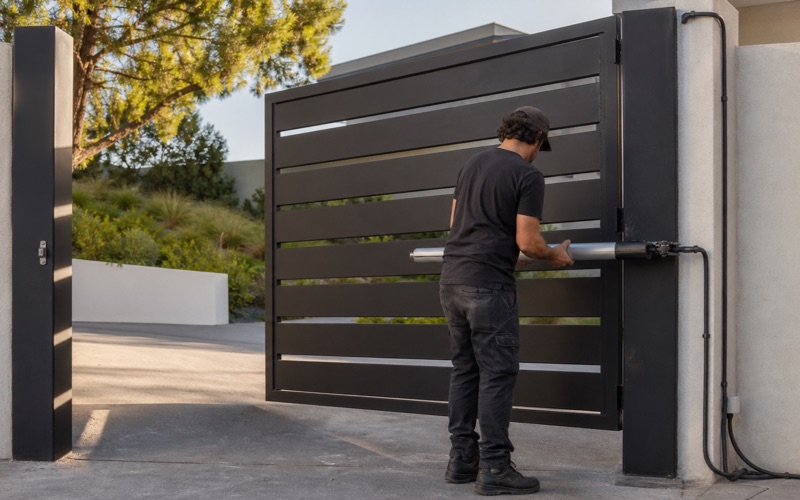
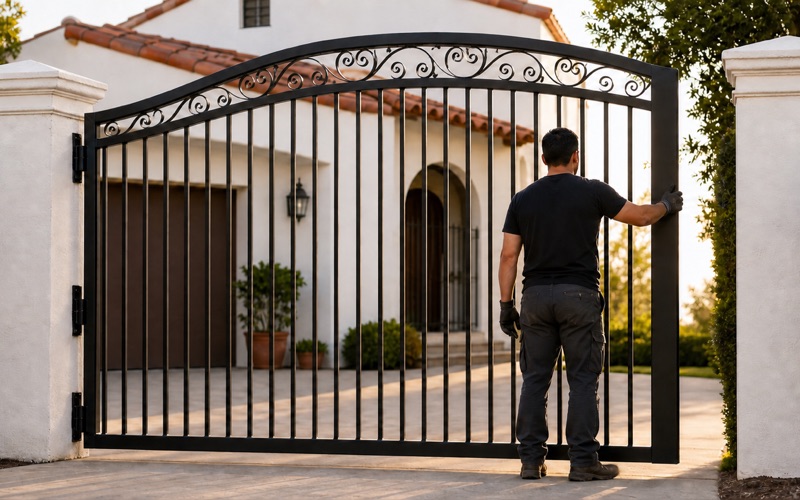
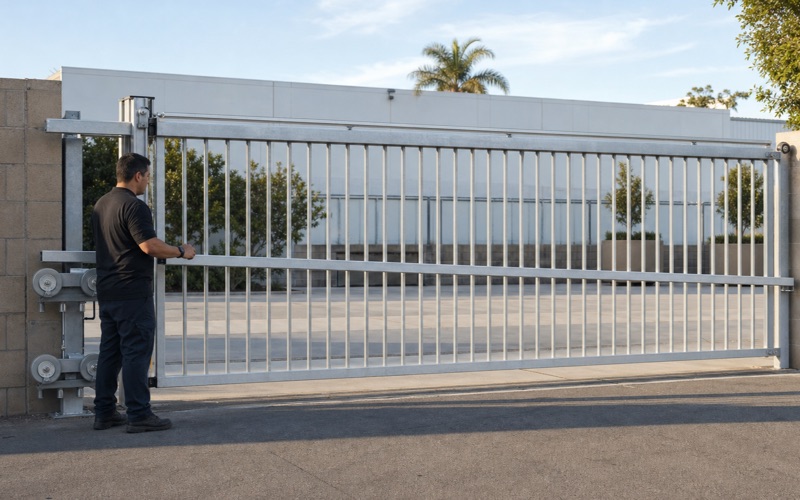
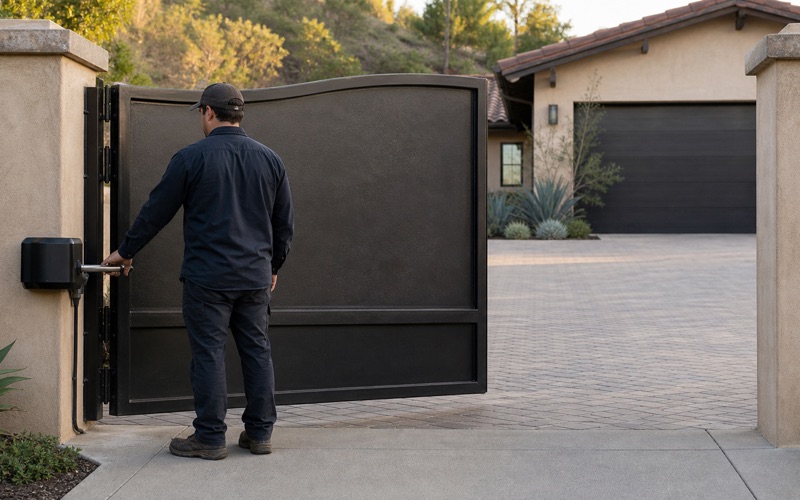
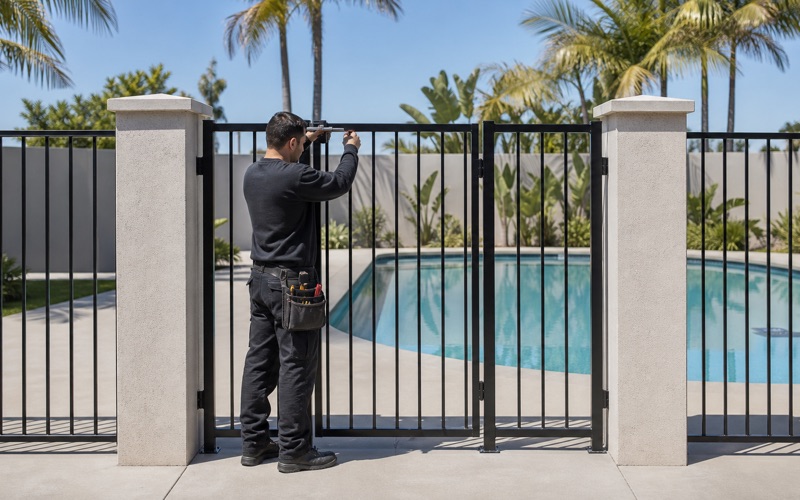
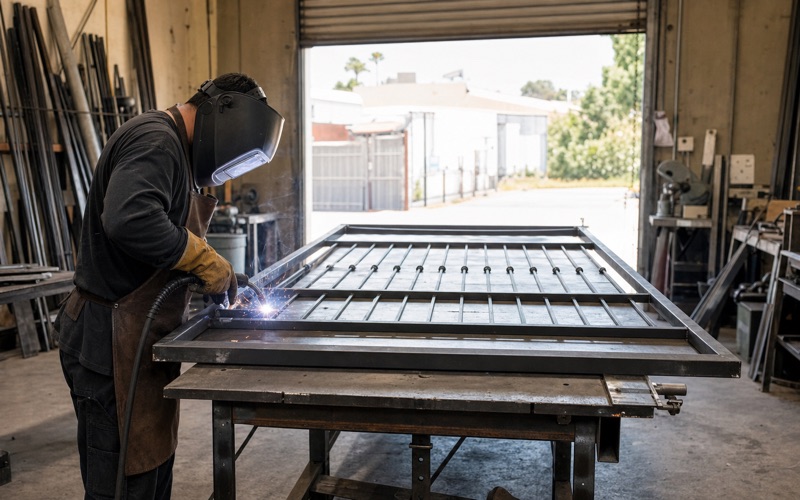
Roughly three quarters of El Segundo is industrial or commercial land, including a major refinery and a long-established aerospace presence, and the gate work follows that proportion. Paramount Metal Gates builds and services perimeter gates, vehicle entrances, controlled-access openings and the pedestrian gates that go with them across those sites, plus the compact residential core the city keeps west of them.
Work on this kind of property differs from ordinary commercial gate work in one important respect: the specification is usually set by somebody else. Refinery and aerospace operators work to their own written standards, their own access procedures and their own documentation requirements, and a contractor’s job is to build precisely to that rather than to propose an alternative that happens to be easier.
We are comfortable working that way. It means reading the scope properly, asking about the things it does not cover, and recording exactly what was installed so the site’s own records stay accurate.
Controlled and High-Security Sites
Building to Somebody Else’s Standard
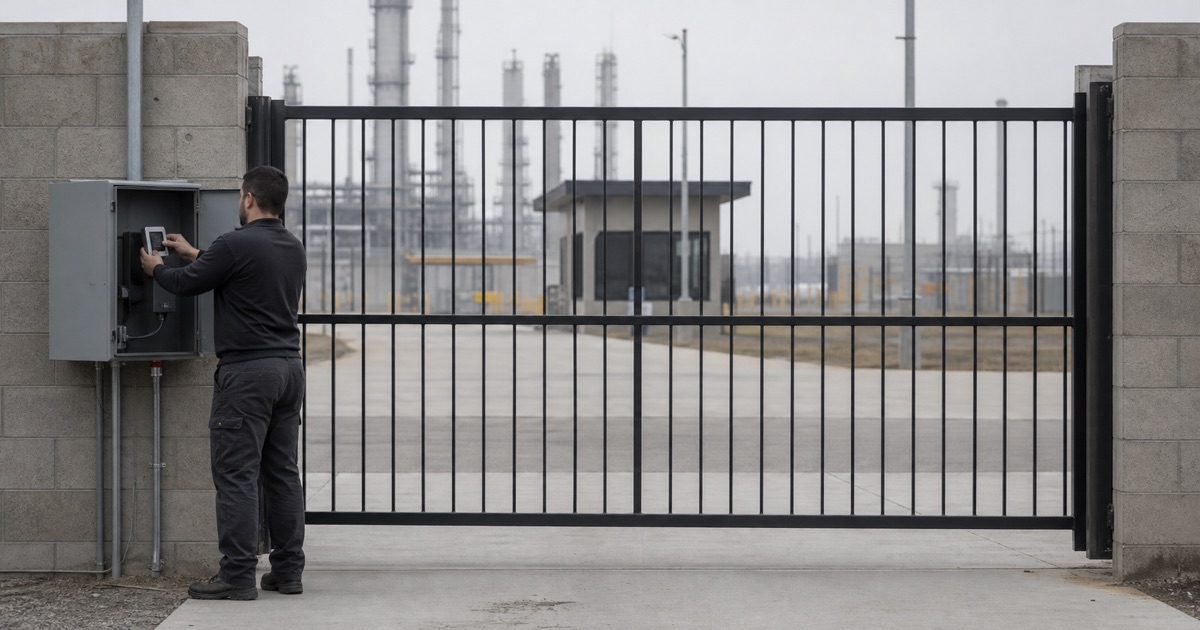
On a regulated site the gate is an item in a documented system rather than a purchase. Frame section, coating specification, hardware, sensing and access method may all be prescribed, and where they are we build to them without substitution. Where the scope is silent on something that matters, we ask rather than assume, because an assumption that turns out to conflict with a site standard is expensive to unwind after installation.
Layered Access and Vehicle Entrances
Sites of this kind commonly separate an outer perimeter from inner controlled areas, and the gate at each layer does a different job. An outer vehicle entrance handles volume and identification; an inner one may need to prevent tailgating entirely, which is a different engineering problem and sometimes calls for an arrangement where two barriers never open at the same time. We build to the layer rather than treating every opening the same.
Pedestrian Openings and Turnstile Interfaces
Where people and vehicles are separated, the pedestrian opening is frequently the more sensitive of the two, because it is used constantly and is where a credential is actually checked. Gates that interface with turnstiles, card readers or guard positions have to fail in a defined direction on loss of power, and which direction that is depends on the site’s own life-safety assessment rather than on a general rule.
Documentation and Handover
Sites like these are audited, and a gate that cannot be evidenced is a finding waiting to happen. We record what was fitted, to what specification, with what settings, and hand that over in a form the site can file. It costs an hour and it is the difference between a straightforward audit and somebody reverse-engineering an installation years later.
Looking for metal gates closer to San Marino? See Metal Gates Services in San Marino.
Perimeter Engineering
Vehicle Barriers Where They Are Genuinely Required
Where a site’s assessment calls for stopping a vehicle rather than deterring one, the requirement moves to barriers tested to a defined impact standard, and what a given rating delivers depends on approach speed and standoff distance. That is a calculation rather than a product choice. We work to the rating the site specifies and are explicit that an ordinary heavy gate, however substantial, is not a substitute for it.
Anti-Climb, Anti-Lift and Gap Control
A perimeter fails at whatever is easiest, which is rarely the middle of a fence panel. Gate hinges that allow a leaf to be lifted, footholds at a latch stile, and clearance beneath a leaf are the three that get exploited. Those are detailing decisions made at the drawing stage and are effectively impossible to retrofit well, which is why we resolve them before fabrication rather than after a survey flags them.
Corrosion in a Refinery Atmosphere
The combination here is unusually hard on steel: coastal salt air plus an industrial atmosphere. Coating systems that perform adequately a few miles inland do not last as well in that environment, and the failure begins at joints and fixings rather than on visible faces. Galvanizing plus a compatible topcoat is the sensible default, and stainless or aluminum hardware where fixings would otherwise be the first thing to go.
Gates That Have to Keep Working
On a site with continuous operations, a gate stuck open is a security event and a gate stuck closed can be a safety one. Both matter, and which is worse depends on the opening. We establish that for each gate rather than applying a single fail-safe philosophy across a site, since the correct behavior for a perimeter vehicle entrance and for an emergency egress route are opposites.
Everyday Commercial Work
Office and Business Park Entrances
Not every commercial opening here is high security. The office and business park frontages need gates that manage visitors, staff and deliveries without feeling like a checkpoint, which means entry hardware sited where a driver can reach it, travel speeds that do not create a queue on the street, and an appearance that suits a corporate frontage rather than a yard.
Loading, Service and Yard Openings
Behind those frontages the requirements revert to the practical: openings sized for the vehicles that actually arrive, hardware rated for repeated daily use, and sensing configured for long vehicles rather than cars. Where a service yard is shared between tenants, we set access up so that revocation is somebody’s defined responsibility rather than a code that has quietly become universal.
Rolling Steel and Building Openings
Rolling curtains cover service and loading openings throughout the commercial stock, and balance rather than gauge is what makes one safe. We service springs, drums, guides and bottom bars, and replace individual slats where impact damage is localized. On buildings where a curtain is part of a fire strategy, we check what its required behavior is before working on it.
Working Around Operations
Sites here run to schedules that a gate contractor does not get to interrupt, so sequencing is part of the job. We prepare and finish off site to keep the on-site phase short, agree access windows in advance, and never leave a controlled opening in a state the site would not accept overnight.
The Residential Core
A Small Neighborhood in an Industrial City
West of the industry, El Segundo keeps a compact and long-established residential neighborhood, and gate work there is ordinary residential work: driveway and pedestrian gates, side access, security ironwork and repair. The scale is modest and the streets are consistent, so gates that suit the frontage rather than dominate it tend to be what owners actually want once they see the options.
Living Near Heavy Industry
Properties within reach of the refinery and the aerospace campuses see an atmosphere that is harder on finishes than a purely residential street, and owners are frequently surprised at how quickly an ordinary painted gate deteriorates. Specifying a residential gate here closer to how we would specify a commercial one is usually money well spent, and we explain why rather than simply quoting a higher number.
Wind Off the Bay
Located on Santa Monica Bay, the city gets steady wind, and a solid gate presents a substantial surface to it. That loads hinges, posts and operator on every cycle and makes a hand-operated leaf awkward on a bad day. Where privacy is the goal we would rather stagger the infill than build something that behaves like a sail.
Repair on Older Residential Ironwork
The residential stock includes older ironwork worth keeping, and the calculation is straightforward: a sound frame with local corrosion or worn hardware is worth restoring, while a leaf built too light for its span will keep failing whatever is done to it. We say which we are looking at before quoting, since the two outcomes differ by a large multiple.
El Segundo’s Shape
Built Around the Refinery
The city was incorporated in January 1917 on land where the Chevron refinery now stands, and that industrial anchor has defined its land use ever since, with roughly three quarters of the city dedicated to industrial and commercial uses. Very few cities are so clearly organized around a single industrial function, and it is why the gate work here skews so heavily commercial.
Aerospace and the Corporate Campuses
Alongside the refinery, El Segundo became a significant center of the aerospace industry, and the campuses that came with it brought controlled-access requirements of a different kind again. Between the two, a large proportion of the openings in this city answer to a documented standard rather than to an owner’s preference, which is unusual and worth knowing before quoting anything.
A Small City With Two Populations
The practical effect is a city with a substantial daytime working population and a small resident one, and gate work that reflects both. We are as likely to be on a controlled perimeter as on a residential driveway here, and the two demand genuinely different disciplines: one documentation and precision to a given standard, the other judgement about what suits a modest street.
Contractor Vetting and Site Access
Working on controlled property means the contractor is vetted before the gate is, and that is worth planning for rather than discovering at the gatehouse. Badging, escort requirements, permits to work and restrictions on what may be brought on site all take time to arrange, and a job scheduled without allowing for them stalls before anyone has picked up a tool. We build that lead time into the schedule rather than treating it as an interruption.
- Licensed & Insured
- Free On-Site Measure
- Fixed-Price Quotes