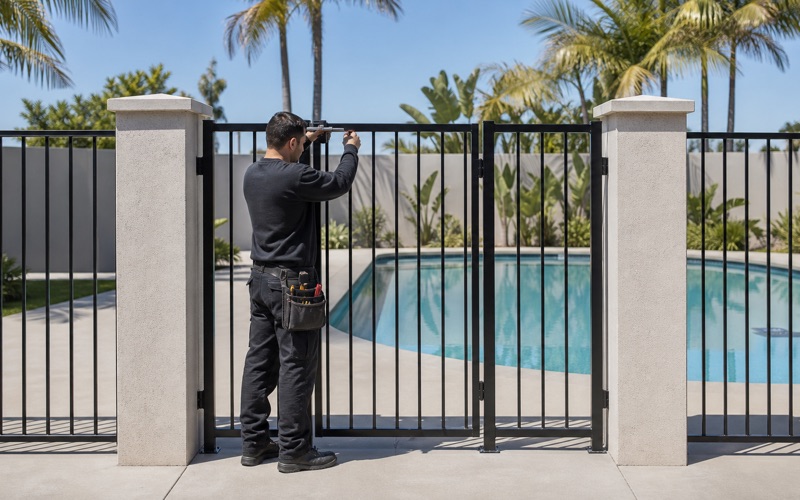
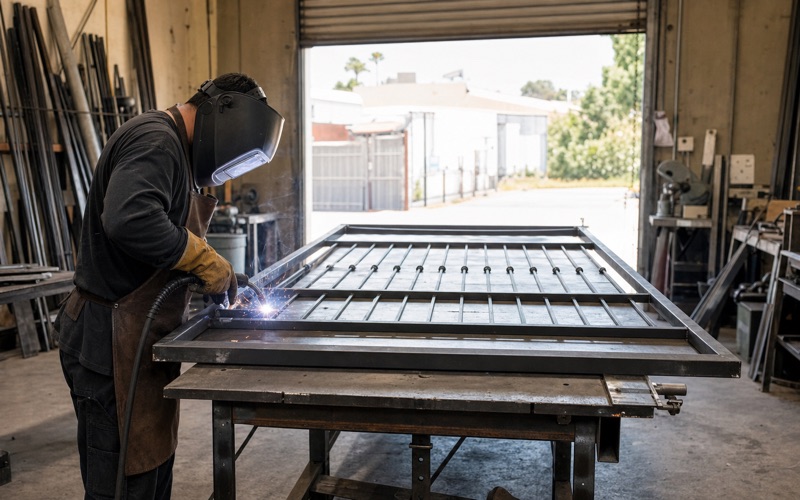
Paramount Metal Gates fabricates wrought iron gates in Downey, covering ornamental driveway gates, entry and courtyard gates, pedestrian gates, security doors and the matching ironwork that ties them together. Every pattern is drawn to the dimensions of the actual opening in our own shop, which is what allows scrollwork and picket spacing to repeat symmetrically across the leaf instead of being cut short at one edge because a stock panel was the wrong width.
Downey’s established residential streets carry a great many masonry pillar entries, and ornamental iron is what those pillars were designed to hold. The visual weight of a proper iron gate suits a substantial pillar in a way that a light aluminum panel never will, and the detailing is what makes the entrance read as designed rather than merely closed off. That is a genuine design decision rather than a matter of taste alone, because a gate too light for its pillars looks temporary no matter how well it is made.
Much of the ironwork already standing on these streets was installed decades ago, which makes matching as common a request here as designing from scratch. A replacement leaf after a vehicle strike, a pedestrian gate added beside an older driveway gate, or a run of panels completing an entrance all have to belong to what is already there. That is a drawing problem as much as a fabrication one, and it starts by measuring the existing work rather than approximating it from a photograph.
Ornamental Pattern and Detail
Scrollwork, Pickets and Finials
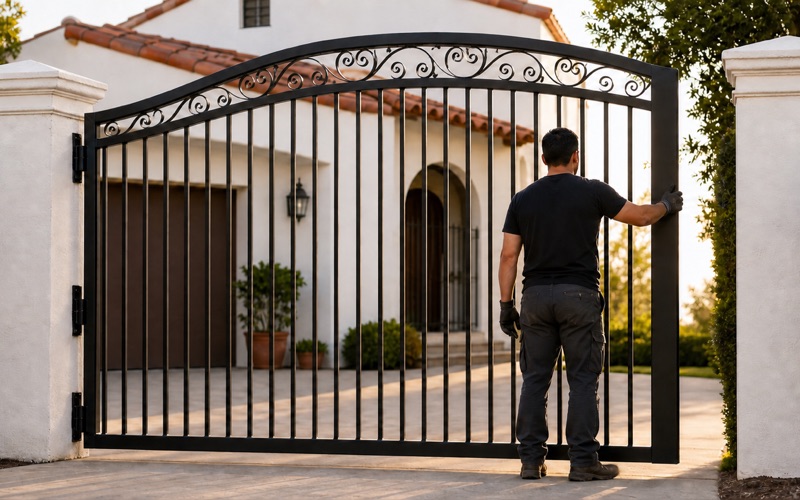
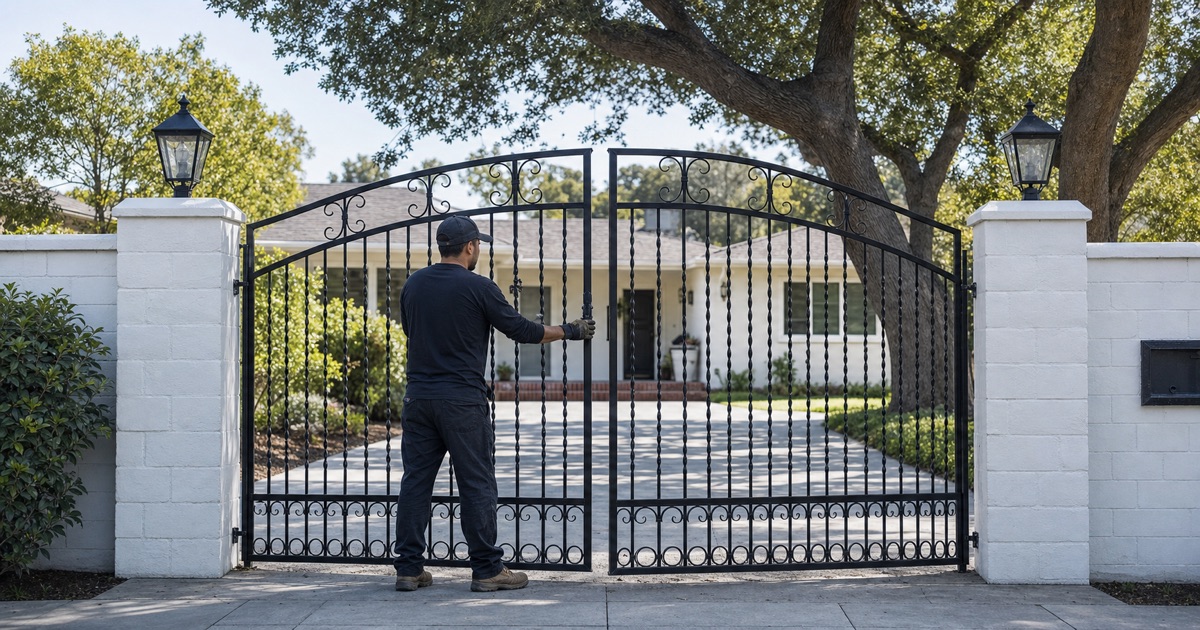
The vocabulary of an iron gate is its picket profile, its top treatment and the scrollwork worked between them. Spear tops, ball finials, twisted pickets, quatrefoil panels and grapevine or cattail scrolls each carry a different visual weight, and the spacing between them decides whether a gate reads as open and decorative or solid and defensive. We set out the pattern against the measured opening first, so the repeat lands evenly and the center line of a double gate falls where the design intends rather than wherever the arithmetic happens to leave it.
Arched, Flat and Scalloped Top Lines
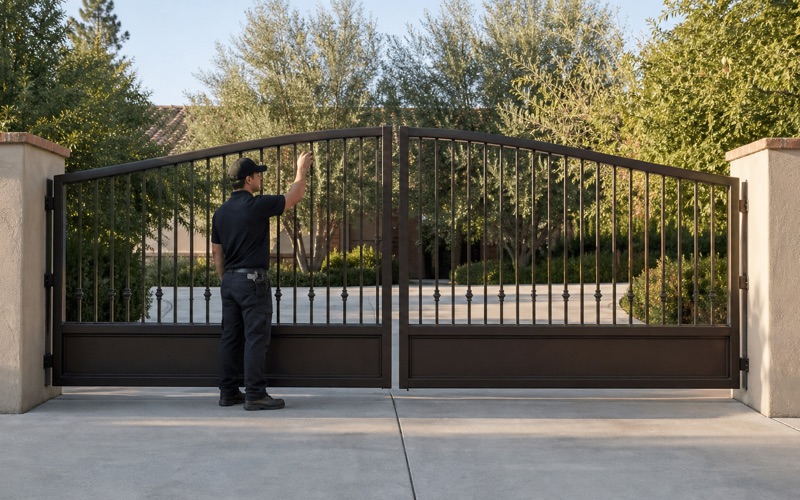
The top line does more to establish the character of an iron gate than any other single element, and it is the detail most worth getting right. Arched and bell-curve tops suit Spanish and Mediterranean entries and pair naturally with an arch already present in the stucco or repeated in the pillar caps. Flat tops read modern and sit better beneath a low roofline. Scalloped and split-arch treatments work across double gates where the two leaves meet and the join itself becomes part of the composition rather than a seam to be disguised.
Matching Existing Ironwork
A great deal of the work here is adding to something already in place: a pedestrian gate to match a driveway gate installed years earlier, a replacement leaf after a vehicle impact, or a run of fence panels to complete an entrance. We reproduce picket profiles, scroll patterns, rail spacing and finish so new work belongs to the original set rather than announcing itself. Where a profile is no longer produced and an exact match genuinely cannot be achieved, we say so before fabrication and propose a deliberate complementary detail instead of an approximation that satisfies nobody once it is hung.
Looking for metal gates closer to Compton? See Metal Gates in Compton.
Building an Iron Gate That Stays Square
Frame, Section and Concealed Bracing
The ornament everyone looks at hangs on a structural frame nobody sees, and that frame is what keeps the gate square for its whole life. We size tube section and wall thickness against the finished weight rather than the nominal width, and build diagonal bracing into the frame itself where the pattern conceals it, rather than strapping a brace across the face of a decorative gate. A leaf that flexes visibly when pushed will rack over time regardless of how good the ornamental work is, and racking is what eventually stops a gate latching cleanly.
Hinges, Posts and Footings
Iron is the heaviest common gate material, and almost everything that goes wrong with an ornamental gate traces back to that weight being underestimated somewhere. A single leaf places a large cantilevered load on one post, so hinges are ball-bearing or heavy weld-on units rated well above the actual weight, with grease fittings where the gate cycles frequently. Post section and footing depth are sized to the leaf and to the ground rather than inherited from an old fence line, because a post that rotates a degree at grade shows up as several inches of drop at the latch.
Automating a Heavy Ornamental Leaf
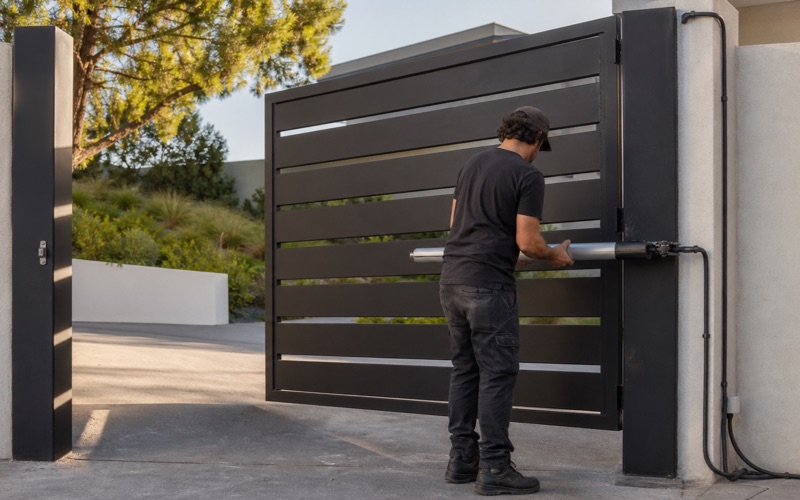
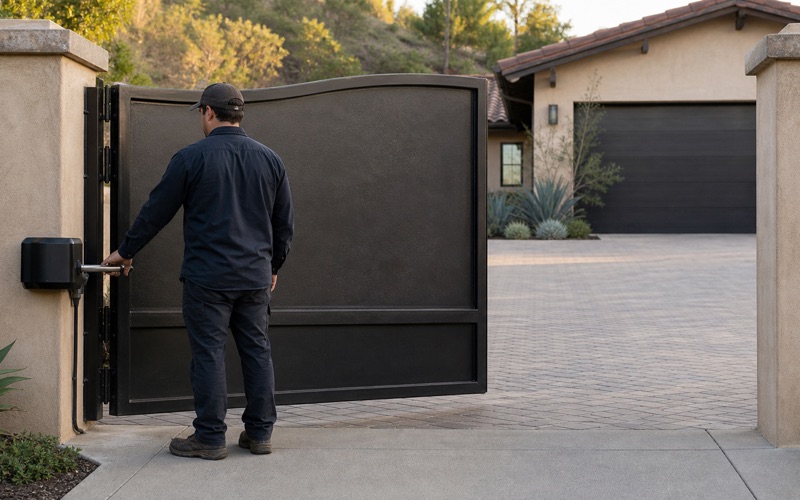
An iron gate that is going to be automated has to be specified for it from the outset rather than adapted afterward. The operator is sized against the real weight and length of the leaf with genuine headroom above it, since a unit working at the top of its rating on every cycle will fail early and take the mounting hardware with it. Monitored entrapment protection, photo eyes and safety edges are fitted to the class of gate, and gaps that a hand could enter are screened, because automation turns a decorative object into a powered machine.
Finish, Protection and Repair
Zinc-Rich Primer and Powder Coating
Rust does not begin in the middle of a picket; it begins at welded joints and along the bottom rail where coating is thinnest and water sits longest. Every weld is treated with zinc-rich primer before any topcoat goes near it, and over that we specify hot-dip galvanizing or a TGIC polyester powder coat over properly pretreated steel. Powder holds color and gloss under UV far longer than wet paint and resists the chalking that makes an older gate look tired long before it is structurally finished.
Color and Texture Choices
Matte and satin black remain the most requested finishes and suit almost any elevation, but bronze, oil-rubbed bronze and hammered textures sit particularly well with Spanish and Mediterranean detailing and with the warmer masonry common on Downey’s older entries. The finish is a protective system rather than a color choice, so we pretreat properly before coating; powder applied over an unprepared surface fails at the edges regardless of how good the powder itself is.
Restoring Rather Than Replacing
An ornamental gate with a corroded bottom rail is very often worth saving, because the pattern above it is sound and reproducing that detailing would cost far more than repairing it. We cut out the failed steel, weld in new tube matched to the original section, treat the joints and refinish the whole leaf so the repair is not visible as a patch. On detailing no longer commercially available, rebuilding preserves something a replacement gate simply cannot supply at any sensible price.
Downey Streets and Local Context
Settlement Along the Rio Hondo
Two small settlements, College Settlement and Gallatin, were established along the Rio Hondo near where Paramount Boulevard and Florence Avenue now cross, and dairying was a major industry across the area before housing replaced it. That agricultural land was subdivided into the residential streets that carry most of this work today, which is why frontages are generous by comparison with the denser cities nearby and why formal pillar entries are so common here.
Larger Frontages and What They Allow
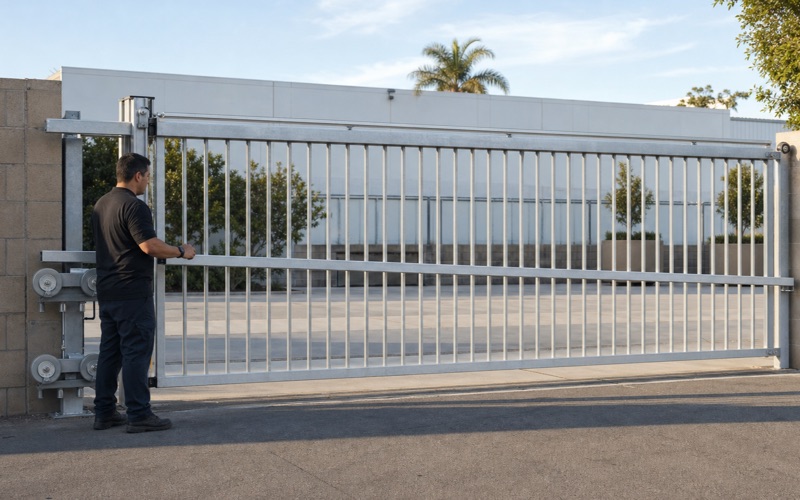
Because many Downey lots offer more depth between the sidewalk and the house than neighboring cities do, a pair of swing leaves is frequently workable where elsewhere it would not be. That matters for ornamental work specifically: a double swing gate presents the pattern as one composition across both leaves, which is how most iron designs are intended to be read. Where the depth is not there, we specify a slide and set the pattern out to suit a single traveling leaf rather than forcing a design that wants to open in two halves.
Height Limits and Corner Lots
Anything standing in the required front yard is limited in height, with a greater allowance once you are behind the front-yard line, and corner lots carry a vision-clearance triangle where nothing may obstruct the sightline at the intersection. Those limits are worth establishing before a design is drawn rather than after, because an ornamental gate built to the wrong height is not something that can be trimmed down afterward without destroying the proportions of the pattern.
Beyond the Driveway Gate
Pedestrian and Courtyard Gates
An ornamental driveway gate rarely stands alone. Most entries also need a pedestrian gate beside it, and a courtyard or side gate further back, and those want to read as part of the same design rather than as three separate purchases. We scale the pattern down rather than simply repeating it, because scrollwork drawn for a wide leaf becomes crowded when it is compressed into a narrow one. Self-closing hardware is fitted where a gate genuinely must not be left standing open.
Handrails, Panels and Window Guards
The same shop capability that produces a gate covers the ironwork around it: matching fence panels to complete a run, handrails to a porch or entry steps, balcony rails, and ornamental window guards on the older housing. Working from one drawing and one finish specification across all of it is what makes an entrance look designed rather than assembled over several years from whoever was available at the time.
Access Control on an Ornamental Entry
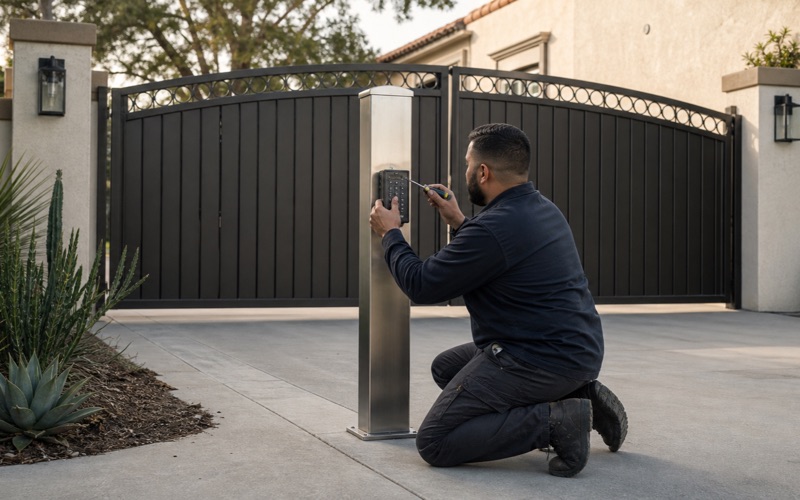
Automation hardware tends to be visually blunt, and on a formal iron entry that matters. We site keypads and call stations on a pilaster or a discreet pedestal rather than on the gate itself, run cabling out of sight, and choose devices whose finish does not fight the ironwork. The gate should look like a gate rather than like a control panel with decoration attached to it.
- Licensed & Insured
- Free On-Site Measure
- Fixed-Price Quotes