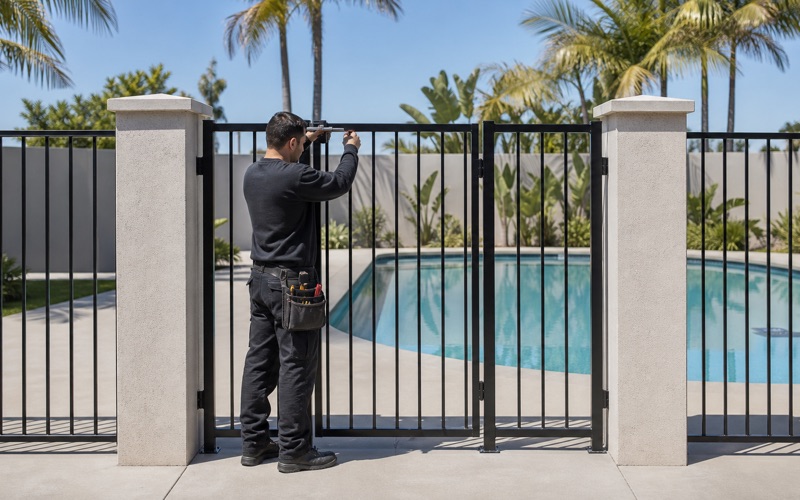
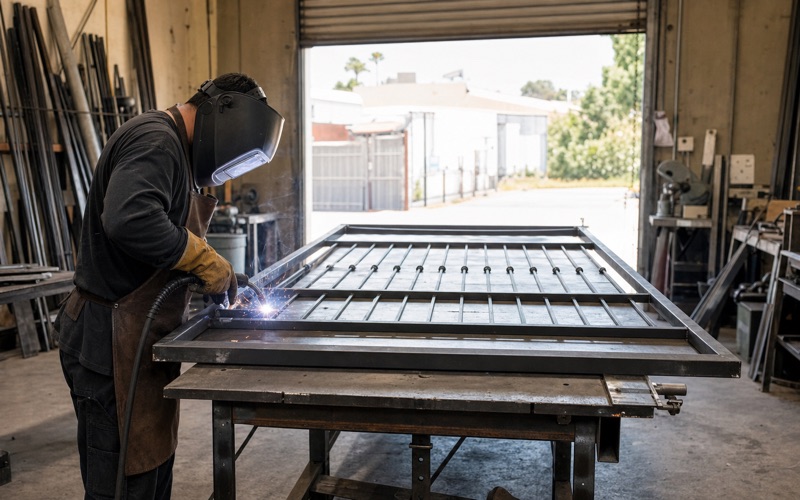
Paramount Metal Gates builds and repairs metal gates in Cudahy, covering driveway gates, side-yard and rear-access gates, security screen doors and window guards, and the automation that runs them. Gates are fabricated to measured openings in our own shop, which matters more here than in most of the surrounding cities because the lot geometry is genuinely unusual and very little about it suits a standard-width gate.
Cudahy was laid out in long, narrow parcels, sometimes called railroad lots, each intended to give a household room for a vegetable garden, a small orchard and a stable or chicken coop behind the house. That pattern survives in the street map today: narrow street frontages with a great deal of depth running back from them. It is also one of the most densely populated incorporated cities in the country, which compounds the effect.
For gate work that produces a very particular set of problems. The front opening is often narrow and hemmed in on both sides, while the useful gate is frequently the one partway down the property giving access to a long rear yard. We measure both and treat them as separate jobs rather than assuming the driveway gate is the whole requirement.
Working With Narrow Frontages
Driveway Gates Where There Is No Arc Room
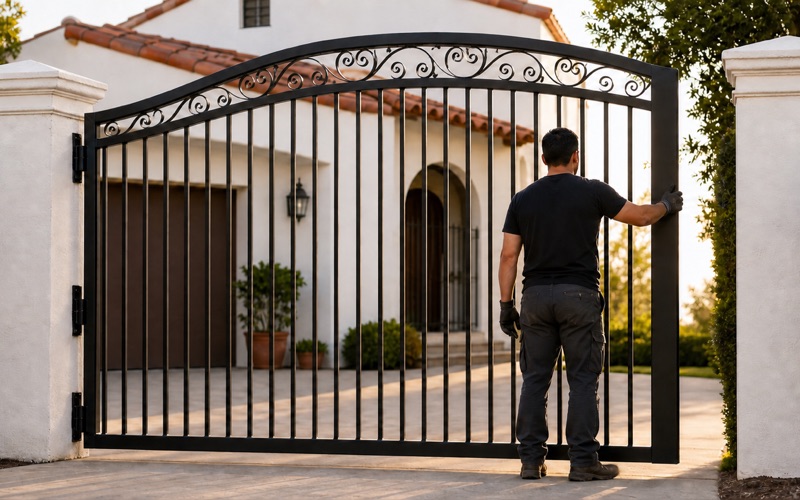
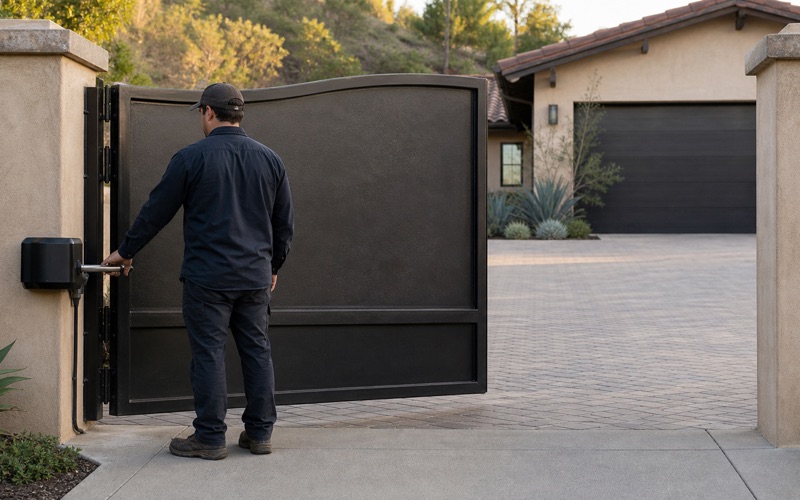
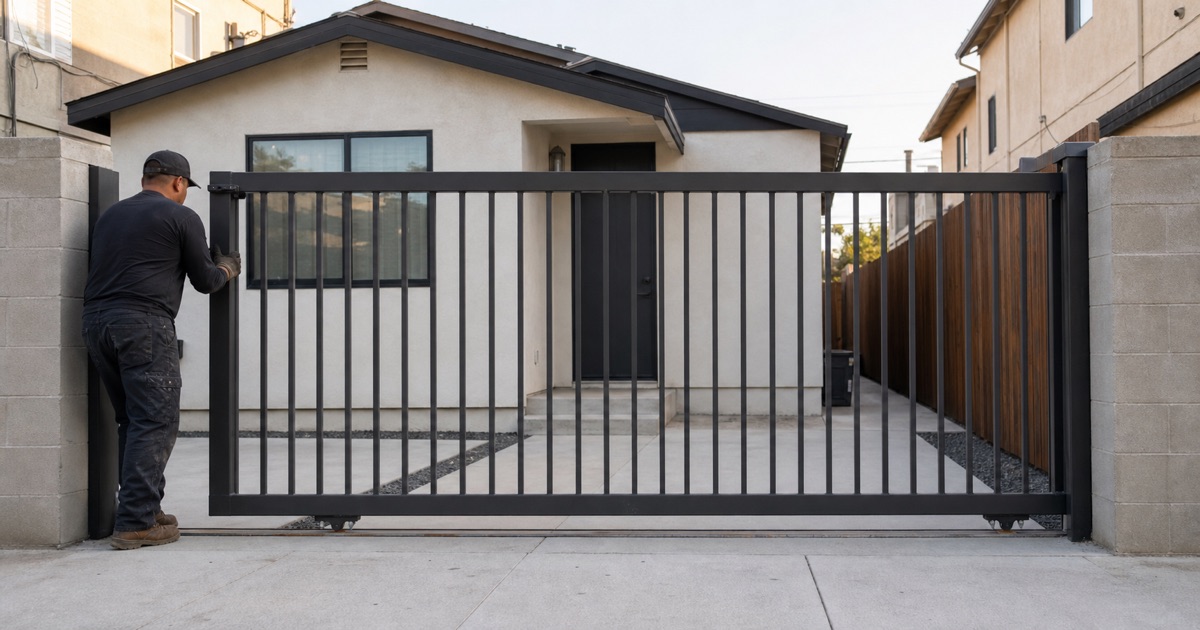
On a narrow lot with buildings close on either side, a swing gate often has nowhere to swing to. The leaf needs clear arc room inside the property, and where a parked vehicle, a wall or a neighboring structure occupies that arc, forcing a swing produces a gate that catches within weeks. We measure the usable depth and specify a sliding gate where the geometry demands it, because a slide travels parallel to the opening and needs side room rather than arc room.
Sliding Gates on Restricted Runs
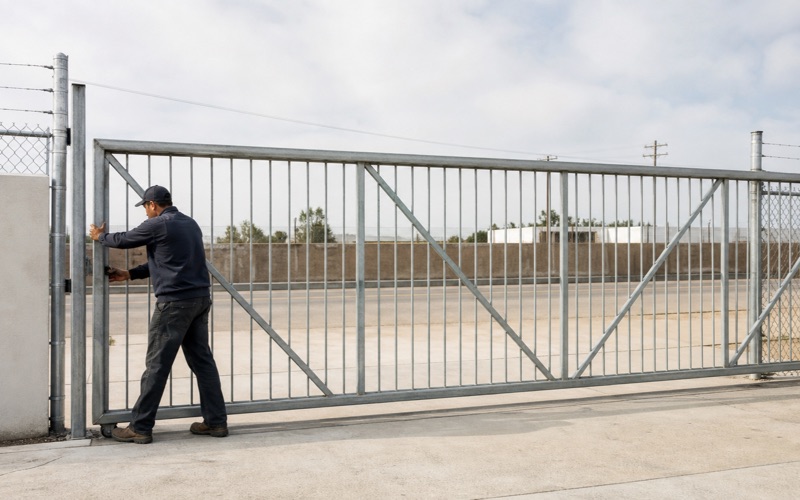
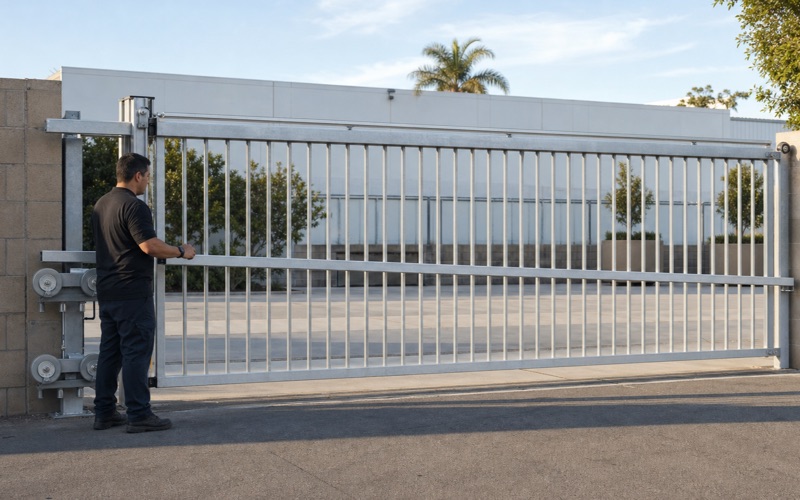
A sliding gate solves the arc problem but introduces its own: it needs a clear run alongside the opening for the leaf to travel into. On a narrow lot that run is frequently occupied by a wall or the side of the house. Where the full run is not available, a telescopic gate stacks two or three shorter leaves that travel together, covering the opening from a much shorter run-back. It costs more in hardware and is worth it where nothing else fits.
Bi-Parting Gates for Tight Openings
Where a single leaf cannot travel far enough in either direction, splitting the opening and sliding from both sides halves the run needed at each end. That arrangement suits exactly the constrained geometry common here, and it also reduces the weight each operator has to move. We propose it where the site genuinely calls for it rather than as a default, since it doubles the operator and sensing hardware and that cost has to be justified by the constraint.
Ground Clearance in Confined Spaces
Where a gate sits between two structures with little room either side, the clearance beneath it matters more than usual, because there is nowhere for debris to be pushed aside as the gate travels. We set clearance so the leaf runs clean over the surface it crosses, and on sliding gates we keep the track or the cantilever path clear of the pinch points that a confined installation creates.
Looking for metal gates closer to Norwalk? See Norwalk Metal Gates.
The Long Rear Lot
Side-Yard and Rear Access Gates
The depth behind the house is what makes these lots valuable, and reaching it is what the side gate is for. That gate typically has to be wider than a pedestrian gate to admit a trailer, a work vehicle or materials, while being hung in a narrow gap between the house and the boundary. We build to the actual gap with the frame sized to the leaf, since a gate widened toward its limit without extra bracing will drop out of square and start fouling the ground within a season.
Gates for Vehicles Stored Behind the House
Where a vehicle, boat or trailer is kept in the rear yard, the gate that admits it is the one that matters most and gets used least, which is a bad combination for hardware left to seize. We specify hinges and latches that tolerate standing unused and then being asked to swing a heavy leaf, and fit drop rods into ground sockets so the gate stays put in wind rather than gradually working itself out of square.
Dividing Front From Back
On a deep lot there is real value in separating the front of the property from the rear, whether for security, for a dog, or simply so a rear yard used for work is not visible from the street. A gate partway down the side of the house does that, and it is often more useful day to day than the driveway gate at the front. We build them to match the front gate so the property reads as one installation.
Pedestrian Gates and Self-Closing Hardware
The pedestrian gate is usually the most-used opening on the property and wears fastest. Where a gate must not be left standing open, self-closing hinges are sized to the actual leaf weight rather than fitted generically, because a closer specified for a light gate and hung on a heavy one will move it most of the way and leave it resting against a latch that never engages. That failure is gradual and nobody notices the day it happens.
Security Ironwork and Automation
Security Doors and Window Guards
Ornamental security screen doors and window guards are a large share of the work on the older housing here, and the requirement is a barrier that reads as part of the building rather than something applied over it. We fabricate to the opening, anchor properly into the structure, and match picket and scroll detail to what is already present. Egress is designed in from the outset rather than treated as a compromise on security.
Operators on Constrained Sites
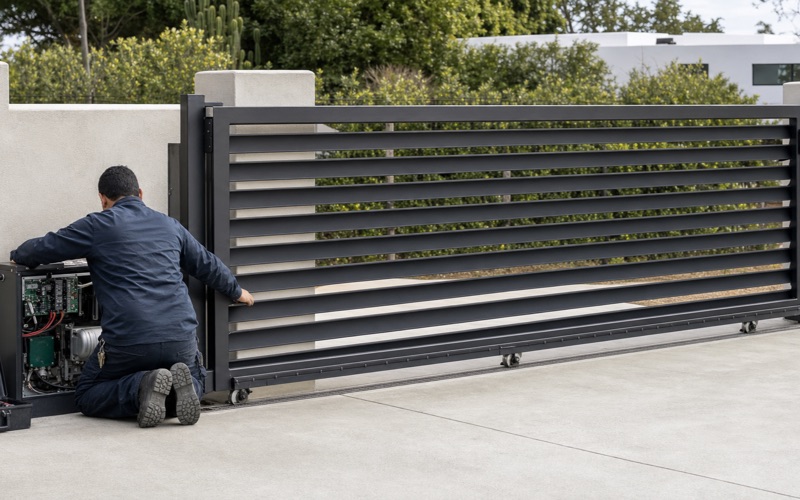
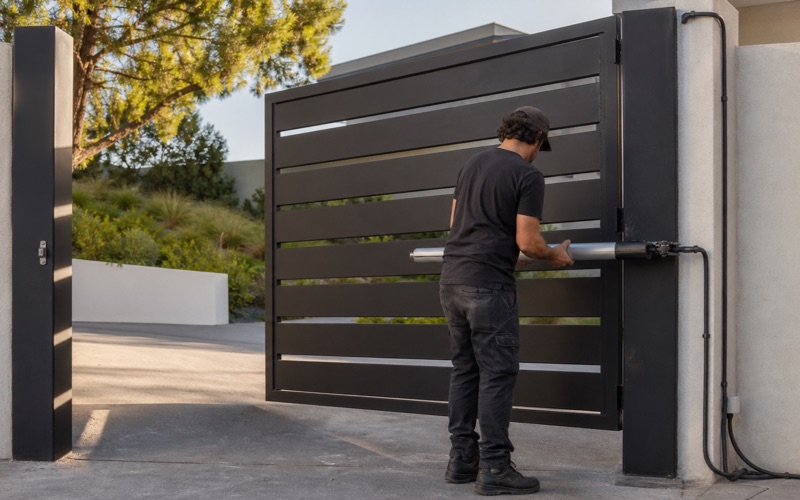
On a long narrow lot the power supply is usually at the house and the gate is at the street, which puts a cable run down the full length of a driveway that vehicles use daily. Surface-run cable on that path does not survive, and a shallow trench across a driveway fails the first time a heavy vehicle crosses it. We plan the route and its depth before the gate is built, or specify a solar operator and remove the run entirely.
Sensing Where Space Is Tight
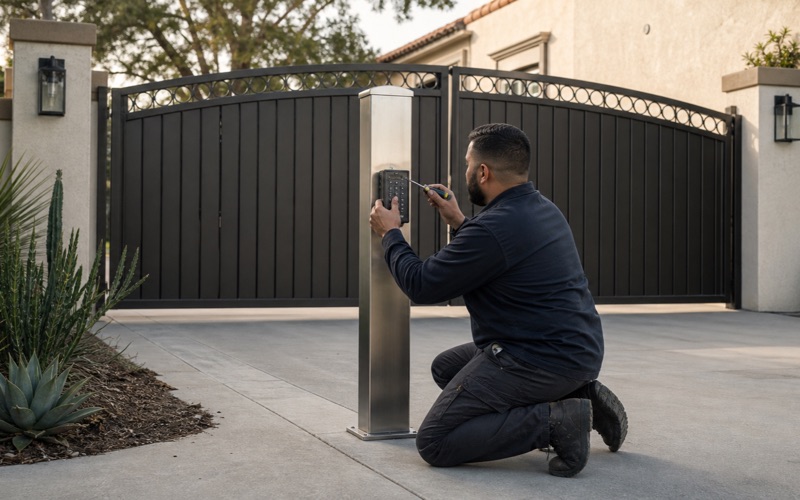
Photo eyes and safety edges have to be positioned where entrapment can actually happen, and on a tight site the pinch points are more numerous rather than fewer: between leaf and post, between leaf and wall, and along a track a pedestrian has to step over. Monitored entrapment protection means the operator verifies its own sensors and refuses to run when one has failed, which matters most exactly where the gate is closest to people.
Cudahy’s Lot Pattern and Density
The Railroad Lot Layout
The long narrow parcels here were laid out deliberately, intended to let each household keep a substantial vegetable garden, a grove of fruit trees and a stable or coop behind the house. That is why frontages are narrow while the lots run so far back, and it is the single most useful thing to understand about gate work in the city. Almost every constraint on a Cudahy gate traces back to that original subdivision.
Density and Its Consequences
Cudahy has one of the highest population densities of any incorporated city in the United States, and the practical effect is that buildings sit close together with very little slack between them. Gates end up tying into neighboring walls, shared boundaries and structures that were not built to carry them. We establish what a gate is actually fixing to before fabrication, because anchoring a heavy leaf into somebody else’s wall is an expensive problem to unwind afterward.
Industrial Past and Present Housing
The factories that once employed much of the city closed by the late 1970s, and the housing stock has carried the city since. That leaves a residential fabric that is older, denser and more heavily worked than the tract cities nearby, which is why so much of the gate work here is repair, replacement and security ironwork rather than first-time installation on a fresh frontage.
Fabricating for Non-Standard Openings
Building to a Gap Nobody Stocks
A confined lot rarely produces an opening that matches a manufactured size, and the usual workaround is to fit the nearest standard gate and pack out the difference with filler hardware. That gap is where the installation eventually fails, because the packing carries load it was never designed for. Fabricating to the measured gap costs no more in material and removes the weak point entirely, which is the main practical argument for building rather than buying.
Working in Confined Access
Installing a gate on a narrow lot is a logistics problem as well as a fabrication one, since there may be no room to bring a fully assembled leaf around the side of a house. We plan how the gate reaches its opening before it is built, fabricating in sections for final assembly on site where access demands it, rather than discovering at delivery that a finished gate cannot physically get to where it is going.
Matching a Neighbor’s Line
Where properties sit this close together, a new gate is visually part of a run that includes whatever is next door. We take that into account without copying it: matching height and setting a compatible proportion so the street reads coherently, while keeping the detail specific to the property. It costs nothing to consider at the drawing stage and is impossible to correct once a gate is hung.
Staging Work to Keep Access
On a property where the only vehicle access is through the gate being replaced, the sequence matters. We stage the work so the opening is not left unsecured overnight, prepare and finish off site so the disruptive on-site phase is short, and set out clearly which periods access will be restricted. On a dense street where there is no alternative parking, that planning is most of what makes a job go smoothly.
- Licensed & Insured
- Free On-Site Measure
- Fixed-Price Quotes