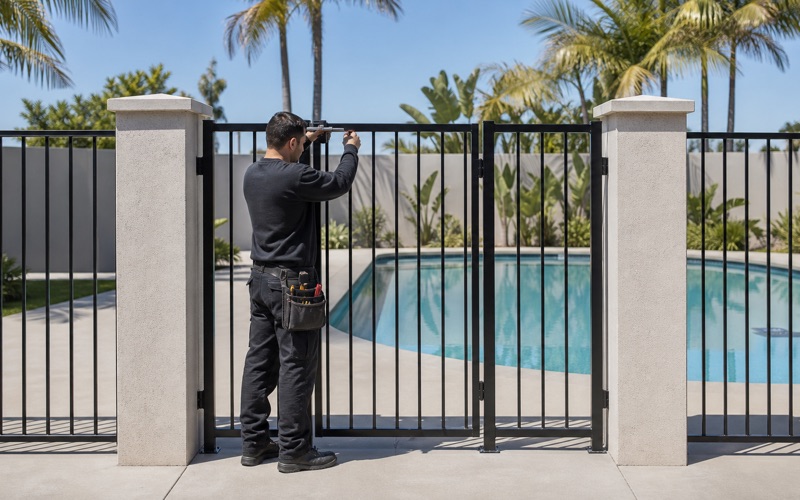
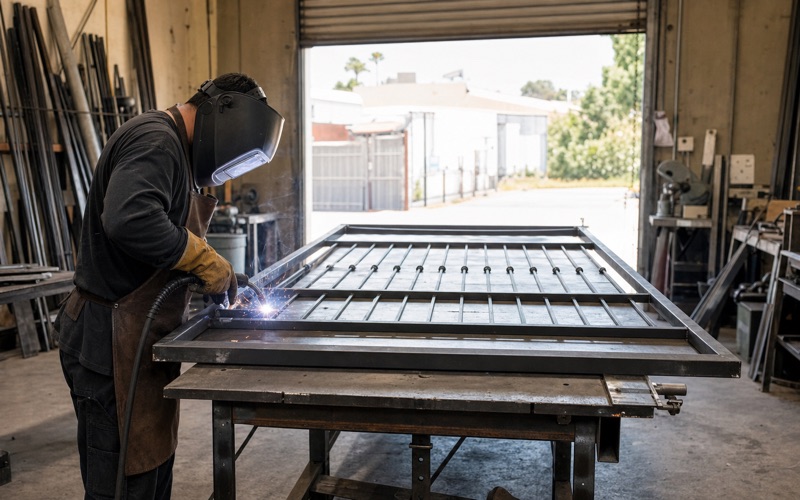
Paramount Metal Gates builds and services metal gates in Commerce, working almost entirely on distribution, logistics and manufacturing property: cantilever gates across yard entrances, dock and delivery gates, perimeter gates on unattended sites, rolling steel on service openings, and the operators, sensing and access control that keep them moving. We fabricate in our own shop, so a bent frame is rebuilt rather than condemned and a non-standard opening is built to rather than packed out.
Commerce exists for the movement of goods and always has. It converted to industry when the railway pushed its main line through in the 1880s, and it now sits against two major freeways with rail still running through it. The gates here reflect that: they are crossed by tractor-trailers all day, they cycle continuously through a shift, and they are frequently the only thing securing a yard full of freight overnight.
That produces a specification that has very little to do with residential gate work. Duty cycle rather than appearance, trailer-length vehicle sensing rather than a single photo eye, galvanizing rather than paint, and a repair response measured against how long a yard can stand open rather than against convenience.
Yard Gates for Trailer Traffic
Cantilever as the Default
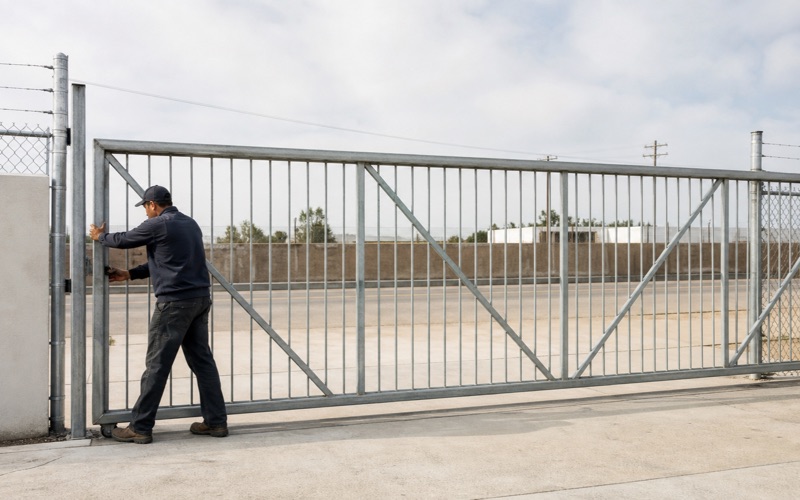
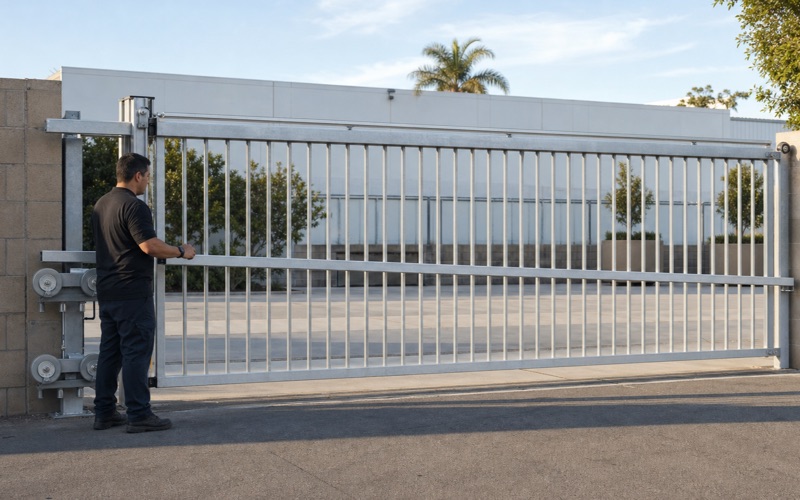
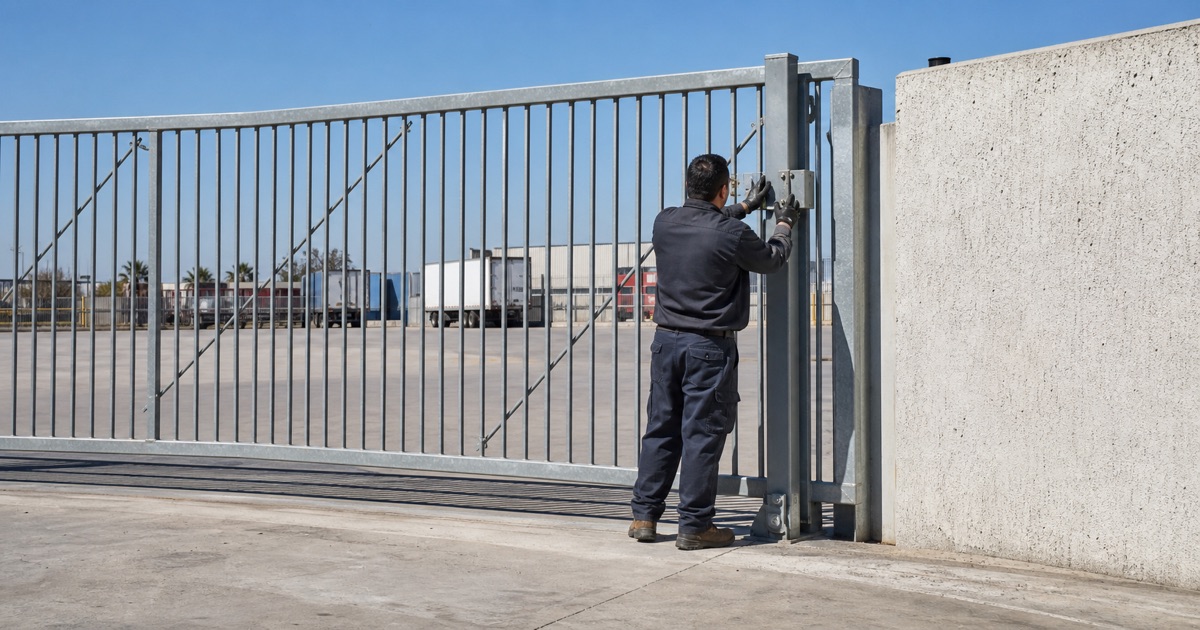
A ground-track gate in a yard crossed by trailers fills with grit and gravel, takes wheel strikes and destroys its rollers and then its track. A cantilever crosses the opening carrying its weight on truck assemblies set back to one side, with nothing on the ground for a wheel to find. On a logistics site that is not a preference between two options, it is the configuration that survives the traffic.
Span, Counterbalance and Side Room
Logistics entrances are wide, and width drives everything else. A cantilever needs a counterbalanced tail with real run beyond the opening, and one built short sags at the leading edge and eats truck assemblies regardless of hardware quality. We measure the available run before proposing the configuration, because on a tightly packed industrial parcel that run is the specification most likely to be unavailable.
Speed Without Sacrificing Control
On a site where trucks queue, gate travel speed is a genuine operational cost, and slow gates are the reason drivers start leaving them open. We specify operators that move a heavy leaf at a workable speed while still stopping under load, and set sensing so speed never comes at the expense of a gate that cannot detect a trailer in the opening.
Impact and Repair
Gates on logistics sites get hit. A trailer swinging wide, a forklift misjudging a turn, a driver reversing onto the leading edge. We build frames that take a knock without racking, and when damage does happen we cut out and rebuild the affected section rather than replacing an entire gate, which on a wide cantilever is the difference between a day’s work and a fortnight’s lead time.
Looking for metal gates closer to Hawaiian Gardens? See Metal Gates Services in Hawaiian Gardens.
Perimeter and Overnight Security
Where a Yard Is Actually Vulnerable
Breaches happen at openings rather than through fence line, so the gate is the item worth over-specifying on a site holding freight. We build heavy galvanized frames with anti-lift detailing at hinges, controlled ground clearance so nothing passes beneath, and hardware that resists forcing. Where a site is unattended overnight, restoring a failed gate to a closed and secured state takes priority over waiting for an ideal part.
Gates That Fail Closed
The most consequential failure mode on a distribution yard is a gate that stops working while open, because the site is then unsecured for as long as it takes to respond. We specify battery backup so an outage does not leave a gate stranded mid-cycle, and we treat a gate stuck open as a different category of call from one stuck closed, prioritized accordingly.
Anti-Climb Detailing
A gate that is easy to climb beside a fence line that is not achieves very little, so the two have to be detailed together. We avoid convenient footholds at the hinge and latch stiles, coordinate any topping across gate and fence so the line is continuous, and check that the gate does not create a step where it meets the adjoining structure.
Documentation and Site Records
Distribution property is leased, insured and audited, and a gate is an item on somebody’s asset record rather than just hardware. We provide written scope and keep the specification on file, which is what an insurer asks for after a vehicle strike and what a new site manager needs when taking over a yard mid-lease.
Access Control on a Busy Site
Credentials for Drivers and Contractors
A logistics gate is used by employees, agency drivers, hauliers on contract and service visits, which makes a single shared code the worst available arrangement because it can only be changed for everybody. We set up credentials issued per person or vehicle so access can be revoked individually, with entries logged per credential where the system supports it.
Vehicle Sensing for Long Combinations
Sensing has to account for tractor-trailers, which occupy an opening far longer than a car and can present a gap between tractor and trailer that fools a badly configured system into thinking the opening is clear. Safety and shadow loops are placed and tuned for the vehicles that actually cross, and loop cuts are sealed properly, since a loop that has taken on water produces intermittent faults that look convincingly like an operator problem.
Intercoms and Driver Access
A driver in a high cab cannot reach a call station mounted for a car window, and one who has to climb down will find a way to avoid doing so. We site entry hardware at a height that works from a truck cab, position it so a vehicle waiting to be admitted is not blocking a public road, and specify weather-rated units because an exposed panel that has taken on water starts reporting presses nobody made.
Fire Access and Compliance
A gate across a fire apparatus access road must be openable by the fire department, with an arrangement that holds when power is lost and the required access width maintained. On a site with limited approaches between buildings, that matters more rather than less. We confirm what the authority having jurisdiction requires before fabrication rather than after an inspection raises it.
Buildings, Docks and Frontages
Loading Dock and Service Openings
Dock openings are sized to trailer heights rather than to people, and a curtain that is fractionally too low becomes the thing every driver clips on the way out. We check the actual clear height against the vehicles a site receives, not the height the opening was originally built for, since fleets change and a dock built for one trailer profile is frequently now receiving a taller one. Raising a header is cheaper than replacing a curtain twice a year.
Scissor Gates on Interior Openings
Side-folding scissor gates secure parts counters, tool cribs and interior openings within a building while letting light and visibility through, then stack aside during working hours. They are common across the units here and almost always neglected until one jams. We install, repair and re-track them and replace worn lattice pivots and locks rather than defaulting to replacement.
Office and Visitor Entrances
Drivers wait, and where they wait determines whether a gate works. A yard with no holding area pushes queuing trucks onto the public road, and the pressure that creates is what gets a gate chained open during busy periods. We look at the approach and the stacking space before specifying travel speed and sensing, because the fastest gate on the corridor will still be defeated by a site that has nowhere for the second truck to stand.
Working Around Shipping Hours
Replacing a gate on an operating distribution site has to happen without stopping shipping, which is a sequencing problem as much as a fabrication one. We prepare and finish off site so the on-site phase is short, stage the work so an entrance is never left unsecured overnight, and agree in advance which windows access will be restricted so receiving can plan around it.
Commerce and the Freight Corridor
Industry From the Railway Onward
The area’s conversion to industrial use began in 1887, when the Atchison, Topeka and Santa Fe Railway built its main line through, and the Los Angeles and Salt Lake Railroad and Pacific Electric followed. That early rail geometry set the parcel sizes and access patterns still in use, which is why entrances here are wide and why so many sites are laid out around vehicle movement rather than frontage.
Freeways and Rail Together
Commerce is served by the Long Beach and Santa Ana freeways as well as Metrolink commuter rail, which is precisely why distribution concentrated here rather than elsewhere. For gate work that means constant heavy vehicle movement across openings that were, in many cases, laid out for a lighter era of freight and have been adapted since rather than rebuilt.
A City Built Around Its Sites
Because the city is overwhelmingly industrial rather than residential, gate work here is almost entirely commercial in character, and the specifications that suit it would be considerable overkill on a residential street two miles away. We build to what a gate actually has to survive rather than applying a single house standard across very different kinds of property.
- Licensed & Insured
- Free On-Site Measure
- Fixed-Price Quotes